Ski trips from Munich
Four Alpine bases within four hours of Munich Hauptbahnhof by train — one on a direct Railjet down the Inntal, two a single change off the same spine, one on a direct train over the Tauern from Salzburg — ordered by the journey each base's own page documents.
At a glance
| Base | Where | Car-free reach | Evenings | Car |
|---|---|---|---|---|
| Innsbruck as a Ski Base | Austria | 10 of 10 areas | Limited | |
| Kitzbühel | Austria | 5 of 5 areas | Limited | |
| St. Anton & the Arlberg | Austria | 7 of 8 areas | Limited | |
| Bad Gastein | Austria | 6 of 6 areas | Limited |
Leaving from Munich, the ski decision is a line decision. One airport, one Hauptbahnhof, and two railways out of it that matter for skiing: the Inntal line through Kufstein into Tirol, and the Salzburg line that turns south over the Tauern. Every time below is the figure the base’s own page documents — re-checked on 1 September 2026 against ÖBB’s timetable tool for the 2026 timetable, which runs until 12 December 2026. The 2027 timetable begins the next day and was not yet published, so treat the clock times as this year’s pattern, not a promise; on busy travel days ÖBB flags its Railjets as reservation-recommended. None of the four bases names Munich as its primary gateway. All four document the journey in their own prose, which is what earns a place here.
The airport leg
Munich’s airport is not on the main line, and every rail journey below starts at the Hauptbahnhof. The S1 and S8 reach it in about 40 minutes at a combined ten-minute interval, the S8 round the clock; the Lufthansa Express Bus does the same run every 20 minutes in about 45. Budget an hour from baggage claim to a long-distance platform. Two fare notes from the operators’ own pages: the Deutschland-Ticket and the Bayern-Ticket are valid on regional trains as far as Kufstein and Salzburg Hauptbahnhof and on no long-distance train, so they buy the first leg of the one-change itineraries and nothing else; ÖBB’s Sparschiene advance fares are bound to the booked train and go on sale about six months ahead.
Down the Inntal on a direct Railjet
The Inntal line is the spine: Kufstein, Wörgl, Innsbruck, and on toward the Arlberg. One base sits on it with no change at all.
Innsbruck — under two hours from Munich Hbf by direct Railjet
Innsbruck’s page calls Munich and the railway its realistic gateways, and the 2026 timetable makes the case: a direct Railjet in 1 hour 55 minutes, roughly every two hours through the day, with one-change alternatives via Kufstein of about 2 hours 25 in the hours between. What the train delivers is the page’s single strongest argument — a station within a few hundred meters of every ski bus in a ten-row matrix, all ten rows transit-served, and a car the page rates unnecessary. The catch is the buses’ clock, not the train’s: the hub-and-spoke ski buses out of the Hauptbahnhof run one morning departure and one late-afternoon return per valley, and every one has made its last run by about 17:30. The evening belongs to the city, which is the point of basing there.
One change off the Inntal spine
Two bases hang off the same line by one connection: one east of it on the older Salzburg–Tyrol railway, one west of it beyond Innsbruck.
Kitzbühel — about two hours, one change at Wörgl
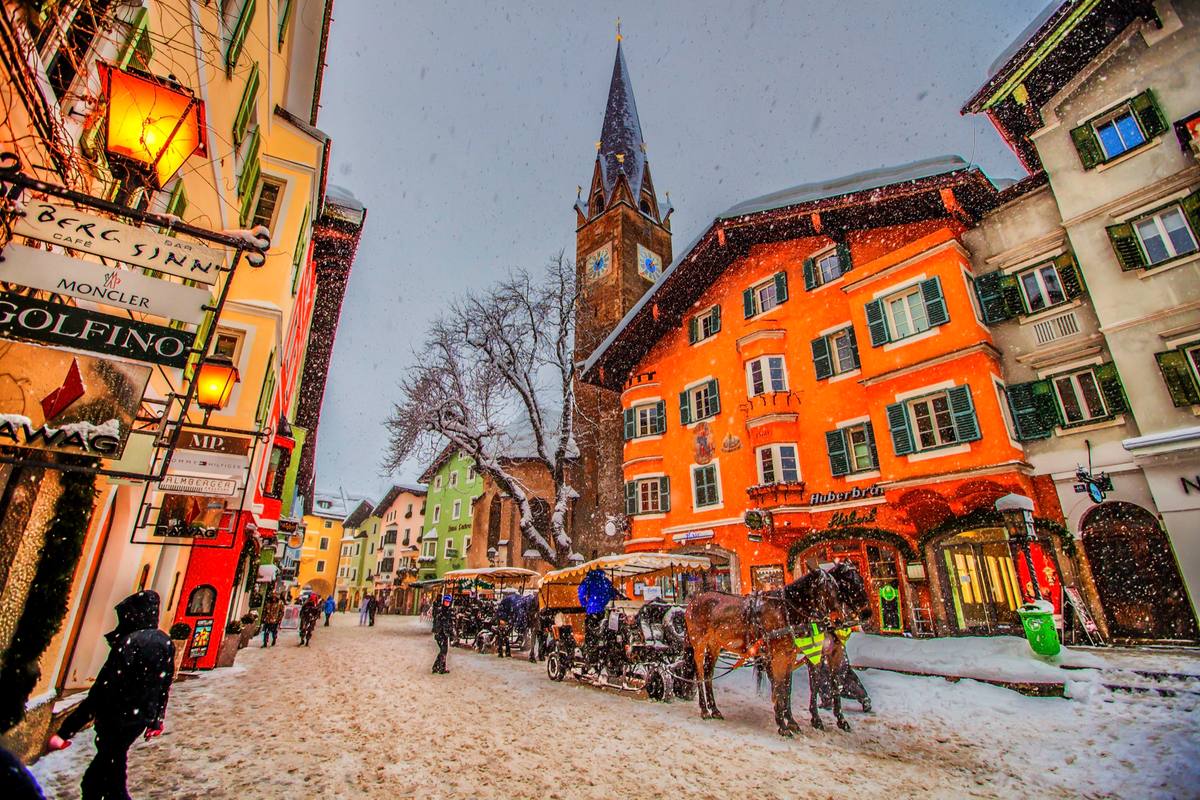
Kitzbühel’s page is blunt that Munich has no direct train — the fast Munich–Innsbruck trains run the Rosenheim corridor and bypass the town — and, as corrected this September, the fastest pattern is a Railjet to Wörgl and an InterRegio on to Kitzbühel: about two hours in all with one change, roughly every two hours; the hours between mean two changes and nearer three hours. What you arrive to is a rail town with three stations, one of them, Hahnenkamm, at the valley station of the town’s own gondola, five to ten minutes on foot from the pedestrianized center. The catch the page carries is the town’s own guest card: the KitzCard, unlike the neighboring Kitzbüheler Alpen Card, does not cover the trains that reach the other areas in its five-row matrix, so the car is rated helpful rather than unnecessary.
St. Anton am Arlberg — 3¾ to 4¼ hours, one change at Kufstein or Innsbruck
St. Anton & the Arlberg’s page documents the Munich journey as one change and roughly 3 hours 40 minutes to 4 hours 25, plus about 45 minutes more from the airport, and the September check landed inside that range at 3 hours 42 to 3 hours 56. The train arrives in the village center, and the Galzigbahn is five to ten minutes on foot from a central bed. From there the page’s story is the single Bus 760 that reaches St. Christoph, Stuben, Zürs and Lech with no transfer, about once an hour in winter, and the winter road to Warth-Schröcken that does not exist — reachable only on snow while the lifts run. Seven of eight rows ride on transit; the car is rated helpful for the corridor, not the village. The same base closes the Zurich guide from the other direction, on a direct Railjet.
Over the Tauern from Salzburg
The second line out of Munich runs east to Salzburg and then south, into a valley whose railway station is physically joined to a gondola.
Bad Gastein — about 3¼ hours, direct trains four times a day
Bad Gastein’s page once estimated four and a half to six hours from Munich Airport; the 2026 timetable is better than that, and the page now says so. From the Hauptbahnhof four direct long-distance trains a day reach Bad Gastein in 3 hours 12 to 3 hours 22, alternating with hourly one-change itineraries via Salzburg of about the same length — roughly four hours from the airport, with the last useful departure from Munich in the early evening. Arrival is the reason to make the journey: a covered overpass runs from the platform to the Stubnerkogel gondola’s valley station, an hourly direct train serves the station on a clean clockface, and a legislated valley-wide Guest Mobility Ticket covers every named ski area in a six-row matrix, tolled road included. The car is rated unnecessary. The catch is the ticket’s border: it covers the valley, not the journey from Munich, and the 2026-27 edition of every timetable it depends on was unpublished when this was written.
What this guide leaves out
Two pages mention Munich and stay out, because a mention is not a documented journey. Zell am See names Munich Airport as a secondary gateway and declines to give a route until it is researched; Val Gardena lists Munich among the airports travelers use and says no airport-to-valley journey was timed by an operator source. Both would enter with a sourced addition to their own pages. What the railway does after arrival across the whole continent — platforms that meet gondolas, lines that keep running inside the ski areas — is the subject of Rail-to-lift ski towns of Europe; this page settles only the journey out of Munich.
Considered and excluded
- Zell am See — its page names Munich Airport as a secondary gateway and explicitly declines to give a route or duration until it is researched.
- Val Gardena — its page lists Munich among the airports travelers use, but states that no airport-to-valley journey was timed by an operator source.