Ski trips from Zurich
Six bases within reach of Zurich by train alone — five Swiss ones spread across four rail corridors, plus a direct Railjet across the Austrian border — ordered by the journey each base's own page documents.
At a glance
| Base | Where | Car-free reach | Evenings | Car |
|---|---|---|---|---|
| Engelberg | Switzerland | 3 of 3 areas | Limited | |
| Davos & Klosters | Switzerland | 10 of 10 areas | Limited | |
| Andermatt | Switzerland | 6 of 6 areas | Limited | |
| Aletsch Arena: Riederalp, Bettmeralp & Fiescheralp | Switzerland | 4 of 4 areas | Limited | |
| The Jungfrau Region: Wengen, Mürren, Grindelwald & Lauterbrunnen | Switzerland | 10 of 10 areas | Good | |
| St. Anton & the Arlberg | Austria | 7 of 8 areas | Limited |
Leaving from Zurich, the ski decision is a corridor decision: one airport, one rail network, and four directions the Swiss journey can take before you ever see a lift. Every time below is the verified figure from that base’s own page, and every one of the five Swiss bases rates a car unnecessary on its own page — the train is the plan, not the fallback. A sixth base, across the Austrian border, closes the guide as the documented exception. What the railway does after arrival — platforms that meet gondolas, lines that keep running inside the ski areas — is the territory of Rail-to-lift ski towns of Europe across the whole continent; this page settles the journey out of Zurich, and carries each page’s own catches, from hourly rhythms to early last buses, exactly as stated.
Via Lucerne
The shortest corridor turns off at Lucerne, where SBB’s roughly half-hourly mainline from Zurich hands over to the Zentralbahn for the final climb.
Engelberg — 2 hours from Zurich Airport by train
The Luzern–Engelberg Express is the cleanest arrival in this guide: a confirmed 43 minutes from Lucerne, hourly in both directions on a clean clockface pattern, terminating beside a working Benedictine monastery. Engelberg’s page budgets roughly 1 hour 45 to 2 hours 15 door to door from the airport, and keeps it honest as a range because whether every itinerary is a single change at Lucerne, or sometimes a second at Zürich HB, was not conclusively resolved. From the platform, the Titlis valley station is an 800-meter walk or a free three-minute village bus. The catch is scale and clock: the matrix holds exactly three rows — this site’s standard floor — and the free bus that reaches all of them makes its last Titlis run at 17:30 and its last Brunni return at 18:11, figures read off the operator’s Winter 2025/26 timetable, so village walking distances carry the evening.
Into Graubünden
This corridor’s one change is at Landquart, where you leave the SBB network for the Rhaetian Railway — and the destination at the end of it has four railway stations of its own.
Davos & Klosters — about 2½ hours from Zurich Airport by train
Davos & Klosters is roughly two and a half hours from Zurich Airport, with published times clustering between 2h20 and 2h40, and its page draws the conclusion flatly: there is no airport transfer to book and no reason to hire a car at the terminal. Klosters Dorf, Klosters Platz, Davos Dorf and Davos Platz are all inside walking distance of lodging, two of them inside walking distance of a lift, and the guest card handed over at check-in covers the local buses plus second-class Rhaetian Railway travel within the local fare zones — enough, from a Davos bed, to reach Parsenn and Rinerhorn without buying anything. All ten matrix rows ride on published transit. The catch is that the network does not join the six mountains: only Parsenn and Gotschna are lift-linked, so every other combination means dropping to the valley floor and riding, and exact last evening services on the local bus lines are not verified on the page.
The Gotthard corridor
South out of Zürich HB, SOB’s Treno Gottardo runs the Gotthard panorama route to Göschenen, where the Matterhorn Gotthard Bahn climbs the Schöllenen gorge.
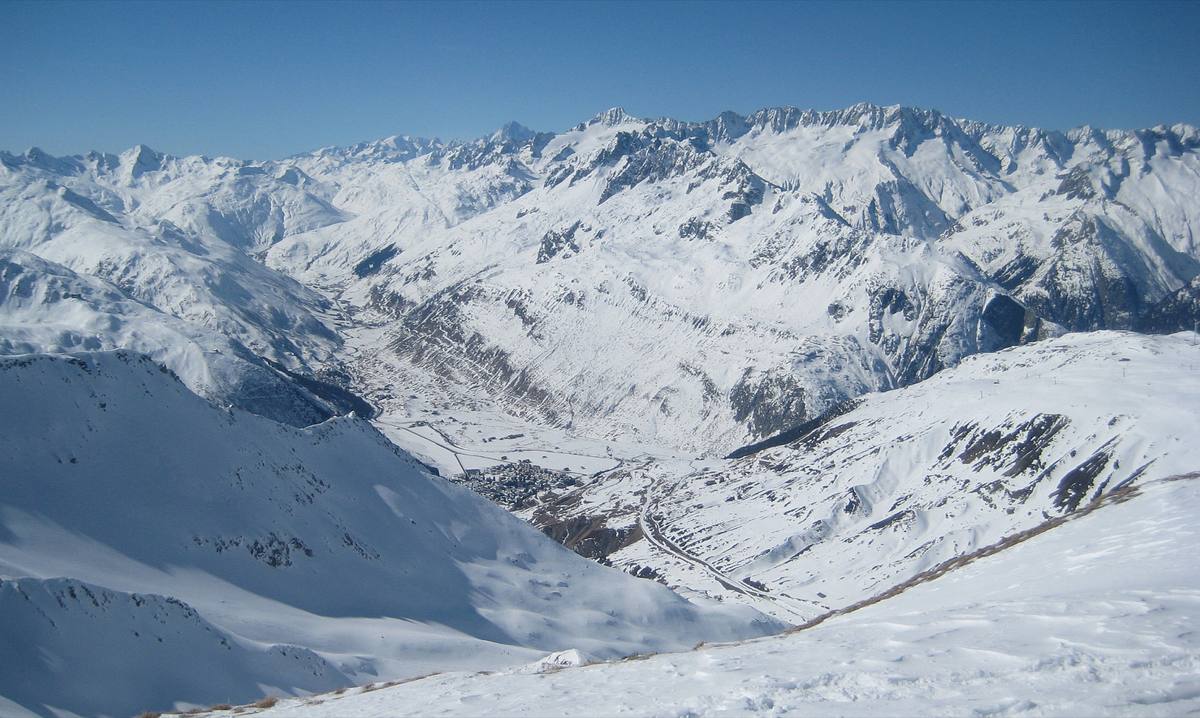
Andermatt — about 2 hours 40 from Zurich Airport by train
Andermatt’s page says to budget about two hours forty from the airport: a short hop into Zürich HB, the Treno Gottardo to Göschenen — sampled at 1 hour 46 from the HB in the official 2026 timetable — then about fifteen minutes up the gorge, a connection tight enough that the official timetable prints it as a through itinerary. Arrival could not be more literal. The Gütsch-Express gondola leaves from the railway station itself, the rental shop waits in the station underpass, and the railway then keeps going into the ski area: Nätschen, Oberalppass and Dieni are, in the operator’s own words, valley stations of named lifts, with the full-area ski pass covering the trains. SOB even sells the whole chain as its Winterhit package — return rail plus a day pass. The trade is the railway’s clock, carried on the 2026 timetable year: hourly departures at :38, a last crossing of the Oberalp at 19:38 — and Epic Pass holders discover the trains cost a CHF 50–150 upgrade on top.
Southwest to the Bernese Oberland and the Valais
Two bases share the fourth direction, and both finish where roads give out: the Valais route runs to Brig, where a valley line continues beneath three villages no road reaches, and the Bernese Oberland route runs via Bern and Interlaken Ost into a valley that never built a road to two of its villages.
The Aletsch Arena — 2½ to 3 hours from Zurich by train and cable car
The Aletsch Arena arrives in three stages: Zürich HB to Brig at roughly 2h11 to 2h30 on published timetables, Matterhorn Gotthard Bahn line 142 on to Mörel, Bettmeralp Talstation or Fiesch in ten, sixteen and thirty-two minutes, then each village’s own cable car up — a typical door-to-door of two and a half to three hours, Riederalp fastest and Fiescheralp slowest. No road reaches Riederalp, Bettmeralp or Fiescheralp, so the cable car is not a transfer; it is the address. Its page carries two cautions to take as written: the railway guarantees no timed connection to the cable cars, so slack belongs in the plan, and the three last cars disagree — Riederalp past 22:00 nightly, Fiescheralp 21:35 every night of the season, Bettmeralp 17:50 Monday through Thursday — which makes the village choice a timetable choice. Luggage rides two pieces per person free from valley station to door; extra pieces need a paid cart.
The Jungfrau Region — about 3¼ hours from Zurich Airport by train
The longest Swiss journey here belongs to the Jungfrau Region: about three and a quarter hours from Zurich Airport to Wengen on published schedules, usually with a change at Bern and always with changes at Interlaken Ost and Lauterbrunnen, the final 37 minutes split between the BOB and the Wengernalpbahn’s climb. Wengen and Mürren have no road — there never was one — so the rack railway is simply how the valley works, and the extra travel time buys the only base in this guide whose page rates evening transit good: trains between Lauterbrunnen and Wengen run from early morning until late at night, so you can eat in Lauterbrunnen or Interlaken and get home, though Mürren’s last connection is meaningfully earlier and the page says to check it on arrival rather than assume. The same page is equally plain about the costs: Swiss prices plus a railway for a lift system is the dearest combination in the Alps, and one ski pass does not mean one mountain — Wengen to Mürren is the better part of an hour.
Across the Austrian border
One more train leaves Zürich HB in a direction none of the Swiss corridors go.
St. Anton am Arlberg — about 2½ hours from Zürich HB by direct Railjet
Say it plainly, as its page does: St. Anton am Arlberg’s primary gateway is Innsbruck, not Zurich. It earns its place here because its page documents the Zurich relationship in detail — a direct Railjet from Zürich HB with no change, commonly around 2 hours 20 to 2 hours 30 point to point, and a realistic 2 hours 45 to 3 hours 25 door to door once the airport-to-HB leg is added — figures the page carries as corroborated by rail aggregators rather than confirmed by the operator, good enough to plan around. Two official tourism sites state seven direct daily connections from Zürich, a claim the page flags as tourism-authority-verified rather than rechecked against ÖBB. The station sits in the village centre, every train that stops is long-distance, and the Galzigbahn is five to ten minutes on foot from central beds. One honest asymmetry with the Swiss five: this page rates a car helpful rather than unnecessary, because Bus 760 to St. Christoph, Stuben, Zürs and Lech runs only about hourly in winter, and once its last run has gone there is no bus back at all.
Considered and excluded
- Chamonix — its published primary gateway is Geneva Airport, 100 minutes away by bus; its access story faces away from Zurich entirely.
- Morzine & the Portes du Soleil — its published gateway is also Geneva, 90 minutes by bus, and the St. Anton page describes that arrival as bus-and-transfer routed through Geneva.
- Innsbruck — its page lists Zurich among four cities with direct trains but documents no journey time, and names Munich and the railway as its realistic gateways.
- Kitzbühel — its published primary gateway is Innsbruck Airport, 90 minutes by train, and its page documents no Zurich journey at all.