Aletsch Arena: Riederalp, Bettmeralp & Fiescheralp
Three villages, three separate valley cable cars, and no two of them keep the same evening hours — Riederalp's last car runs past 22:00 nightly, Fiescheralp's holds at 21:35 every night of the season, and Bettmeralp's stops at 17:50 on an ordinary Tuesday, which makes "which village" the real first decision here, not an afterthought.
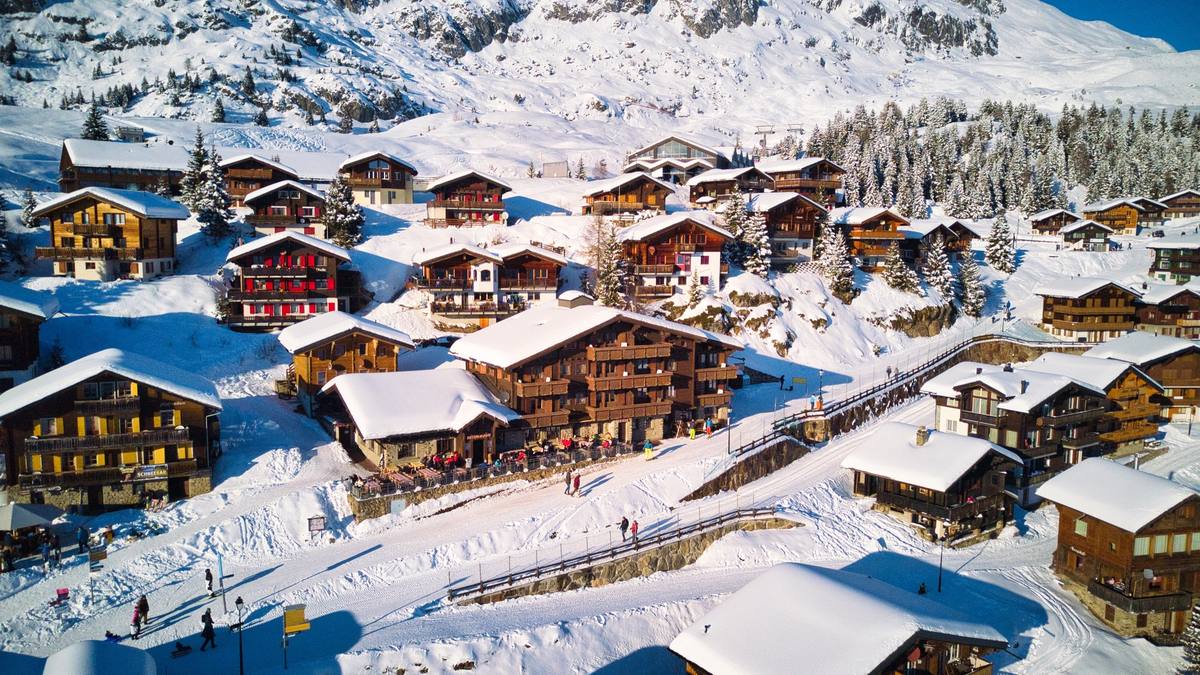
Car-free arrival is practical, daily needs are walkable or transit-served, and at least 80% of the ski areas in this page’s matrix are reachable on published transit during normal ski hours. Verified August 18, 2026.
EveningsBettmeralp 17:50 Mon–Thu (20:50–21:50 Fri–Sun); Fiescheralp 21:35 nightly, every night of the season; Riederalp 22:03 nightly, plus a further car 23:05 Mon–Sat / 23:30 Sun
At a glance
- Ski areas
- 4
- Within 30 min
- 2
- Closest
- 22 minCable car
- Reachable by transit
- 4 of 4
- Arriving from
- Zurich Airport2h 50m by train
- Groceries on foot
- YesSeasonal
The verdict
Verdict
Come for car-free arrival that is actually structural, not marketed. No road reaches Riederalp, Bettmeralp or Fiescheralp, and each sits at the top of its own cable car on its own timetable — and the three timetables do not agree. Fiescheralp's last car runs to 21:35 every night of the season; Riederalp's runs later still, past 22:00 nightly with a further car most nights; Bettmeralp's direct line stops at 17:50 Monday through Thursday. Pick a village without checking which is which and the schedule, not you, decides your bedtime. All three share one lift pass and one valley rail line up from Brig, so day-tripping between them works well; sleeping in one and eating dinner in another after dark does not, reliably, in every case.
Do not come expecting a big mountain or a real town underneath it. This is three small plateaus on one pass, a fraction of the terrain next door in the Jungfrau region, and each village is a hamlet of a few hundred people with a season-driven economy rather than a year-round town. And do not assume every name on the map belongs to this pass — Belalp and Bellwald are separate destinations by Aletsch Arena's own account, and this page could not verify their transit access well enough to include them.
Is this base for you?
Who this suits
Best for
- Travelers who want car-free arrival to be a fact, not a feature. No vehicle ever reaches any of the three villages, by law rather than by parking policy.
- Confident intermediates who want quiet, high, dry snow over sheer scale — a smaller, calmer counterpart to the bigger names next door in the Jungfrau region.
- Anyone willing to let the evening cable-car schedule decide their base. Riederalp or Fiescheralp reward it; Bettmeralp asks you to plan around it.
Depends on you
- Which of the three villages you pick. The evening asymmetry between Riederalp, Fiescheralp and Bettmeralp cuts a different way depending on the answer, and nothing on the piste map warns you about it.
- A car-free-by-law model. Total quiet and zero traffic, set against zero backup — miss the last cable car and there is no road to fall back on, in any of the three villages.
- Hamlet scale. A few hundred residents per village reads as intimate to some and thin to others, especially once the mountain restaurants close for the day.
The honest part
Things you should know
- 01
Bettmeralp's direct cable car stops for the night at 17:50 Monday through Thursday, and only extends to 20:50–21:50 Friday through Sunday. A midweek guest who wants dinner off the plateau, or who is skiing elsewhere on the pass and wants to sleep in Bettmeralp, is working against a genuinely early curfew — the tightest of any village on this page.
- 02
Miss the last car at any of the three villages and there is no fallback. No road reaches Riederalp, Bettmeralp or Fiescheralp, so there is no late taxi and no drive down — you are in Brig, Mörel, Bettmeralp Talstation or Fiesch until the cable car reopens the next morning.
- 03
These are hamlets, not towns. Swiss population-register figures put Bettmeralp at 452 residents and Riederalp at 438 (Dec. 2020) — three small, season-driven plateaus sharing one lift pass, not a year-round municipality with its own hospital or school.
The access matrix
What you can ski from Aletsch Arena
Typical door-to-lift times in normal winter conditions. ● marks areas reachable on published transit during ski hours. Every row is dated below.
- On foot or skis
- Public transport
- Lift from town
- Needs a vehicle
| Ski area | Getting there | Time | Best for | Main drawback |
|---|---|---|---|---|
| Transit-served. Moosfluh–Riederalp | Cable carMGB 142 to Mörel + cable car via Greich · every 24 or 36 min · last daily car 22:03Evidence & assumptions for Moosfluh–RiederalpMGB 142 from Brig to Mörel is 10 min; the Aletsch Bahnen AG cable car (line 2330 "A3" via Greich) on to Riederalp Mitte is another 12 min. That cable car runs every 24 or 36 min, alternating, from 05:52, with a last DAILY car at 22:03 and one further car at 23:05 Mon–Sat / 23:30 Sun — the latest last ascent of the three home villages. The alternate line 2331 "A1/A2" via Ried-Mörel to Riederalp West has a last regular car at 21:39, plus two phone-reservation-only departures (23:20 Mon–Sat / 23:45 Sun) that stop at Ried-Mörel, short of Riederalp proper. Source [1] Winterfahrplan 2025/26 & Jahresfahrplan 2026, West (Riederalp) — lines 2330 & 2331 — verified August 18, 2026 | [1] | The latest last car of the three villages, plus the Moosfluh glacier viewpoint over the Aletsch | Two competing routes up run on two different schedules (Mitte via Greich, West via Ried-Mörel), and the genuinely late departures past 22:03 need a phone booking and only reach Ried-Mörel, short of the village itself |
| Transit-served. Bettmerhorn–Bettmeralp | Cable carMGB 142 to the Talstation + direct cable car · every 30 min · last car 17:50 midweekEvidence & assumptions for Bettmerhorn–BettmeralpMGB 142 from Brig to Bettmeralp Talstation is 16 min; the direct Aletsch Bahnen AG cable car (line 2336) on to the village is another 7 min, every 30 min from 05:50. A second, smaller aerial tramway also reaches Bettmeralp via Betten Dorf in about 9 min. The evening timetable's day-of-week footnotes are dense enough that a transcription slip is plausible — treat "17:50 midweek" as the reliable headline and re-check the exact Friday start time against the live winter schedule before relying on it. Source [2] Line 2336 timetable PDF — Bettmeralp Talstation–Bettmeralp — verified August 18, 2026 | [2] | The most central of the three plateaus, closest to Fiescheralp, with the strongest bar and restaurant scene on the pass | The direct cable car stops for the night at 17:50 Monday through Thursday — the tightest evening window of any village on this page, easing only Friday to Sunday (20:50–21:50) |
| Transit-served. Eggishorn–Fiescheralp | Cable carMGB 142 to Fiesch + cable car · roughly every 10 min, 07:15–17:30 · last car 21:35 nightlyEvidence & assumptions for Eggishorn–FiescheralpMGB 142 from Brig to Fiesch is 32 min, the longest of the three rail legs; the Aletsch Bahnen AG cable car (line 2343) on to Fiescheralp is another 10 min, running roughly every 10 min from 07:15 to 17:30, then 18:30, 19:30 and a last car at 21:35 both ways — every night of the season, unlike Bettmeralp's midweek cutback. Source [3] Line 2343 timetable PDF — Fiesch–Fiescheralp — verified August 18, 2026 | [3] | The most dependable evening line of the three — the same last-car time every night of the season, with no midweek cutback | The longest transfer from Brig of the three villages, at roughly 40 minutes before you're even on the cable car, and the smallest and most low-key plateau of the three once you're up |
| Transit-served. Goms cross-country network | TrainMGB 142 via Fiesch · trailheads roughly 20–46 min beyond by rail · composed estimateEvidence & assumptions for Goms cross-country networkESTIMATED, composed from two separately verified segments rather than one published door-to-door figure: the 32-minute Brig–Fiesch leg on MGB 142 (see the Fiescheralp row above), plus the onward Fiesch–Goms leg, which the same operator timetable puts at roughly 20 minutes to the nearest stop (Reckingen) and up to 46 minutes to the furthest (Oberwald). Trails are reported open from mid-November. Source [4] Line 142 timetable PDF — Visp–Brig–Oberwald–Andermatt–Göschenen — verified August 18, 2026 | [4] | A genuine cross-country network in a separate valley direction, for a day away from the three alpine plateaus | Trailheads are spread across four villages 20 to 46 minutes from Fiesch by rail, so "the Goms loipe" means a materially different trip depending which stop you actually want, and reaching any of them means backtracking through Fiesch in the opposite direction from Riederalp and Bettmeralp |
Where to stay
The choice here is not lodging style. It is which cable car you are committing to for the week, and that makes it a more consequential decision than picking a village usually is.
Bettmeralp is the liveliest and most central of the three, closest to Fiescheralp, with the strongest bar and restaurant scene on the pass, a lake circuit, a rope park and an indoor children’s center. The cost is the tightest evening line on this page: the direct cable car down stops at 17:50 Monday through Thursday, opening up only Friday through Sunday. A midweek dinner off the plateau means watching the clock.
Riederalp reads as the quiet option, with easier access to the Moosfluh glacier viewpoint and a marked geology trail — and, once its own timetable was actually located rather than assumed, it turns out to run the latest last car of the three, past 22:00 every night with a further car most nights. That is not the reputation the marketing gives it; it is what the operator’s own timetable says.
Fiescheralp is the highest, smallest and most low-key of the three, and currently the most dependable after dark: the same 21:35 last car runs every night of the season, with no midweek cutback to plan around. The tradeoff is the longest transfer up from Brig of the three.
All three are hamlets rather than towns — a few hundred year-round residents each — sharing one lift pass and one valley rail line, not one village with three neighborhoods.
Getting there
Zurich and Geneva are the working airport gateways. Published Swiss rail timetables put Zürich HB to Brig at roughly 2h11 to 2h30 depending on train, and Genève to Brig at roughly 2h27 to 2h38. Both figures read as elapsed time between matched departures and arrivals in the official multi-train grid, which renders a single train and a same-column connection identically — treat them as representative ranges from an official source, not a single booked itinerary. From Brig, Matterhorn Gotthard Bahn line 142 continues to Mörel, Bettmeralp Talstation (renamed from Betten Talstation in December 2024) or Fiesch — but MGB’s own site is explicit that it guarantees no timed connection to the Aletsch Bahnen AG cable cars waiting at each of those stations, so build in slack rather than trusting a tight change. Door to door, including the cable car, that puts a typical arrival from Zurich at roughly two and a half to three hours depending which village you are headed to — Riederalp fastest, Fiescheralp slowest.
Drivers face a seasonal gap worth knowing before booking a rental: the Furka and Simplon passes close for winter, and the year-round route north to Brig is the Lötschberg car-carrying rail shuttle between Kandersteg and Goppenstein, not an open road.
Getting around
No road reaches Riederalp, Bettmeralp or Fiescheralp — not a restricted-access rule, an absence of road. Each village sits at the top of its own valley cable car, and the three timetables do not agree with each other. Riederalp’s line runs latest, past 22:00 nightly with a further car most nights; Fiescheralp’s runs to 21:35 every night of the season without exception; Bettmeralp’s direct line stops at 17:50 on an ordinary Tuesday and only extends into the evening Friday through Sunday. Pick a base without checking which is which, and the asymmetry picks your bedtime for you.
Luggage moves the same way people don’t. Two pieces per person travel free from the valley station to the door; extra pieces need a paid cart. The vehicle itself is seasonal — a snowmobile in winter, an electric cart in summer, at Riederalp and Bettmeralp. Fiescheralp has no named local firm; transport there is booked directly through the cable car company.
Two names come up constantly alongside these three and belong to neither this pass nor this matrix. Belalp, across the valley above Blatten bei Naters, and Bellwald, one stop further up the line past Fiesch, are both listed by Aletsch Arena’s own site as separate neighboring destinations rather than parts of this pass — and the only routes located for either rested on a single ski-guide mention, not an operator timetable, which is not the bar this page holds transit claims to. Both stay out of the matrix above. The Goms valley beyond Fiesch is the exception: a genuine cross-country network on the same rail line, roughly 20 to 46 minutes past Fiesch depending which of four villages you want — worth a day away from the alpine plateaus rather than a lift-served excursion.
Who it suits
- Travelers who want car-free to be a fact, not a feature. Nothing rolls into any of these three villages, ever — one of the strongest versions of that claim on this site.
- Quiet, high, dry snow over scale. Three small plateaus on one connected pass, not a match for the terrain next door in the Jungfrau region or at Zermatt.
- Anyone who checks the return schedule before booking. The three villages are not interchangeable, and this page exists because nobody else was publishing that comparison.
It suits anyone chasing evening flexibility from a Bettmeralp bed on an ordinary Tuesday least — base in Riederalp or Fiescheralp instead, or plan the week around the 17:50 curfew.
Living for a season
These are ski hamlets, not towns. A few hundred residents each, a season-driven economy, and none of the year-round infrastructure — hospital, school, a real supermarket chain — that Brig, forty minutes or more down the valley, supplies instead. Treat a season here as living inside the lift system rather than beside a functioning municipality. Switzerland’s usual rule applies on top: non-EU and non-EFTA nationals need work authorization arranged before arrival, and this page has not assessed the seasonal-worker housing market at any of the three villages — treat any rental estimate you are given as unverified until you can check it directly.
Not sure?
Choose somewhere else if…
- Jungfrau Region
Terrain scale matters more than logistics. Wengen, Mürren and Grindelwald give you the Lauberhorn, the Eiger and a much bigger connected mountain — at higher prices, thicker crowds, and only two of its four villages genuinely car-free rather than all three of Aletsch's.
- Davos & Klosters
You want the same Swiss-rail-served, no-driving idea but built around a real year-round town. Davos trades the pure car-free-by-law villages for one with a road, in exchange for six lift areas, a hospital and evening options that do not depend on one cable car's timetable.
- Zermatt
You want the same "no road reaches the village" claim at far larger scale and a far higher price — glacier skiing, a famous peak on every postcard, and a resort town built for it rather than three quiet hamlets sharing one lift pass.
This base appears in
Sources & data notes
How this page was verified
Section verification
- Access matrixAugust 18, 2026
- Getting thereAugust 18, 2026
- Getting aroundAugust 18, 2026
- Where to stayAugust 18, 2026
Sources
- Winterfahrplan 2025/26 & Jahresfahrplan 2026, West (Riederalp) — lines 2330 & 2331 — Aletsch Bahnen AG · operator timetable, cited not reproduced · retrieved
- Line 2336 timetable PDF — Bettmeralp Talstation–Bettmeralp — Aletsch Bahnen AG · operator timetable, cited not reproduced · retrieved
- Line 2343 timetable PDF — Fiesch–Fiescheralp — Aletsch Bahnen AG · operator timetable, cited not reproduced · retrieved
- Line 142 timetable PDF — Visp–Brig–Oberwald–Andermatt–Göschenen — Matterhorn Gotthard Bahn (MGB) · operator timetable, cited not reproduced · retrieved
- Fahrplanfeld 300 "Bern – Thun – Spiez – Visp – Brig," Fahrplanjahr 2026 — öv-info.ch (official Swiss printed-timetable portal / Kursbuch; publisher of fahrplanfelder.ch) · official timetable portal, cited not reproduced · retrieved
- Fahrplanfeld 100 "Lausanne – Sion – Brig," Année Horaire 2026 — öv-info.ch (official Swiss printed-timetable portal / Kursbuch; publisher of fahrplanfelder.ch) · official timetable portal, cited not reproduced · retrieved
- Timetable and rail traffic information — Matterhorn Gotthard Bahn (MGB) · official operator page, cited not reproduced · retrieved
- Travel and mobility — reaching the car-free Aletsch Arena villages — Aletsch Arena AG / Aletsch Bahnen AG · official operator page, cited not reproduced · retrieved
- Neighboring destinations — Aletsch Arena AG · official destination site, cited not reproduced · retrieved
- Cross-country skiing in Goms — Goms Tourismus · official regional tourism site, cited not reproduced · retrieved
Images

Page last reviewed August 18, 2026. Transit routes, schedules and fares change between seasons — check the operator before you travel. Mountain specifications for the northeastern US are maintained separately on NESKIS.