Kitzbühel
Three rail stations, not the two most guides assume, serve a town whose own Hahnenkamm and Kitzbüheler Horn sectors are not lift-connected to each other — and whose own KitzCard, unlike the neighboring Kitzbüheler Alpen Card one stop away, does not cover the trains that reach either one.
The core trip works without a car, but a car materially expands your lodging, evening or mountain choices. Verified August 18, 2026.
EveningsThe free-in-ski-gear window on the regional trains to SkiWelt and St. Johann in Tirol runs 7:50am–6pm; whether an ordinary-fare train later than that still gets a rider back to Kitzbühel for dinner was not checked against a late timetable this pass. Postbus line 850 to Pass Thurn/Mittersill runs Mon–Sat 6:30am–8pm and Sun/holiday 6:30am–6:30pm, per the operator-corroborated current-season timetable.
At a glance
- Ski areas
- 5
- Within 30 min
- 4
- Closest
- 8 minWalk
- Reachable by transit
- 5 of 5
- Arriving from
- Innsbruck Airport1h 30m by train
- Groceries on foot
- YesYear-round town
The verdict
Verdict
Come for a town with three rail stations doing real work, not the two most guides assume, and two home ski sectors on one lift pass, Hahnenkamm and the Kitzbüheler Horn, each an easy walk from the historic center. A direct train reaches a second linked network, SkiWelt Wilder Kaiser-Brixental, through Brixen im Thale in ten to eleven minutes, and the same line reaches St. Johann in Tirol just as fast. All five access chains here run on published transit.
Do not assume the two home sectors connect by lift. Kitzbühel's own tourism site says plainly that they do not, so a day on both means two separate trips, not one circuit. Do not assume a lift ticket buys the trains, either: the KitzCard excludes free public transport, unlike the neighboring Kitzbüheler Alpen Card. And do not route through Munich expecting a direct train — none exists; the fastest connections take about two hours with one change at Wörgl, and nearer three with two changes in the hours between.
Is this base for you?
Who this suits
Best for
- Skiers who want two distinct home ski sectors and a second and third linked network within a short train ride, without ever needing a rental car.
- Rail travelers connecting onward through the region — Brixen im Thale, Westendorf and St. Johann in Tirol are all a direct ten-to-fifteen-minute train away.
- Travelers who value a real historic town over a purpose-built base — Kitzbühel's walled old town predates skiing by centuries, and three rail stations serve it rather than one.
Depends on you
- A guest-card system split across two neighboring products. The KitzCard covers winter ski buses with a lift ticket; the free regional trains belong to the Kitzbüheler Alpen Card one valley over, not to Kitzbühel's own card.
- Two unconnected home sectors rather than one big linked circuit. Hahnenkamm and the Kitzbüheler Horn are both walkable from town, but treating them as one ski day means two separate trips.
- A thin off-peak rail and bus skeleton. Daytime frequencies are real and workable, but the Pass Thurn bus gaps and the unchecked evening-return picture mean a loosely-timed day can cost you a long wait.
The honest part
Things you should know
- 01
Kitzbühel's own two ski sectors, Hahnenkamm and Kitzbüheler Horn, are not lift-connected to each other — kitzbuehel.com states this directly, and skiing both in one day means two separate trips on foot or the Ringbus, not one continuous circuit.
- 02
The KitzCard, Kitzbühel's own guest card, explicitly excludes free public transport ("keine kostenlose Nutzung öffentlicher Verkehrsmittel" on the operator's own FAQ) — only winter ski buses boarded with a valid lift ticket are free, unlike the neighboring Kitzbüheler Alpen Card, which added free regional rail from winter 2025/26 on the same corridor through Kitzbühel's own station.
- 03
Through-service on Postbus line 850 to Pass Thurn/Resterhöhe runs only about a dozen times a day, with gaps of 60 to 120 minutes through the morning that only tighten to 20–45 minutes from early afternoon — this is not a turn-up-and-go route.
- 04
Munich has no direct train to Kitzbühel. Every routing needs at least one change: about two hours with a single change at Wörgl on the two-hourly Railjet pattern, nearer three hours with two changes in the hours between, and worse on some evening connections.
- 05
Whether an ordinary-fare train after 6pm gets a rider back from Brixen im Thale, Westendorf or St. Johann for a Kitzbühel dinner was not checked against a late timetable this pass — the free-in-ski-gear window on that line ends at 6pm, and evening service beyond it is unconfirmed.
The access matrix
What you can ski from Kitzbühel
Typical door-to-lift times in normal winter conditions. ● marks areas reachable on published transit during ski hours. Every row is dated below.
- On foot or skis
- Public transport
- Lift from town
- Needs a vehicle
| Ski area | Getting there | Time | Best for | Main drawback |
|---|---|---|---|---|
| Transit-served. Hahnenkamm | WalkWalk 5–10 min from the old town · own rail halt directly at the gondolaEvidence & assumptions for HahnenkammRoughly 5 to 10 minutes on foot from the pedestrianized historic core, confirmed directly on kitzbuehel.com. A separate Kitzbühel Hahnenkamm rail halt sits directly at the gondola for guests arriving by train rather than walking from the center. Source [1] Kitzbühel Hahnenkamm railway station — infrastructure page — verified August 18, 2026 | [1] | Rail or on-foot arrivals who want the town's main gondola a few minutes from the historic center | This valley station's own circuit does not lift-connect to the Kitzbüheler Horn across town, and its parking is paid — unlike the free lift-base lot one stop away at Kirchberg in Tirol on the same linked circuit |
| Transit-served. Kitzbüheler Horn | WalkWalk ~10 min · or the free Ringbus every 15–30 min (timetable to 15 Mar 2026)Evidence & assumptions for Kitzbüheler HornAbout 10 minutes on foot from the center, or the town's free Ringbus (Österreichische Postbus AG, run jointly with Bergbahn AG Kitzbühel/KitzSki), which loops both valley stations and the Bahnhof roughly every 15 minutes at peak, thinning to about 30 at midday on the current-season timetable (valid 20.12.2025–15.03.2026). Source [3] Ski area structure — Kitzbühel (Hahnenkamm and Kitzbüheler Horn) — verified August 18, 2026 | [3] | A second, distinct sector on the same lift pass for a change of aspect without leaving town | Not lift-linked to the Hahnenkamm side at all — kitzbuehel.com states this directly, so skiing both sectors in a day means two separate trips, not one connected circuit |
| Transit-served. SkiWelt via Brixen im Thale | TrainDirect IR/S8 · 10–11 min · every 24–36 min · free in ski gear 7:50am–6pmEvidence & assumptions for SkiWelt via Brixen im ThaleLive ÖBB Scotty query timed Kitzbühel Hahnenkamm→Brixen im Thale at 10–11 minutes direct (IR 518 in 10, S-Bahn S8 5024/5026 in 11), IR and S8 alternating roughly every 24–36 minutes. Brixen im Thale is the closer of SkiWelt's two Kitzbühel-line gateway stations, about 3 minutes closer than Westendorf in Tirol on the same trains — a correction to this page's own initial assumption that Westendorf was closer. skiwelt.at treats both as equal direct, gondola-adjacent gateways. Driving is an estimated 19 minutes for about 16 road km, an unverified aggregator estimate. Source [5] Live ÖBB Scotty journey-planner query — Kitzbühel Hahnenkamm departures — verified August 18, 2026 | [5] | A second, larger linked ski network reached without changing trains | A different lift network and pass system from KitzSki — the free-in-ski-gear window on this train runs only 7:50am–6pm, so a rider outside those hours pays the ordinary fare |
| Transit-served. St. Johann in Tirol (Harschbichl) | TrainDirect train every 25–35 min, then a local skibus to the lift · bus leg unverifiedEvidence & assumptions for St. Johann in Tirol (Harschbichl)Live ÖBB Scotty query timed the direct train at 10–11 minutes (IR 715 in 10, S8 5025 in 11), roughly every 25–35 minutes through midday. A further local skibus onward to the Harschbichl valley station is reported at about 4 minutes by a resort aggregator (skiresort.at) rather than independently timed against an operator schedule this pass; the 15 minutes above combines the two. Driving is an estimated 12–13 minutes for about 11 road km, an unverified aggregator estimate. Source [5] Live ÖBB Scotty journey-planner query — Kitzbühel Hahnenkamm departures — verified August 18, 2026 | [5] | A third distinct ski network reached by direct train, for a mid-week change of scene | Two legs, not one — the direct train ends at St. Johann in Tirol Bahnhof, and reaching the Harschbichl lift base itself still needs the connecting local skibus timed to it |
| Transit-served. Pass Thurn / Resterhöhe | Public busPostbus 850 · through runs ~a dozen a day, morning gaps 60–120 min · to 15 Mar 2026Evidence & assumptions for Pass Thurn / ResterhöhePostbus line 850 — renumbered from 4010 at the December 2025 Fahrplanwechsel — runs Kitzbühel Bahnhof/Hahnenkamm–Aurach–Jochberg–Pass Thurn (Resterhöhe)–Mittersill. Kitzbühel– Jochberg alone runs hourly. Timed at 31 minutes Bahnhof to Rester Höhe on two independent runs against the current-season PDF (Gültig 20.12.2025–15.03.2026); add about 5 minutes from Hahnenkamm. Driving is an estimated 19 minutes for about 19 road km — an unverified, aggregator-derived figure, not checked against a route planner or stated by an operator. Source [2] Line 850 timetable — Kitzbühel–Jochberg–Pass Thurn–Mittersill — verified August 18, 2026 | [2] | The westernmost reach of the Hahnenkamm-linked circuit, with the same bus continuing toward Mittersill | Through-service to Pass Thurn itself runs only about a dozen times a day, with gaps of 60 to 120 minutes through the morning that only tighten to 20–45 minutes from early afternoon |
Where to stay
Kitzbühel’s historic core, the pedestrianized Vorderstadt, is the walkable answer: close to both the Hahnenkamm gondola and its own rail halt, with the town’s shops, restaurants and evenings on the same streets — and likely its most expensive address.
The Hauptbahnhof quarter is the more functional arrival point, since every long-distance and regional train calls here, but it is a confirmed ten-minute walk from the old town rather than inside it. Schwarzsee, the lakeside quarter, has its own small rail halt just two minutes from Hahnenkamm by train and a quieter, more residential feel, at the cost of a longer walk into the center.
Reith bei Kitzbühel, Aurach bei Kitzbühel and Jochberg — the three neighboring municipalities sharing Kitzbühel’s KitzCard guest-tax zone — sit directly on the Pass Thurn bus corridor: cheaper, village-scale lodging at the cost of a genuinely bus-dependent evening.
Kirchberg in Tirol, one rail stop away, is worth naming directly: its own rebuilt station, free lift-base parking where Hahnenkamm’s is paid, and a high-capacity gondola into the same linked circuit. Kitzbühel’s own draw is the walled old town and the separate Horn sector, not superior mountain access.
Getting there
Innsbruck Airport is the fastest realistic gateway: bus F to Innsbruck Hauptbahnhof runs about 20 minutes, then rail via Wörgl reaches Kitzbühel, for a realistic total of about one hour twenty to one hour forty-five.
Salzburg Airport is the larger, more commonly-flown-into option. Bus Line 2 reaches Salzburg Hauptbahnhof every 15 to 20 minutes in about 23 to 25 minutes, confirmed directly on the airport’s own page, then the direct InterRegio “Pinzgau” reaches Kitzbühel roughly every two hours — a frequency corroborated across aggregators rather than confirmed directly on oebb.at this pass. Total realistically two and a half to three hours.
Munich has no direct train to Kitzbühel. Munich–Salzburg–Innsbruck EuroCity and Railjet trains run the faster Rosenheim corridor, which crosses into Germany and bypasses the town entirely — Kitzbühel instead sits on the older, all-Austria Salzburg–Tyrol line. Every Munich routing needs at least one change. On the 2026 timetable the fastest pattern is a Railjet to Wörgl and an InterRegio on to Kitzbühel — about two hours in all with one change, roughly every two hours through the day; the hours between mean two changes and nearer three hours, and some evening connections are worse. From Munich Airport the S-Bahn into the city adds about 40 minutes, and the town’s tourism office also lists shared airport shuttles for the 127 km road journey.
Three rail stations serve the town, not the two a visitor might assume: Hauptbahnhof, the main arrival point; Hahnenkamm, at the town’s own gondola; and Schwarzsee, a couple of rail minutes further out.
Getting around
Every ski area in this matrix is reachable on scheduled transit, and the center is a walk to two of the five: Hahnenkamm and the Kitzbüheler Horn. But KitzSki’s two home mountains are not lift-connected to each other — kitzbuehel.com states this plainly — so a day on both sectors means two separate trips, on foot or on the free Ringbus, not one continuous circuit.
Two guest cards cover two different things, and the difference is worth knowing before booking. The KitzCard, issued to Kitzbühel’s own overnight guests, covers winter ski buses for anyone boarding with a valid lift ticket — it does not extend to ordinary public transport. The Kitzbüheler Alpen Card, issued one valley over in the Brixental/Hohe Salve/St. Johann/Pillerseetal zone, added free regional and InterRegio rail starting winter 2025/26, on a corridor that runs directly through Kitzbühel’s own station. A KitzCard holder based in Kitzbühel pays the ordinary ÖBB fare on that same train; a guest in Westendorf or Kirchberg holding an Alpen Card rides it free.
The free Ringbus loops both home valley stations and the Bahnhof roughly every 15 minutes at peak, thinning to about 30 at midday. Postbus line 850 — renumbered from 4010 at the December 2025 Fahrplanwechsel — reaches Pass Thurn and Resterhöhe, though through-service there runs only about a dozen times a day with real gaps in the morning. Direct trains reach Brixen im Thale (SkiWelt’s closer gateway station, corrected here from an earlier assumption that Westendorf was closer) and St. Johann in Tirol in ten to fifteen minutes, running roughly every 25 to 36 minutes through midday. Any driving-time figure noted in the matrix above is a dossier-level estimate, not an operator figure.
Who it suits
- Skiers who want two distinct home sectors plus onward rail. Hahnenkamm and the Kitzbüheler Horn are both a walk from the center, and Brixen im Thale and St. Johann in Tirol are both a direct ten-to-fifteen-minute train away.
- Rail-first travelers connecting through the region. Three working stations — Hauptbahnhof, Hahnenkamm, Schwarzsee — and direct trains in multiple directions make Kitzbühel a plausible stop on a longer Tirol itinerary, not just a dead-end base.
- Travelers who want a historic town, not a purpose-built one. The walled Vorderstadt predates skiing by centuries, and three rail stations serve it rather than a single gondola-adjacent lobby.
It suits guests counting on one card to cover everything least. The KitzCard buys ski buses, not trains — anyone hoping to ride the region’s rail network free needs to know that benefit belongs to a neighboring guest card, not this one.
Living for a season
Kitzbühel is a genuine year-round town, not a camp that empties after Easter — its economy runs on summer tennis, golf and conference tourism as well as winter skiing, and groceries and everyday services sit in and around the historic center and the Hauptbahnhof quarter.
This pass did not independently assess seasonal housing pressure or specific work-permit guidance for Kitzbühel, unlike some other destinations on this site, so treat availability and cost as an open question to raise directly with an employer rather than an assumption either way. Non-EU citizens need a work permit before a season here is possible; a tourist entry does not cover employment.
What the town is like
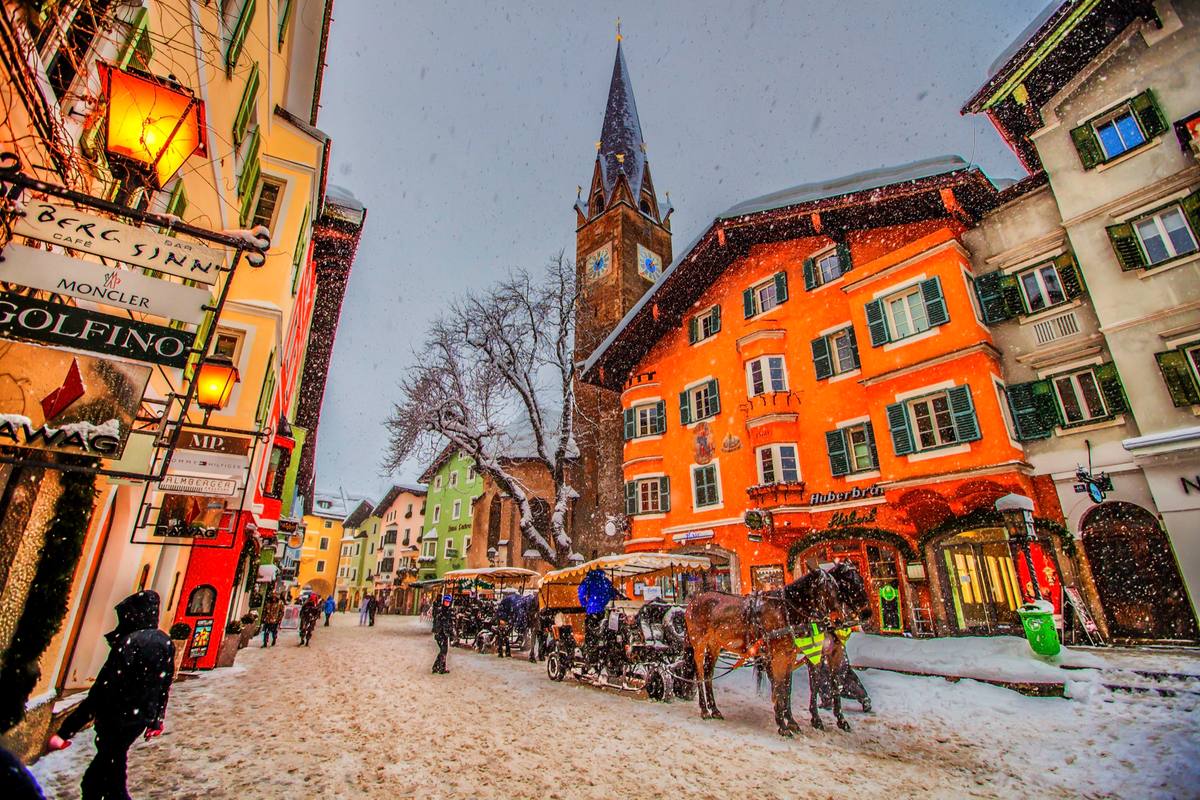
Kitzbühel is built around a walled medieval Altstadt — the Vorderstadt and Hinterstadt, lined with colorfully painted merchant houses — that predates organized skiing by centuries and gives the town a genuine historic core rather than a purpose-built resort front. Golf, tennis and a long summer conference season sit alongside the winter identity; this is not a place that goes quiet between April and November.
Three distinct rail stations and four linked municipalities — Kitzbühel itself plus Reith, Aurach and Jochberg sharing its guest-tax zone — are more moving parts than a single-lift resort village. That complexity, not a bigger mountain, is what makes the access picture on this page worth publishing.
Source note: this page reads off a research pass completed 18 August 2026. Several operator sources are German-language only — the Postbus timetable PDFs, and the KitzCard and Kitzbüheler Alpen Card FAQ pages — noted where cited. Road-distance and drive-time figures are dossier-level estimates, not checked against a route planner. A sixth possible access chain, Bichlalm’s own named town-bus line, was not researched this pass and is left out rather than guessed. Whether ordinary-fare evening trains extend car-free access past the 6pm free-ski-train cutoff was not checked against a late timetable and should be verified before travel.
Not sure?
Choose somewhere else if…
- Innsbruck
You want a bigger roster and a full city underneath it. Innsbruck's ten lift-served areas on published buses from one railway station beat Kitzbühel's five rows outright, at the cost of a compact historic center traded for a working university city instead.
- Zell am See
You want the same rail-served Salzburg–Tyrol corridor with a lake at the center of town instead of a walled old town. Zell am See sits further down the same line, with its own four-row matrix and a shorter run from Salzburg Airport.
- Bad Gastein
You want the free-transit case to be structural rather than card-dependent. Bad Gastein's Guest Mobility Ticket is a legislated, province-wide program covering every named ski bus; Kitzbühel's own guest card does not reach the trains at all, even though a neighboring card does.
This base appears in
Sources & data notes
How this page was verified
Section verification
- Access matrixAugust 18, 2026
- Getting thereSeptember 1, 2026
- Getting aroundAugust 18, 2026
- Where to stayAugust 18, 2026
- Living for a seasonAugust 18, 2026
Sources
- Kitzbühel Hahnenkamm railway station — infrastructure page — Kitzbühel Tourismus (kitzbuehel.com) · destination organization page, cited not reproduced · retrieved
- Line 850 timetable — Kitzbühel–Jochberg–Pass Thurn–Mittersill — Österreichische Postbus AG · operator timetable, cited not reproduced · retrieved
- Ski area structure — Kitzbühel (Hahnenkamm and Kitzbüheler Horn) — Kitzbühel Tourismus (kitzbuehel.com) · destination organization page, cited not reproduced · retrieved
- Ringbus timetable — Kitzbühel town loop (Hahnenkamm/Horn/Bahnhof) — Österreichische Postbus AG / Bergbahn AG Kitzbühel (KitzSki) · operator timetable, cited not reproduced · retrieved
- Live ÖBB Scotty journey-planner query — Kitzbühel Hahnenkamm departures — ÖBB (Österreichische Bundesbahnen) · operator timetable tool, cited not reproduced · retrieved
- Arrival by train — SkiWelt Wilder Kaiser-Brixental — SkiWelt Wilder Kaiser-Brixental (lift company) · operator page, cited not reproduced · retrieved
- KitzCard — guest card FAQ — Kitzbühel Tourismus (kitzbuehel.com) · destination organization page, cited not reproduced · retrieved
- Kitzbüheler Alpen Card — guest card and mobility FAQ — Kitzbüheler Alpen Tourismus (kitzbueheler-alpen.com) · destination organization page, cited not reproduced · retrieved
- Getting to and from the airport — public transport — Salzburg Airport (Salzburger Flughafen GmbH) · operator page, cited not reproduced · retrieved
- Innsbruck Airport — public transport access — Innsbruck Airport (Tiroler Flughafenbetriebsgesellschaft) · operator page, cited not reproduced · retrieved
- ÖBB Scotty — München Hbf → Kitzbühel (live query, 2026 timetable) — ÖBB · operator timetable tool, cited not reproduced · retrieved
- Timetable change 2026 — Tirol — ÖBB · operator notice, cited not reproduced · retrieved
- Anreise mit dem Flugzeug — Kitzbühel Tourismus (kitzbuehel.com) · destination organization page, cited not reproduced · retrieved
- Munich Airport — public transport — Flughafen München GmbH · operator page, cited not reproduced · retrieved
Images

Page last reviewed September 1, 2026. Transit routes, schedules and fares change between seasons — check the operator before you travel. Mountain specifications for the northeastern US are maintained separately on NESKIS.