Bad Gastein
A legislated valley-wide transit ticket that covers every named ski area — including the one toll road — a covered overpass from the platform to the gondola, and an hourly direct train: the car-free case here is as strong as anywhere on this site, built into a valley too small to fill an eight-row matrix.
Car-free arrival is practical, daily needs are walkable or transit-served, and at least 80% of the ski areas in this page’s matrix are reachable on published transit during normal ski hours. Verified August 18, 2026.
EveningsWeekday Line 550/553 buses reach Bad Gastein Bahnhof to roughly 22:00 on the most recently published (2025/26) timetable; specific après or dining-hour service beyond that core corridor has not been checked.
At a glance
- Ski areas
- 6
- Within 30 min
- 5
- Closest
- 3 minWalk
- Reachable by transit
- 6 of 6
- Arriving from
- Salzburg Airport2h 45m by train
- Groceries on foot
- YesYear-round town
The verdict
Verdict
Come for a train that asks nothing of you and a valley that has made car-free skiing a matter of law rather than a marketing line. Step off an hourly direct train and cross a covered overpass straight to the Stubnerkogel gondola. The Guest Mobility Ticket, funded by a legislated lodging levy through at least 2027, puts every named ski area in the valley on a free bus — including the one stretch that charges everyone else a toll. A dedicated shuttle reaches Angertal roughly every ten minutes, and the same valley line runs the length of the corridor to Sportgastein and Dorfgastein.
Do not come for a large roster. This is one lift-linked circuit — Stubnerkogel, Schlossalm, Angertal — plus three satellites, six honestly countable access chains, not the ten-plus at Innsbruck or a linked French valley. Do not expect a flat, easy townsite either: Bad Gastein climbs a waterfall gorge, and the wrong bed turns a five-minute walk into a real hill. And do not plan a trip around 2026/27 timetables before they are published — every frequency here still reads off last winter's schedule.
Is this base for you?
Who this suits
Best for
- Rail-only travelers. An hourly direct train reaches the platform, and a covered overpass — not a street crossing — puts you at the Stubnerkogel gondola in a few minutes.
- Anyone who wants the free-transit case to be structural. The Guest Mobility Ticket is a legislated program funded through at least 2027, not a hotel perk, and it covers the valley's one toll road along with every named ski bus.
- Travelers who want a real town with a spa, not a built resort village. Bad Gastein is a historic Kurort around a waterfall, with the Felsentherme thermal spa beside the station and everyday services near the center.
Depends on you
- A single small valley. Six honestly countable access chains beat almost anywhere else on car-free grounds, but it is a fraction of Innsbruck's or a linked French valley's roster.
- A steep, historic townsite rather than a flat purpose-built village. The gorge setting is the whole visual identity of the place, and also the reason some beds are a genuine uphill walk from dinner.
- A transit program still inside its first legislated funding window. The schedule is set through at least May 2027, unusually solid for a scheme introduced in 2025, but it is not the multi-decade infrastructure of a national rail network.
The honest part
Things you should know
- 01
The matrix tops out at six distinct access chains — one lift-linked circuit (Stubnerkogel–Schlossalm–Angertal) plus three satellites — genuinely smaller than the double-digit rosters at Innsbruck or a linked French valley.
- 02
Every frequency on this page is verified against the 2025/26 timetables, the most recently published season as of this write-up. Winter 2026/27 line-by-line schedules for both the railway and every bus line were not yet public and should be rechecked before relying on an exact departure time.
- 03
The Sportgastein toll road is free only for Guest Mobility Ticket holders and valid lift-pass holders — a day visitor without either pays a road toll stacked on top of the bus or drive fare for the valley's longest access leg.
- 04
Bad Gastein is built on a steep hillside around a waterfall gorge, not a flat valley floor. Lodging above or below the historic center can turn a short map distance into a genuinely demanding walk after dinner.
The access matrix
What you can ski from Bad Gastein
Typical door-to-lift times in normal winter conditions. ● marks areas reachable on published transit during ski hours. Every row is dated below.
- On foot or skis
- Public transport
- Lift from town
- Needs a vehicle
| Ski area | Getting there | Time | Best for | Main drawback |
|---|---|---|---|---|
| Transit-served. Stubnerkogel | WalkCovered overpass straight from Bad Gastein Bahnhof to the gondola stationEvidence & assumptions for StubnerkogelA direct covered overpass runs from Bad Gastein Bahnhof to the Stubnerkogelbahn valley station and the adjoining Felsentherme thermal spa — a genuine architectural connection, not a street crossing. This is the one ski area in the matrix reachable entirely on foot from the platform. Source [1] Arriving in the Gastein valley by train — verified August 18, 2026 | [1] | Rail arrivals who want zero gap between the train and the gondola | The overpass reaches only the Stubnerkogel valley station — Schlossalm, Angertal, Graukogel, Sportgastein and Dorfgastein all still need a bus from the same station forecourt |
| Transit-served. Schlossalm | Public busSVV bus 550/553 · ~every 30 min weekday daytime · 2025/26 timetableEvidence & assumptions for SchlossalmSVV Regionalbus 550/553 links Bad Gastein Bahnhof to Bad Hofgastein's bus terminal, at the Schlossalmbahn gondola, roughly every 30 minutes on weekday daytime service (2025/26 timetable). A rail alternative also exists: one stop to Bad Hofgastein's own Tauernbahn station, then a short local bus into the center. Source [2] Line 550/553 timetable — St. Johann–Dorfgastein–Bad Hofgastein–Bad Gastein–Böckstein–Sportgastein — verified August 18, 2026 | [2] | A short, frequent valley bus straight to the Bad Hofgastein gondola door | This is the same 550/553 line the whole valley shares — a delay at any upstream stop, from Dorfgastein to Böckstein, pushes back your departure |
| Transit-served. Graukogel | WalkWalk ~1.5–2 km from the station · or Ortsbus 555, winter frequency unpublishedEvidence & assumptions for GraukogelRoughly 1.5–2 km on foot from Bad Gastein Bahnhof. The alternative is Ortsbus Line 555 (Verkehrsbetriebe H. Lackner GesmbH), running Bad Hofgastein–Bad Gastein–Grüner Baum and calling at a stop named directly for the lift, "Graukogellift" — line, operator and stop are confirmed, but the winter minute-interval is not published anywhere checked this pass. Source [4] Bus connections in the Gastein valley — verified August 18, 2026 | [4] | A walk straight from the station for skiers who would rather skip a bus timetable entirely | The route runs along the B167 and Kötschachtalstraße rather than a dedicated path, and the alternative Ortsbus (Line 555) has a confirmed operator and stop but no published winter frequency, so it cannot be timed as a fallback |
| Transit-served. Dorfgastein-Grossarltal | Public busBus 550/553 direct · rail alternative ~10 min but not independently re-checkedEvidence & assumptions for Dorfgastein-GrossarltalSVV Regionalbus 550/553 runs direct to a stop named for the gondola, "Dorfgastein Gipfelbahn Fulseck Talstation". A faster alternative exists on the same Tauernbahn mainline that serves Bad Gastein: Dorfgastein has its own station with direct Railjet and InterCity service — call it roughly 10 minutes by train against 20–25 by bus, though this pass did not independently re-query Dorfgastein's own timetable the way it did for Bad Gastein. Source [2] Line 550/553 timetable — St. Johann–Dorfgastein–Bad Hofgastein–Bad Gastein–Böckstein–Sportgastein — verified August 18, 2026 | [2] | Down-valley access on the same line that serves the rest of the matrix | Dorfgastein is a separate town with its own lodging market — this row gets you to the lift and back, not to a Bad Gastein evening, so track the last bus same as any other outer trip |
| Transit-served. Angertal | Resort shuttleBus 550/553, then Skibus 552 · ~every 10 min daily, timetable valid 7 Jan–6 MarEvidence & assumptions for AngertalAngertal is a separate valley station from Schlossalm, reached by its own dedicated line, 552 "Skibus Angertal – Bad Hofgastein", confirmed running roughly every 10 minutes daily on the timetable valid 07.01.2026–06.03.2026. The 25 minutes covers the 550/553 leg from Bad Gastein plus the connection, not the shuttle's own short hop alone. Source [3] Line 552 timetable — Skibus Angertal–Bad Hofgastein — verified August 18, 2026 | [3] | A dedicated, roughly 10-minute shuttle once you reach Bad Hofgastein | One transfer at Bad Hofgastein — arrive on the 550/553 without connecting straight onto the 552 and the wait stacks on top of the ride |
| Transit-served. Sportgastein | Public busBus 550/553 over the tolled Alpenstrasse · toll waived with lift pass or Guest Mobility TicketEvidence & assumptions for SportgasteinThe same 550/553 service continues past Böckstein over the tolled Gasteiner Alpenstrasse to the Goldbergbahn valley station. The toll is waived for Guest Mobility Ticket holders and for anyone holding a valid Sportgastein lift ticket; everyone else pays it on top of the regular bus or drive fare. Source [2] Line 550/553 timetable — St. Johann–Dorfgastein–Bad Hofgastein–Bad Gastein–Böckstein–Sportgastein — verified August 18, 2026 | [2] | The farthest reach of the valley bus network, toll road included | The last, longest leg of the valley bus route, and the one segment that charges a road toll on top of the fare for anyone without a Guest Mobility Ticket or a valid lift pass |
Where to stay
Bad Gastein is not a compact, purpose-built resort village — it is a historic spa town spread up a steep gorge, and where you sleep changes the shape of every day here.
The station and Stubnerkogel quarter is the simplest choice mechanically: it puts you on the covered overpass, a couple of minutes from the platform to the gondola, with the Felsentherme thermal spa on the same walk. Book here and “train in, ski out” is literal rather than marketing copy.
The historic center, built up the gorge around the town’s waterfall, has the strongest architecture, dining and walking identity — grand Belle Époque hotels stacked on switchback streets — but the gradients are real, and some routes down to the station are indirect rather than a straight walk.
Böckstein, the quieter village at the head of the valley, sits on the same 550/553 corridor and is the jumping-off point toward Sportgastein.
Bad Hofgastein and Dorfgastein are separate lodging markets with their own centers, not extensions of Bad Gastein. Both are reachable for skiing on the valley bus — see the access matrix — but this page treats them as access points, not as places to base a trip.
Getting there
Salzburg Airport is the practical gateway. The likely chain — a Salzburg Verkehr bus to Salzburg Hauptbahnhof, then an ÖBB train south to Bad Gastein — runs an estimated two and a half to three hours end to end. The exact connection times were not independently re-verified this pass, but the entire chain is covered free by the Guest Mobility Ticket, because both endpoints sit inside Salzburg province.
Munich Airport has more flights and, on the 2026 timetable, a simpler chain than it once had: the S-Bahn into Munich Hauptbahnhof takes about 40 minutes, and from there four direct long-distance trains a day reach Bad Gastein in 3 hours 12 to 3 hours 22, alternating with hourly one-change itineraries via Salzburg of about the same length — roughly four hours from the airport in all, with the last useful departure from Munich in the early evening. Salzburg–Munich itself runs hourly by day, but this leg crosses out of Salzburg province, so the Guest Mobility Ticket does not cover it.
The train into Bad Gastein is the headline fact. A live query of the ÖBB timetable, run at three times of day in both directions, shows a direct long-distance train on a clean hourly clockface — Railjet and InterCity alternate to produce the pattern, so Railjet-branded departures themselves run roughly every two hours, but a direct train leaves on the hour, every hour. This replaced a two-hourly pattern with the December 2025 timetable change. Bad Gastein Bahnhof itself was rebuilt in a 2026 project that added two lifts, a new bus terminal and a rebuilt pedestrian underpass; ticketing is by machine only, with no staffed counter, and parking at the station is free.
From the platform, a direct covered overpass — not a street crossing — leads to the Felsentherme thermal spa and the Stubnerkogelbahn valley station, the one ski area in this matrix reachable entirely on foot.
Getting around
The valley’s car-free case rests on the Gastein Guest Mobility Ticket, a legislated province-wide program rather than a resort perk. Introduced 1 May 2025 and funded by a mandatory lodging levy — €0.50 per night today, rising to €1.10 from 1 May 2027 — it is free to every overnight guest anywhere in Salzburg province, issued digitally at check-in and valid for the whole stay. Over 3.9 million tickets had been issued by mid-February 2026. Coverage includes city transport, regional buses, S-Bahn, regional and long-distance trains, and Salzburg Verkehr shuttles.
Gastein’s own mobility page is specific about the detail that matters most here: free bus service extends across the entire valley, including the toll on the Böckstein–Sportgastein road. That toll road is run by a separate operator, and ordinary drivers and bus riders without the ticket still pay it. Stacking on top of guest status, winter ski buses are also free to anyone boarding with a valid lift ticket or ski equipment, whether or not they are staying overnight.
The valley spine is SVV Regionalbus 550/553, running Dorfgastein–Bad Hofgastein–Bad Gastein–Böckstein–Sportgastein roughly every 30 minutes on weekday daytime service, with buses reaching Bad Gastein Bahnhof into the evening — confirmed running to around 22:00 on the weekday timetable checked this pass. Angertal breaks off this pattern: a dedicated shuttle, line 552, connects it to Bad Hofgastein roughly every 10 minutes, confirmed on the timetable valid into early March 2026. Graukogel is served by Ortsbus Line 555, with a confirmed operator and a stop named directly for the lift, but no published winter frequency — walking is the more plannable option there.
All of this reads off the winter 2025/26 timetables, the most recently published as of this write-up. Winter 2026/27 schedules, for the railway and for every bus line named here, were not yet public and should be rechecked before travel.
Who it suits
- Rail-only travelers. An hourly direct train, a covered overpass instead of a street crossing, and a legislated free-transit ticket waiting at check-in — this is about as frictionless as a car-free Alpine arrival gets.
- Travelers who want the free-transit case to be structural. The Guest Mobility Ticket is law, funded on a schedule through at least 2027, not a seasonal offer that can quietly end.
- Spa and wellness travelers. The Felsentherme thermal spa sits on the same overpass as the gondola, and Bad Gastein’s identity as a historic Kurort runs deeper than its ski lifts.
It suits roster-chasers least. Six access chains is a genuinely small matrix next to Innsbruck’s ten or a linked French valley’s dozen-plus, and there is no single big connected terrain here to substitute for the count.
Living for a season
Bad Gastein is a real, year-round town built around its thermal waters long before skiing existed, not a seasonal camp that empties in April. Groceries and everyday services sit near the station and historic center, walkable for anyone based in either quarter.
Non-EU citizens need a work permit before a season here becomes relevant — a tourist entry does not cover employment, and Austria checks this at the employer level. This pass did not assess seasonal housing pressure specifically for Gastein, unlike some other destinations on this site, so treat availability and cost as an open question to raise directly with employers or agencies rather than an assumption either way.
What the town is like
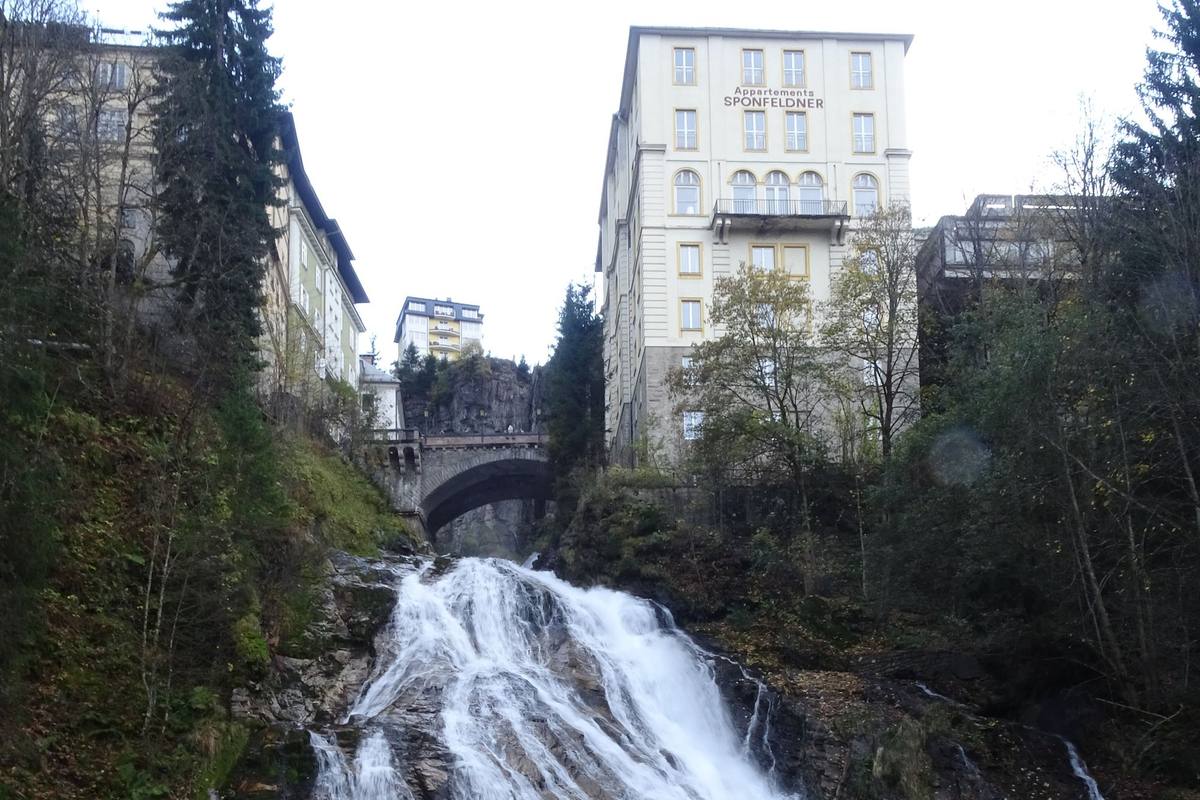
Bad Gastein is a historic Kurort built into a dramatic waterfall gorge, its grand Belle Époque hotels stacked up switchback streets above the falls rather than arranged around a flat village green. That vertical setting is the town’s whole visual identity — and the reason where you stay matters more here than in a purpose-built resort. The station and Stubnerkogel quarter is the functional, modern side of town; the historic center is the atmospheric, photogenic one; Böckstein, up-valley, is quieter still. All three are the same town, connected by the same 550/553 buses, but they do not feel like the same place.
Source note: winter 2026/27 timetables for the Tauernbahn and for every bus line named above were not yet published as of this verification (2026-08-18). Every frequency and departure-time claim on this page reads off the most recently published season (2025/26) and should be rechecked pre-season.
Not sure?
Choose somewhere else if…
- Innsbruck
You want a bigger roster and a full city underneath it. Innsbruck's ten lift-served areas and a railway station beat Gastein's six rows outright, at the cost of longer bus rides to most of them and no legislated free-transit program covering the fare.
- Davos & Klosters
You want valley-wide rail completeness that is not a two-year-old program. Switzerland's train network has done this for decades and the linked terrain is far larger, but Swiss prices apply to everything and nobody waives your fare for being an overnight guest.
- Chamonix
The mountains have to be the whole point. Chamonix's peaks are in a different league and a valley bus links its separate base areas much like Gastein's does, but you trade a historic spa town and a legislated free-transit ticket for a town built to service serious mountaineering.
This base appears in
Sources & data notes
How this page was verified
Section verification
- Access matrixAugust 18, 2026
- Getting thereSeptember 1, 2026
- Getting aroundAugust 18, 2026
- Where to stayAugust 18, 2026
- Living for a seasonAugust 18, 2026
Sources
- Arriving in the Gastein valley by train — Gastein Tourism (gastein.com) · destination organization page, cited not reproduced · retrieved
- Line 550/553 timetable — St. Johann–Dorfgastein–Bad Hofgastein–Bad Gastein–Böckstein–Sportgastein — Salzburger Verkehrsverbund GmbH (Salzburg Verkehr) · operator timetable, cited not reproduced · retrieved
- Line 552 timetable — Skibus Angertal–Bad Hofgastein — Salzburger Verkehrsverbund GmbH (Salzburg Verkehr) · operator timetable, cited not reproduced · retrieved
- Bus connections in the Gastein valley — Gasteinertal.com (Gastein valley tourism/transport summary site) · destination organization page, cited not reproduced · retrieved
- Live ÖBB Scotty journey-planner query — Bad Gastein departures — ÖBB (Österreichische Bundesbahnen) · operator timetable tool, cited not reproduced · retrieved
- 2026 timetable changes in Salzburg province — ÖBB (Österreichische Bundesbahnen) · operator timetable notice, cited not reproduced · retrieved
- Guest Mobility Ticket — free public transport for overnight guests — Salzburger Verkehrsverbund GmbH (Salzburg Verkehr) · operator product page, cited not reproduced · retrieved
- Mobilität vor Ort (mobility on site) — German-language edition — Gastein Tourism (gastein.com) · destination organization page, cited not reproduced · retrieved
- Gasteiner Alpenstrasse — the Böckstein–Sportgastein toll road — Gasteiner Alpenstraße (toll road operator) · operator page, cited not reproduced · retrieved
- Bad Gastein station — facilities and access — ÖBB (Österreichische Bundesbahnen) · operator station page, cited not reproduced · retrieved
- Bad Gastein station rebuild completed — press release, 8 July 2026 — ÖBB (Österreichische Bundesbahnen) press office · operator press release, cited not reproduced · retrieved
- Getting to the Gastein valley — 'Train in – Ski out' — Skigastein (Gastein cable car operator) · operator page, cited not reproduced · retrieved
- The local ski and hiking bus — Skigastein (Gastein cable car operator) · operator page, cited not reproduced · retrieved
- Train connections between Austria and Munich — ÖBB (Österreichische Bundesbahnen) · operator route page, cited not reproduced · retrieved
- ÖBB Scotty — München Hbf → Bad Gastein (live query, 2026 timetable) — ÖBB · operator timetable tool, cited not reproduced · retrieved
- Munich Airport — public transport — Flughafen München GmbH · operator page, cited not reproduced · retrieved
Images
- Photo by VillageHero, licensed under CC BY-SA 2.0
Page last reviewed September 1, 2026. Transit routes, schedules and fares change between seasons — check the operator before you travel. Mountain specifications for the northeastern US are maintained separately on NESKIS.