Innsbruck as a Ski Base
Ten lift-served ski areas on published scheduled buses from one railway station, a funicular to a serious mountain leaving from the edge of the old town, and a working Austrian city underneath all of it — at the price of a timetable that decides when your ski day starts and ends.
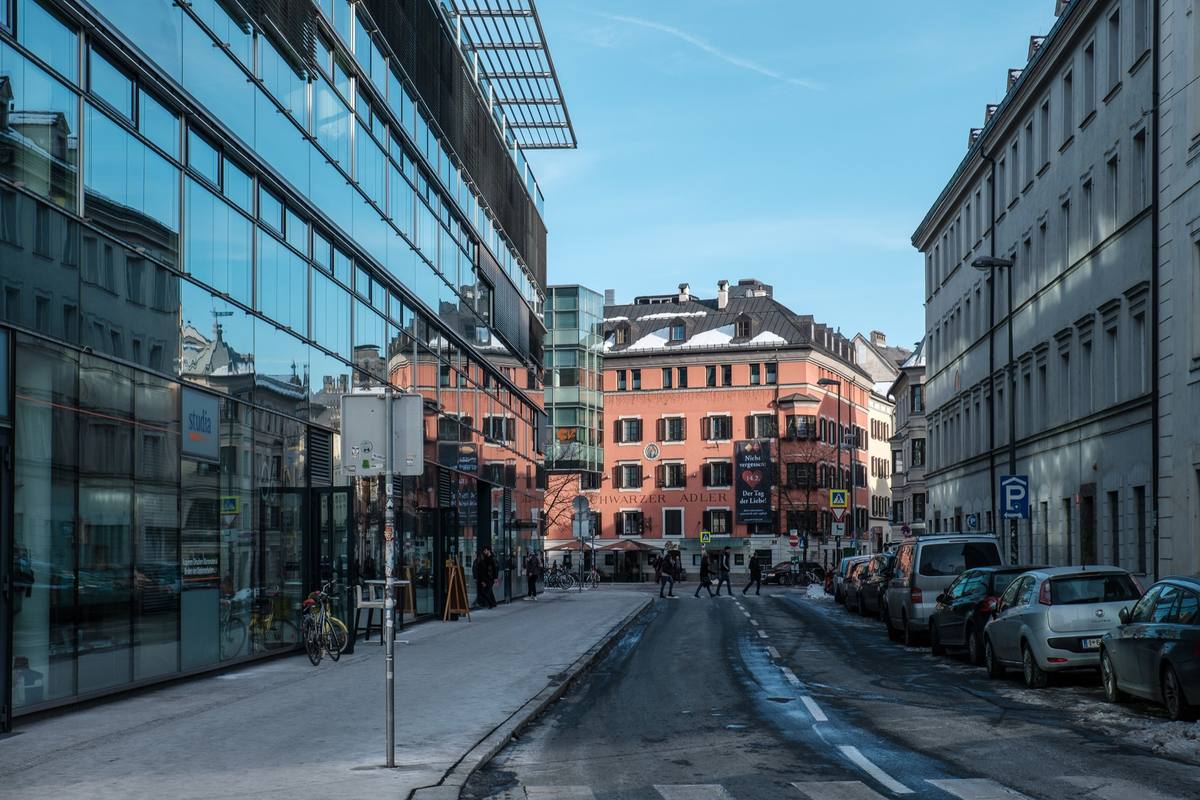
Car-free arrival is practical, daily needs are walkable or transit-served, and at least 80% of the ski areas in this page’s matrix are reachable on published transit during normal ski hours. Verified August 20, 2026.
EveningsCity trams and buses run into the late evening and weekend Nightliner services exist, but every ski-area bus in this matrix has made its last run by about 17:30. Night-ski services to Kühtai (Wednesday) and Rangger Köpfl (Tuesday, Friday) are the only exceptions.
At a glance
- Ski areas
- 10
- Within 30 min
- 2
- Closest
- 25 minFunicular
- Reachable by transit
- 10 of 10
- Arriving from
- Innsbruck Airport20 min by public bus
- Groceries on foot
- YesYear-round town
The verdict
Verdict
Come here for a city and a ski week. You need not choose between them. Read a bus timetable instead of signing a rental-car agreement. Ten separate lift-served areas sit on published scheduled buses from Innsbruck's railway station. The Nordkette funicular leaves from a stop you can walk to from the old town. Evenings unfold in a university city with bookshops, trams and a hospital, rather than four restaurants and a hotel bar.
Do not come for linked terrain. Every area on this page is its own mountain with its own road, its own bus and its own last departure, and none of them is a Zillertal circuit. Do not come if you like starting when you feel like it — the system runs on one morning departure per valley and one return in the late afternoon. And do not come for the Nordkette alone. It is the best view in skiing attached to very little actual skiing.
Is this base for you?
Who this suits
Best for
- Groups containing non-skiers. Innsbruck's old town, university, museums and covered market provide a full day while skiers take buses from the Hauptbahnhof.
- Alpine visitors who refuse to drive. Ten lift-served areas sit on published bus routes, and the Nordkette funicular leaves from the edge of the Altstadt.
- Short-break skiers. Direct trains reach the city, the airport is minutes away, and Nordkette or Patscherkofel can turn an arrival or departure day into a half ski day.
Depends on you
- A city rather than a resort. Restaurants stay open on a Tuesday in March and daily life is genuinely urban, but nearly every full ski day begins with a bus from the railway station.
- Ten separate ski areas. A forecast-led skier can choose Nordkette, Axamer Lizum or high Kühtai, while someone seeking a single large linked domain will spend the week changing buses.
- The Ski plus City Pass. It bundles twelve ski areas, public transport, museums and the pool, valuable to a broad itinerary and unnecessary if you intend to repeat one mountain.
The honest part
Things you should know
- 01
The network runs on one morning departure per valley. Line 412 to Axamer Lizum leaves the Hauptbahnhof at 08.34 and the last bus out of the Lizum goes at 16.09; line 420 to Kühtai leaves at 09.00 and comes back at 16.17. Miss either end of that and the repair is a taxi over the Axams or Sellrain road, which will cost more than the ski day did.
- 02
Nothing close to the city is high. The Muttereralm, Rangger Köpfl and Glungezer valley stations all sit around or below a thousand meters, so in a mild February the areas you can reach in under an hour are the first to shut. The dependable snow is Kühtai above two thousand meters and the Stubai glacier — the 75-minute and 85-minute rows at the bottom of the matrix.
- 03
The free ski bus is not entirely free. Lines 412, 414 and 420 are free only with the Welcome Card an Innsbruck-region accommodation issues at check-in — day visitors staying elsewhere pay. Line 590 into the Stubai needs a paid ticket for the Innsbruck to Schönberg leg (€4.60 in 2025/26) unless you hold a Welcome Card or a SKI plus CITY Pass voucher, and the city tram or bus you take to reach the Hauptbahnhof in the first place needs its own ticket.
The access matrix
What you can ski from Innsbruck
Typical door-to-lift times in normal winter conditions. ● marks areas reachable on published transit during ski hours. Every row is dated below.
- On foot or skis
- Public transport
- Lift from town
- Needs a vehicle
| Ski area | Getting there | Time | Best for | Main drawback |
|---|---|---|---|---|
| Transit-served. Nordkette | FunicularHungerburgbahn from Rennweg 3 · every 15 min · then the Seegrubenbahn up to the snowEvidence & assumptions for NordketteTimed from an old-town bed. Roughly eight minutes on foot to the Hungerburgbahn valley station — signed Altstadt, at Rennweg 3; older material still calls the stop Congress — then a published eight minutes to Hungerburg with departures every fifteen minutes, then the Seegrubenbahn up to the snow. The funicular figures are the operator's own; the walk and the cable-car leg are estimated. Source [1] Nordkettenbahnen — funicular and cable cars from the city center — verified August 20, 2026 | [1] | A half-day above the rooftops and one genuinely steep run | Two cable-car stages and very little terrain; you ride back down rather than ski to town |
| Transit-served. Patscherkofel | Public busSki bus J from Marktplatz 08.54 · last bus back 16.42 · 2025/26 timetableEvidence & assumptions for PatscherkofelVerified against the 2025/26 Innsbruck ski-bus timetable. Line J leaves Marktplatz at 08.54, inside the old town, and reaches the Patscherkofelbahn at 09.23. The last bus back leaves the valley station at 16.42 and is in the center by 17.10. Source [2] Bus and tram line overview, Innsbruck — verified August 16, 2026 | [2] | Wide intermediate cruising on the 1976 Olympic downhill face | One aspect served by one main lift; a full day here starts repeating itself by lunch |
| Transit-served. Muttereralm | Public busLine 414 from the Hauptbahnhof 08.30 · last return 16.06 · ran only 6 Dec–15 MarEvidence & assumptions for MuttereralmLine 414 leaves Innsbruck Hauptbahnhof from Steig K at 08.30 and reaches the Muttereralm Bergbahnen at 08.52; last return 16.06. Add about ten minutes to get from the old town to the station. The 2025/26 season for this line ran only 6 December to 15 March — the shortest of any ski bus here. Source [3] Free ski bus network, Innsbruck and region — verified August 16, 2026 | [3] | A cheap short afternoon and a gondola that suits nervous beginners | Low base and a thin piste network; first area in the matrix to lose cover in a mild winter |
| Transit-served. Glungezer | Public busVVT line 540 to Tulfes · absent from the ski-bus flyer · times unverifiedEvidence & assumptions for GlungezerEstimated, not verified. VVT line 540 serves Tulfes from Innsbruck as a scheduled regional bus and the SKI plus CITY Pass lists Glungezer as bus-served, but this journey is absent from the published Innsbruck ski-bus flyer and the 45 minutes here has not been checked against a timetable. Source [4] Ski bus routes in the Innsbruck urban area — verified August 16, 2026 | [4] | One long top-to-bottom descent and touring above the lift network | Only the upper mountain is dependable; the run out to Tulfes needs a strong snow year |
| Transit-served. Serlesbahnen Mieders | Public busLine 590 · every 10 min Mon–Fri per the operator · door-to-lift unverifiedEvidence & assumptions for Serlesbahnen MiedersEstimated, not verified. Mieders is the first Stubai village on line 590, which the operator publishes as running every ten minutes Monday to Friday from Innsbruck Hauptbahnhof, but the door-to-lift time has not been checked against a timetable. Source [4] Ski bus routes in the Innsbruck urban area — verified August 16, 2026 | [4] | Families, a long floodlit toboggan run and the shortest Stubai trip | Genuinely small — a morning of skiing rather than a day, and it knows it |
| Transit-served. Rangger Köpfl | Public busLine 461 out 09.20, back 16.36 · Tue/Fri night-ski bus 17.50 out, 21.14 backEvidence & assumptions for Rangger KöpflLine 461 leaves Innsbruck Hauptbahnhof from Steig L at 09.20 for the Rangger Köpfl lift at 09.58, returning 16.36. Night skiing on Tuesday and Friday has its own service — out on line 462 at 17.50, back on line 464 at 21.14. Source [3] Free ski bus network, Innsbruck and region — verified August 16, 2026 | [3] | Night skiing and empty weekday mornings | Small, south-facing, and the morning bus does not put you on the lift until nearly 10.00 |
| Transit-served. Axamer Lizum | Public busSki bus 412 out 08.34, return 16.09 · free with the Welcome Card · 6 Dec–12 AprEvidence & assumptions for Axamer LizumSki bus line 412 leaves Innsbruck Hauptbahnhof from Steig K at 08.34 and arrives at 09.20; the return leaves the Lizum at 16.09 and reaches the station at 16.50. Free with the Welcome Card your accommodation issues — not free for day visitors. Ran 6 December to 12 April in 2025/26. Source [4] Ski bus routes in the Innsbruck urban area — verified August 16, 2026 | [4] | The most sustained lift-served skiing within an hour of the city | One bus in and one bus out — the 16.09 departure ends your day whether you are done or not |
| Transit-served. Schlick 2000 | Public busLine 590 to Fulpmes (estimated) · or the Lüftner hotel shuttle 08.15–08.45, back 16.30Evidence & assumptions for Schlick 2000Estimated from line 590 to Fulpmes. The verified alternative is the Lüftner ski shuttle, which collects from named city hotels between 08.15 and 08.45 and leaves Schlick 2000 at 16.30. Source [4] Ski bus routes in the Innsbruck urban area — verified August 16, 2026 | [4] | A varied full ski day without committing to the glacier run | The valley station sits outside Fulpmes, so the bus leg ends in a connection or a walk |
| Transit-served. Kühtai | Public busLine 420 out 09.00, back 16.17 · Wednesday night bus 18.30 out, 22.05 backEvidence & assumptions for KühtaiLine 420 leaves Innsbruck Hauptbahnhof from Steig L at 09.00 and reaches Kühtai Ort at 10.03; the return leaves at 16.17 and arrives 17.24. A separate Wednesday night bus runs 18.30 out and 22.05 back for floodlit skiing. Source [4] Ski bus routes in the Innsbruck urban area — verified August 16, 2026 | [4] | Snow reliability, a high treeless bowl and Wednesday night skiing | An hour of Sellrain valley road each way, and no trees to ski when the light goes flat |
| Transit-served. Stubai Glacier | Public busLine 590 out 08.35, back 16.00 · Schönberg leg paid without a Welcome CardEvidence & assumptions for Stubai GlacierLine 590 leaves Innsbruck Hauptbahnhof from Steig B at 08.35 and reaches Mutterbergalm at 09.51; the return leaves at 16.00 and arrives 17.15. The Innsbruck to Schönberg leg needs a paid ticket unless you hold a Welcome Card or SKI plus CITY Pass voucher. Source [4] Ski bus routes in the Innsbruck urban area — verified August 16, 2026 | [4] | October-to-May snow and the largest single ski area on the pass | Close to three hours on a bus for a return day, plus the Mutterbergalm lift queue on a Saturday |
Where to stay
The Altstadt and the center is the obvious answer and mostly the right one. From the old town you can walk to the Hungerburgbahn’s Altstadt station in about eight minutes, catch line J to the Patscherkofel from Marktplatz without going anywhere near the railway station, and finish the day in a city that has restaurants open on a Tuesday in March. It is also the most expensive address in Innsbruck and the one where you will hear stag parties.
Around the Hauptbahnhof — Saggen, Pradl, the streets behind Südtiroler Platz — is the most functional place to sleep in the whole region and nobody puts it on a postcard. Every regional ski bus leaves from platforms B, K and L outside the station. Staying within five minutes of it takes ten to fifteen minutes off every row in the matrix except the Nordkette and the Patscherkofel, and the hotel-shuttle network exists mainly to move people from the center to exactly this spot.
Hungerburg puts you above the city on the funicular line, which means you live at the Nordkette’s first change point and look down on the whole valley. It is quiet, it is residential, and everything except the Nordkette becomes a two-leg journey.
Igls and Mutters are villages inside the city’s transport net rather than suburbs of it. Igls has the Patscherkofelbahn at the end of the street and line J into town; Mutters has the Muttereralmbahn and both the 414 bus and the Stubaitalbahn tram. Choose either if you want a village evening and are content to ski one mountain most days.
Fulpmes or Neustift, up the Stubai, are the honest choice if the skiing matters more than the city. You are then based at Schlick 2000 or the glacier road, with line 590 running back into Innsbruck all day — the inverse of this page’s argument, and a perfectly good trip.
Getting there
Innsbruck Airport sits about four kilometers west of the center and the F bus takes roughly twenty minutes into town. It is a small airport with a short, weather-exposed approach and a winter charter schedule that thins out fast; treat it as a bonus rather than a plan.
The realistic gateways for most people are Munich and the railway. Innsbruck Hauptbahnhof is on the main east–west Austrian line and on the Brenner route to Italy, with direct trains from Munich, Salzburg, Vienna and Zurich, plus scheduled coaches from Munich Airport. On the 2026 timetable the direct Railjet from Munich Hauptbahnhof takes 1 hour 55 minutes and runs roughly every two hours through the day, with one-change alternatives via Kufstein of about 2 hours 25 in the hours between; the S-Bahn from Munich Airport into the city adds about 40 minutes. Arriving by train puts you within a few hundred meters of every ski bus in the matrix, which is the single strongest practical argument for this destination.
Driving is straightforward — the A12 Inntal autobahn runs along the valley — but you need an Austrian motorway vignette, city parking is expensive and metered, and a car adds nothing to eight of the ten rows below.
Getting around
This is the section that justifies the page. Innsbruck publishes a season ski-bus timetable, and what it shows is a hub-and-spoke network out of the Hauptbahnhof with one morning departure and one late-afternoon return per valley. Line 412 for Axamer Lizum leaves Steig K at 08.34. Line 420 for Kühtai leaves Steig L at 09.00. Line 590 for the Stubai glacier leaves Steig B at 08.35 and runs every ten minutes on weekdays. Line 414 to Muttereralm, line 461 to the Rangger Köpfl, and line J to both the Nordkette and the Patscherkofel fill in the rest. The Hungerburgbahn funicular runs every fifteen minutes from the edge of the old town.
Two caveats matter more than the marketing does. First, “free ski bus” means free with the Welcome Card, which any accommodation in the Innsbruck region issues at no charge — a day visitor without one pays, it does not cover the city tram you take to reach the station, and line 590 into the Stubai charges for the Innsbruck to Schönberg leg unless you hold a Welcome Card or a SKI plus CITY Pass voucher. Second, the timetable is thin. One outbound and one inbound service per area is enough for a ski day and nothing else; if you want to stop for a beer at the base after the lifts close, you are walking to a different valley.
The SKI plus CITY Pass Stubai Innsbruck is the product that makes the whole thing coherent. It covers twelve ski areas along with city public transport, museums and the municipal swimming pools. Ten of those twelve are in the matrix below. The twelfth, Hochötz in the Ötztal, needs a train and a connecting bus and we have not timed it; the operator’s own website was unreachable and its certificate had expired at the time of writing, so we have left it out rather than guess.
Hotel ski shuttles run alongside the public network. The Lüftner service collects from named city hotels between 08.15 and 08.45 for Axamer Lizum, Schlick 2000 and the Stubai glacier, returning between 16.30 and 17.00. If your hotel is on that list it is faster than the bus and removes the walk to the station.
Source note: the bus times on this page were read off the official Innsbruck ski-bus timetable for the 2025/26 season, and each row cites the registered VVT, Innsbruck Tourismus or Nordkettenbahnen record for its service. A few line numbers quoted in the notes (414, 461/462) come from that timetable but do not yet have registered line pages of their own.
Who it suits
- Skiers traveling with people who do not ski. This is the strongest case for Innsbruck and it is not close. A non-skiing partner has a university city, an old town, museums, a covered market and a tram network, not a hotel lobby and a spa.
- Anyone who does not want to drive in the Alps. Ten areas on scheduled buses is a genuinely unusual number, and none of it depends on renting a car or on winter tires.
- Freeriders with a forecast. The Nordkette, Axamer Lizum and Kühtai between them give you a reason to choose a mountain each morning rather than ride the same lift for a week.
- Short trips. Two or three days works here in a way it does not at a resort that needs a transfer at each end.
It suits piste-milers least. If your measure of a ski holiday is kilometers of connected groomer, everything on this page will feel small, and the Zillertal or the Skicircus will serve you better for less bus time.
Living for a season
Innsbruck is a real year-round city with a large university, a teaching hospital, and an economy that does not switch off when the snow does. That makes it one of very few Alpine bases where a winter season does not have to mean staff accommodation. Long-term rentals exist, shops stay open in May, and you can register a life here rather than camp in one.
The constraint is the same as in every desirable university city — student demand and short-term letting have tightened the rental market, and February arrivals will struggle. Start looking in early autumn. Non-EU citizens should note that working a season in Austria requires the appropriate permit; a tourist entry does not cover it, and ski-school and lift-company jobs are checked.
What the town is like
Innsbruck is a city of about 130,000 people wedged into the Inn valley with a two-thousand-meter limestone wall directly behind it. The Nordkette is not a view from the town, it is the end of the street. That proximity is the defining fact of the place, and it explains everything from the funicular to the number of people carrying skis on a city tram at eight in the morning.
The center is a genuine medieval old town — arcaded streets, the Goldenes Dachl, the wide Maria-Theresien-Straße running south — surrounded by nineteenth-century and post-war blocks and, out by the ring road, the same retail sheds as everywhere else. The university gives it a student population, cheap food and a nightlife that survives the shoulder season. Two Winter Olympics and the Bergisel ski jump, which sits on a hill inside the city, mean winter sport is civic infrastructure rather than a visiting industry.
The frustrations are urban ones. Traffic on the Innrain and around the station is bad at rush hour, the föhn wind that warms the valley in midwinter also shuts the Nordkette cable cars, and the valley floor collects inversion murk while the mountains sit in sun. On those days the sensible move is the one the whole city makes — get on the funicular and go up.
Not sure?
Choose somewhere else if…
- Salt Lake City
You want the same city-as-base argument with far more snow and far more terrain. Salt Lake has an international airport, four canyons and a bus network, but the canyon roads jam and close in the storms that make the place worth visiting, and the city itself is nothing like as pleasant to walk.
- Chamonix
The skiing has to be the point. Chamonix runs on the same structure — separate areas linked by a valley bus rather than by lifts — but the mountains are in a different league, and you give up a real city for a town that exists to service them.
Full comparison - Davos & Klosters
You want the transit completeness and big linked terrain in one place. Parsenn and Jakobshorn are properly large and the trains reach them, but Davos is a long commercial strip rather than a city, and Swiss prices apply to everything including the lift ticket.
- St. Anton am Arlberg
You want to step off a long-distance train and walk to the lift, then ski one connected domain that runs on snow all the way to Warth-Schröcken — accepting that the bus on to Lech and Zürs runs about once an hour in winter and does not run at all after its last departure.
Full comparison
This base appears in
Sources & data notes
How this page was verified
Section verification
- Access matrixAugust 16, 2026
- Getting thereSeptember 1, 2026
- Getting aroundAugust 16, 2026
- Where to stayAugust 16, 2026
Sources
- Nordkettenbahnen — funicular and cable cars from the city center — Innsbrucker Nordkettenbahnen · operator page, cited not reproduced · retrieved
- Bus and tram line overview, Innsbruck — Innsbrucker Verkehrsbetriebe und Stubaitalbahn GmbH (IVB) · operator timetable, cited not reproduced · retrieved
- Free ski bus network, Innsbruck and region — Innsbruck Tourismus · destination organization page, cited not reproduced · retrieved
- Ski bus routes in the Innsbruck urban area — SKI plus CITY Pass Stubai Innsbruck (Axamer Lizum GmbH & Co KG / Innsbruck Tourismus) · operator page, cited not reproduced · retrieved
- Northeast resort profiles — NESKIS · sibling property; mountain specifications maintained there · retrieved
- ÖBB Scotty — München Hbf → Innsbruck Hbf (live query, 2026 timetable) — ÖBB · operator timetable tool, cited not reproduced · retrieved
- München → Innsbruck route page — Deutsche Bahn · operator route page, cited not reproduced · retrieved
- Munich Airport — public transport — Flughafen München GmbH · operator page, cited not reproduced · retrieved
Images
Page last reviewed September 1, 2026. Transit routes, schedules and fares change between seasons — check the operator before you travel. Mountain specifications for the northeastern US are maintained separately on NESKIS.