Salt Lake City as a Ski Base
Six major mountains inside an hour of a metro of 1.2 million people — the only place in North America where you can ski a different resort every day of the week and still pay city rent, shop at a normal supermarket and reach the airport on a light-rail train.
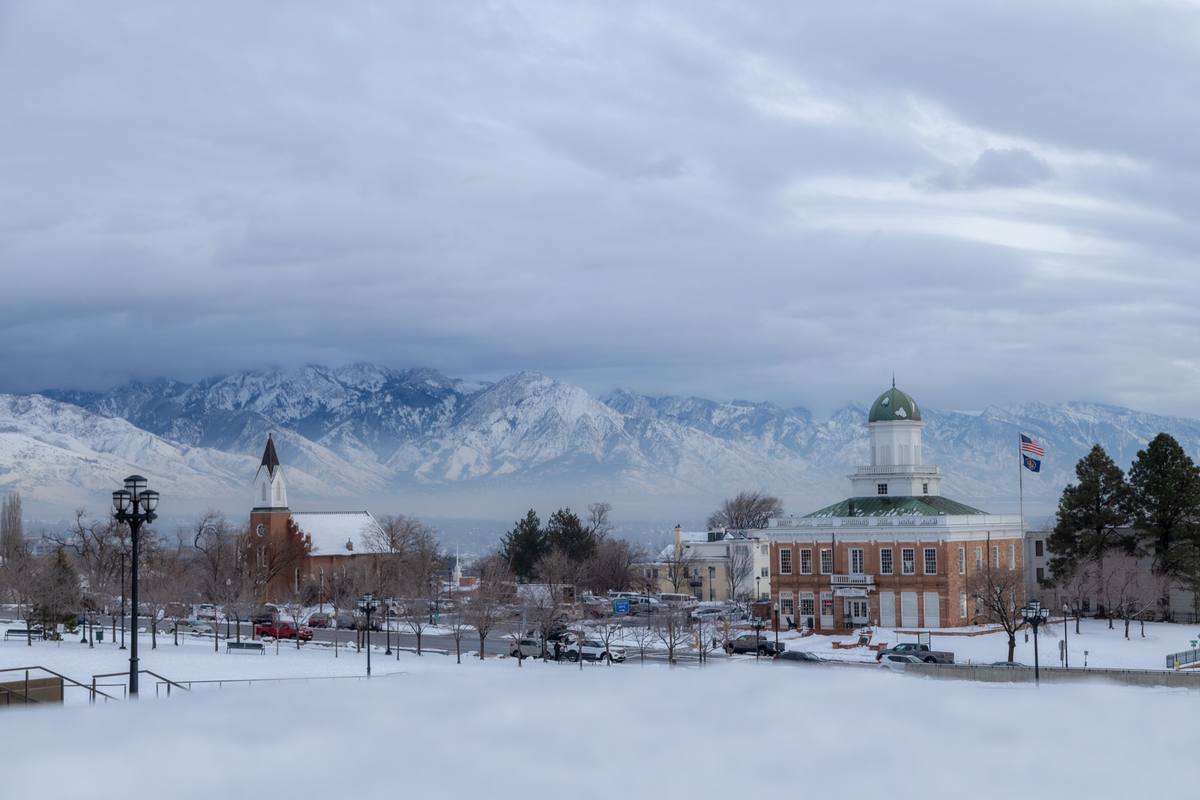
The core trip works without a car, but a car materially expands your lodging, evening or mountain choices. Verified August 16, 2026.
EveningsTRAX runs to roughly 23:30 on weeknights; canyon ski buses stop shortly after the lifts close
At a glance
- Ski areas
- 12
- Within 30 min
- 0
- Closest
- 40 minDrive
- Reachable by transit
- 7 of 12
- Arriving from
- Salt Lake City International (SLC)26 min by train
- Groceries on foot
- YesYear-round town
The verdict
Verdict
Come to ski four or six different mountains in a week. Sleep in a city at city prices. Salt Lake City has an identity beyond skiing. Nowhere else in North America puts this much lift-served terrain within an hour of an international airport you can leave by light rail. You can land at noon, ride the Green Line downtown, and be on the Snowbird tram the next morning without renting anything. The trade is that you commute: every ski day begins with a drive or a bus up a canyon that several thousand other people are also driving up.
Do not come if you want to step out of the door onto snow. Salt Lake is a base, not a ski town. The lifts are thirty miles away, the evenings happen at street level, and nothing about the place is arranged around your vacation. If a slopeside week is what you are buying, Park City or the Snowbird lodges will serve you better — and charge you for it.
Is this base for you?
Who this suits
Best for
- Skiers who want variety without repacking. Alta, Snowbird, Brighton, Solitude, Park City and Deer Valley give six substantial mountains from one metropolitan base.
- Visitors traveling on points or a budget. Downtown and Sugar House offer city hotel rates, supermarkets and restaurants without a resort's captive-market pricing.
- Mixed groups and remote workers. The non-skier gets museums, climbing gyms and neighborhoods, while the city supplies hospitals, internet and an airport train for a month-long stay.
Depends on you
- A city at the foot of the Wasatch. You keep full urban life and an airport TRAX platform, while every ski day is a commute with no village walk home in boots.
- The Cottonwood ski buses. Ikon and resort-pass holders ride free and avoid parking, but a downtown guest first takes TRAX and can spend about ninety minutes reaching a lift.
- Skier-only Alta and Deer Valley. Skiers get two distinctive mountains without snowboard traffic; mixed skier-snowboarder parties must separate or choose the other resorts.
The honest part
Things you should know
- 01
Each Cottonwood canyon is served by exactly one road. SR-210 to Snowbird and Alta and SR-190 to Solitude and Brighton both close for avalanche control, both enforce a traction law during storms, and both back up into a stationary line from the canyon mouth on a powder morning. The forty-five-minute drive that makes this destination work is a forty-five-minute drive on a Tuesday, not on the Saturday after a two-foot night.
- 02
Salt Lake sits in a bowl, and in winter that bowl fills. Temperature inversions trap cold, dirty air over the valley floor for days at a time, and the particulate readings in a bad January week are the worst in the country. The canyons are above it — you drive up into sunshine — but you live down in it, and if anyone in your party has asthma this is the single thing most likely to ruin the trip.
- 03
Being transit-served is not the same as being convenient. The UTA ski buses do not start downtown: route 994 begins at Historic Sandy and route 972 at Midvale Fort Union, so a downtown bed means TRAX plus a transfer plus a canyon bus, and eighty to ninety minutes each way. UDOT's plan to run canyon buses every ten to twenty minutes and to toll the road is real but phased — it is not the service you will find this season.
The access matrix
What you can ski from Salt Lake City
Typical door-to-lift times in normal winter conditions. ● marks areas reachable on published transit during ski hours. Every row is dated below.
- On foot or skis
- Public transport
- Lift from town
- Needs a vehicle
| Ski area | Getting there | Time | Best for | Main drawback |
|---|---|---|---|---|
| Transit-served. Park City Mountain | DriveCar-free: fare-free HVT 107 + Park City Transit · well over 2 hours each wayEvidence & assumptions for Park City MountainEstimated by car via I-80 and SR-224. Car-free works but is slow — High Valley Transit route 107 (fare-free) from Salt Lake Central to Kimball Junction, then free Park City Transit; allow well over two hours each way. Source [3] Route 107 — Park City / Salt Lake City Commuter — verified August 16, 2026 | [3] | A large-acreage day that finishes in a town with restaurants and a bus network | Holiday-week crowding, and gentler terrain than the Cottonwood areas |
| Transit-served. Snowbird | Drive or shuttleTRAX Blue Line + UTA 994 · 85–95 min by transit · check the last downhill departureEvidence & assumptions for SnowbirdEstimated door-to-lift by car from downtown in clear conditions — not measured. By transit it is TRAX Blue Line to Historic Sandy plus UTA route 994; budget 85–95 minutes and check the last downhill departure. Source [1] Route 994 — Historic Sandy Station to Snowbird & Alta — verified August 16, 2026 | [1] | Sustained steep terrain on a storm day | SR-210 closes for avalanche control and interlodge lockdowns with little warning |
| Transit-served. Solitude | Drive or shuttleTRAX Blue Line + UTA 972 · 80–90 min door-to-lift by transitEvidence & assumptions for SolitudeEstimated by car from downtown. UTA route 972 runs Big Cottonwood from Midvale Fort Union Station on the TRAX Blue Line — plan on 80–90 minutes door-to-lift by transit. Source [2] Route 972 — Midvale Fort Union Station to Solitude & Brighton — verified August 16, 2026 | [2] | Weekday quiet and intermediate cruising near the city | Paid base parking and a village with very little in it outside the resort |
| Transit-served. Deer Valley | DriveCar-free: same HVT 107 + Park City Transit chain · makes for a long dayEvidence & assumptions for Deer ValleyEstimated by car to Snow Park Lodge; the East Village base off US-40 is a similar drive. Transit is the same route 107 plus Park City Transit chain, which makes for a long day. Source [3] Route 107 — Park City / Salt Lake City Commuter — verified August 16, 2026 | [3] | Grooming, service and the new East Village terrain off US-40 | The most expensive lift ticket in Utah, and snowboarding is not permitted |
| Transit-served. Alta | Drive or shuttleUTA 994 continues past Snowbird to Alta · adds roughly 5–10 min to the Snowbird runEvidence & assumptions for AltaEstimated by car from downtown. UTA route 994 continues past Snowbird to Alta, adding roughly five to ten minutes to the Snowbird run. Source [1] Route 994 — Historic Sandy Station to Snowbird & Alta — verified August 16, 2026 | [1] | Powder days for skiers who want a snowboard-free mountain | Skiers only, and the base has essentially no evening life once the road closes |
| Transit-served. Brighton | Drive or shuttleUTA 972 terminates at Brighton · about 5 min past SolitudeEvidence & assumptions for BrightonEstimated by car. Route 972 terminates at Brighton, about five minutes past Solitude, so the transit penalty over Solitude is small. Source [2] Route 972 — Midvale Fort Union Station to Solitude & Brighton — verified August 16, 2026 | [2] | The cheapest lift-served day in the Cottonwoods — check current night-skiing days | Furthest up Big Cottonwood, so it absorbs the worst of the storm-day road delays |
| Transit-served. Solitude Nordic Center | Drive or shuttleUTA 972 passes the Silver Lake Day LodgeEvidence & assumptions for Solitude Nordic CenterAt the Silver Lake Day Lodge between Solitude and Brighton; route 972 passes it. Coordinates are approximate to the day lodge rather than surveyed. Source [2] Route 972 — Midvale Fort Union Station to Solitude & Brighton — verified August 16, 2026 | [2] | Groomed classic and skate skiing at altitude without leaving the Cottonwoods | Small network by Nordic-destination standards and it sits at about 8,700 feet |
| Soldier Hollow | DriveEvidence & assumptions for Soldier HollowEstimated by car via I-80 and US-40. The 2002 Olympic venue, run by the Utah Olympic Legacy Foundation rather than a resort. Verified August 16, 2026 | Groomed Nordic and biathlon trails within reach of the city | An hour out in Midway with no transit at all, and the trails are exposed and often firm | |
| Snowbasin | DriveUTA 675/677 start in Ogden and Layton · FrontRunner connection unverifiedEvidence & assumptions for SnowbasinEstimated by car via I-15 and Trappers Loop. UTA runs seasonal ski buses (routes 675 and 677) but they originate in Ogden and Layton, so a Salt Lake City rider needs FrontRunner first — that connection could not be verified out of season, so this row is scored as not transit-served. Verified August 16, 2026 | 2002 Olympic downhill pitch and base lodges that outclass the lift lines | An hour each way on I-15 and no practical transit chain from Salt Lake City | |
| Sundance | DriveSeasonal UTA 880 reaches Sundance from Orem, not from Salt Lake CityEvidence & assumptions for SundanceEstimated by car via I-15 and Provo Canyon. UTA seasonal route 880 reaches Sundance from Orem, not from Salt Lake City. Verified August 16, 2026 | A quiet day on Mount Timpanogos with no resort scene attached | Small by Utah standards, and an hour south — the opposite direction from the Cottonwoods | |
| Nordic Valley | DriveEvidence & assumptions for Nordic ValleyEstimated by car via I-15 and Ogden Canyon. Despite the name it is an alpine area, not a Nordic center. Verified August 16, 2026 | Cheap night skiing and beginners who want nothing to do with a Cottonwood crowd | Very small, largely a night operation, and no bus route reaches it at all | |
| Powder Mountain | DriveSeasonal UTA 674 runs from Ogden only · FrontRunner transfer not verifiableEvidence & assumptions for Powder MountainEstimated by car. UTA seasonal route 674 runs from Ogden only; from Salt Lake City it needs FrontRunner plus a timed transfer that was not verifiable in August. Ownership changed in 2023 and the public/private lift split has moved since — check before buying a ticket. Verified August 16, 2026 | Enormous, lightly skied acreage on a midweek storm day | Part of the mountain is now reserved for homeowners, and the access road is slow and steep |
Sourcing note. The canyon rows cite the registered UTA route 994 and 972 schedule records, the Park City rows cite the High Valley Transit route 107 record, and the evening claim rests on the registered TRAX Blue Line record. The Snowbasin, Powder Mountain and Sundance rows are drive estimates and deliberately carry no citation.
Where to stay
Downtown is the default and the right answer for a first trip. It is the only base with the full city attached: the Green Line runs to the airport in about twenty-six minutes, the Blue Line runs south to both ski-bus origins, and you can eat somewhere different every night without driving. The cost is that you are furthest from the canyon mouths — add ten to fifteen minutes to every number in the matrix above compared with a bed in the southeast valley.
Sugar House is the compromise most people should actually make. It is a proper neighborhood rather than a hotel district — coffee, a supermarket, bars that are open on a Tuesday in March — and it shaves real minutes off the drive to both Cottonwoods. Rentals here are the ones that make a season stay work.
Cottonwood Heights is the insider answer and nobody advertises it. It sits directly between the two canyon mouths; from the right street you are ten minutes from the base of Big Cottonwood and twelve from Little Cottonwood, which on a powder morning is the difference between being in the line and being ahead of it. The trade is that it is suburban in the flattest sense. There is no walkable center, the restaurants are chains, and if you want an evening you are driving back into the city.
Sandy and Midvale are the cheap, functional option. Both sit on the TRAX Blue Line, both are where the ski buses actually begin, and both are noticeably less expensive than anything closer to downtown. You are staying in a Salt Lake suburb, with everything that implies, but if the trip is about skiing six days out of seven and sleeping cheaply, this is the most efficient base in the valley.
Getting there
Salt Lake City International is the reason this page exists. It is a Delta hub with direct service from most of North America and a growing set of European routes, and it is fifteen minutes from downtown by road. More usefully, the TRAX Green Line platform is inside the terminal, on the same level as baggage claim — no shuttle, no rental counter, about twenty-six minutes to downtown and a $2.50 fare. There is no other major ski gateway in North America where you walk from the carousel to a train.
Amtrak’s California Zephyr stops at Salt Lake Central, though in the middle of the night and only once a day in each direction, so treat it as a curiosity rather than a plan. Driving in, Salt Lake is on I-15 and I-80, roughly five hours from Las Vegas and eight from Denver.
Getting around
The city itself works without a car. TRAX covers the north–south spine and the airport, the FrontRunner commuter train reaches Ogden and Provo, buses fill in the grid, and service runs late enough that an evening out does not require a taxi home.
Getting up the canyons is a different question, and the honest answer is that it half works. UTA runs ski buses into both Cottonwoods — route 994 to Snowbird and Alta, route 972 to Solitude and Brighton — at $5 a ride, free with an Ikon pass or a resort season pass. They are genuinely good buses. The problem is where they start: Historic Sandy and Midvale Fort Union, both a TRAX ride south of downtown. From a downtown hotel you are looking at roughly ninety minutes door-to-lift, which is double the drive.
Park City and Deer Valley are reachable too, via High Valley Transit’s fare-free route 107 from Salt Lake Central to Kimball Junction and then Park City’s own free buses. It works. It also takes over two hours each way, which makes it a way to live in Park City rather than a way to day-trip there from the city.
The live story is what UDOT does next. In December 2025 the department committed to a roughly $250 million program for Little Cottonwood: about thirty new buses over two winters, two indoor bus stations, a ban on roadside parking near the resorts, and eventually a variable toll on the canyon road that will not switch on until the bus service is good enough to be a real alternative. The stated target is canyon buses every ten to twenty minutes instead of every thirty. A parallel plan for Big Cottonwood is in consultation. None of it is finished, and the frequency improvement is being described in years rather than seasons — but if it lands, this page’s carNeed rating changes.
Who it suits
- Skiers who want variety without repacking. Six substantial mountains, two of them among the best in North America, all from one bed. Nothing else on this site matches the density.
- Anyone traveling on points or a budget. City hotel rates, city restaurant prices, a supermarket rather than a resort general store, and no captive-market surcharge on anything.
- Remote workers taking a month. Normal rents, real internet, hospitals, an airport, and a Wednesday morning at Alta.
- Mixed groups where not everyone skis. The non-skier gets a city — museums, climbing gyms, a symphony, actual shops — instead of a base lodge and a hot tub.
It suits least the person who wants a ski vacation to feel like a ski vacation. There is no village, no cobbled street, no walk home in ski boots. You are commuting, and it feels like it.
Living for a season
This is where Salt Lake separates itself. A season in a ski town normally means employee housing, a shared room at an inflated rate, and a local economy that exists to serve visitors. Salt Lake is a metro of about 1.2 million with a university, a state government, a tech corridor and a normal rental market. Seasonal ski jobs exist across the four Cottonwood areas and up in Park City, but you do not have to take one to be here, and you are not competing for beds with a resort’s own workforce.
Practical points: the four Cottonwood areas are all on the Ikon Pass, which for a season base is the obvious purchase; a season pass from any of the four includes the UTA ski bus. Car insurance and winter tires are the hidden costs — Utah’s canyon traction law is enforced, and a two-wheel-drive car on summer tires will be turned around at the canyon mouth in a storm.
We have not yet sourced a housing-market figure for Salt Lake County, so this page does not carry a housing warning either way. Rents have risen sharply since 2020; they are still not ski-town rents.
What the town is like
Salt Lake is not charming and does not try to be. The street grid is enormous — blocks are 660 feet on a side, laid out for wagon turns — which makes the city feel emptier than it is and makes walking distances longer than the map suggests. The Temple and its square dominate the center and the Church still shapes the place, but the city itself has been majority non-Mormon for years and the drinking laws that people warn you about are, in practice, a minor administrative oddity rather than a constraint.
What you actually get is a working western city with mountains at the end of the street. The Wasatch rises 7,000 feet directly off the eastern edge of the valley, close enough that from most of the east bench you can see the runs at Snowbird. Sugar House and 9th and 9th have the independent restaurants and bookshops; downtown has the hotels and the arena; the whole thing shuts down less than you would expect and stays open later than a ski town does.
The inversion is the thing nobody who lives here will pretend away. For stretches of January the valley sits under a gray lid, and the standard local response is to drive up out of it. That is a genuine feature of the destination — the escape hatch is a forty-minute drive — but it is also a reminder that this is a city first, with a city’s air, and skiing is something you leave it to do.
Not sure?
Choose somewhere else if…
- Innsbruck
Car-free is not a preference but a requirement. Innsbruck is the European version of this argument — a real city with a dense mountain matrix — and it does the transit part properly, with scheduled buses from the center to nearly every area rather than a park-and-ride chain you have to reach by light rail first.
- Summit County, Colorado
You would rather live at the mountains than commute to them. Breckenridge, Keystone, Copper and Arapahoe Basin are strung along one valley with a free county-wide bus, so the ski day starts at the lift instead of at a canyon mouth — at ski-town prices and 9,600 feet of base elevation.
Full comparison - Sapporo
You want the city-base thesis pushed further. Sapporo is a metro of two million with lift served terrain inside the city limits and snow that makes Utah look dry, and it is genuinely cheaper to live in — but the vertical is modest and you are buying a long-haul flight.
This base appears in
Sources & data notes
How this page was verified
Section verification
- Access matrixAugust 16, 2026
- Getting thereAugust 16, 2026
- Getting aroundAugust 16, 2026
- Where to stayAugust 16, 2026
Sources
- Route 994 — Historic Sandy Station to Snowbird & Alta — Utah Transit Authority · operator schedule, cited not reproduced · retrieved
- Route 972 — Midvale Fort Union Station to Solitude & Brighton — Utah Transit Authority · operator schedule, cited not reproduced · retrieved
- Route 107 — Park City / Salt Lake City Commuter — High Valley Transit · operator schedule, cited not reproduced · retrieved
- Route 701 — TRAX Blue Line — Utah Transit Authority · operator schedule, cited not reproduced · retrieved
- Northeast resort profiles — NESKIS · sibling property; mountain specifications maintained there · retrieved
Images
- Photo by gadee10, licensed under Public Domain Mark 1.0
Page last reviewed August 16, 2026. Transit routes, schedules and fares change between seasons — check the operator before you travel. Mountain specifications for the northeastern US are maintained separately on NESKIS.