Chamonix & the Mont Blanc Valley
One valley, nine named Skibus lines and a parallel railway divide a dozen disconnected ski sectors — free to ride on a lift pass, not on the hotel guest card whatever the guest card promises, and none of it linked by a single ski lift.
The core trip works without a car, but a car materially expands your lodging, evening or mountain choices. Verified August 18, 2026.
EveningsOn the 2025/26 winter guide (2026/27 not yet published), daytime Skibus lines wind down with the lifts in the late afternoon. The paid Chamo'nuit evening lines (N1 Les Houches–Argentière la Fis, N3 Argentière–Vallorcine Barberine, N4 Les Houches–Servoz) run into the evening on their own separate timetable, at €4.50 a ride, with reservation required for some runs.
At a glance
- Ski areas
- 9
- Within 30 min
- 7
- Closest
- 8 minPublic bus
- Reachable by transit
- 8 of 9
- Arriving from
- Geneva Airport1h 40m by public bus
- Groceries on foot
- YesYear-round town
The verdict
Verdict
Come for genuinely serious mountains organized as a valley of separate access points, not one resort. Nine named Skibus lines, free to ride on any lift pass, reach Brévent, Flégère, Grands Montets and both sides of the Balme domain from Chamonix Centre, Les Praz and Argentière; the Mont Blanc Express train beats the bus to three of the same doors and continues on into Switzerland. This is a free, town-to-town network, confirmed line by line against two consecutive years of the operator's own winter guide.
Do not come expecting to ski between sectors. Nothing here is lift-linked to anything else: Brévent does not connect to Flégère despite the shared branding, and Grands Montets stands entirely alone. A week means a different bus or train most mornings, not a lap of the valley. Do not confuse your hotel's guest card with your lift pass, either — the card buys a free train between Servoz and Vallorcine and a discount on bus passes, not a free ride on the Skibus that actually reaches the lifts. And do not plan a trip around 2026/27 timetables before they are published — every Skibus frequency here still reads off the 2025/26 winter guide.
Is this base for you?
Who this suits
Best for
- Skiers who want variation across the valley's separate sectors — Brévent, Grands Montets and Balme, each reached by its own Skibus line or the train — all free to ride on any lift pass.
- Travelers anchored in Chamonix Centre who want the valley's two most central domains, Brévent and Flégère, within a short walk or a 20-minute Skibus ride, with the railway covering everything further up-valley.
- Anyone holding Mont Blanc Unlimited who wants a real, if paid and unconfirmed-frequency, cross-border day at Courmayeur rather than treating the pass's Italian access as theoretical.
Depends on you
- Basing yourself in Chamonix Centre versus a satellite village. The center gives the broadest lodging and evening choices plus quick access to Brévent and Les Planards; Argentière or Les Houches put you right at Grands Montets or the Prarion but shrink the evening options.
- How much you value ski-to-ski linked terrain over separately-accessed mountains. Nothing in this valley connects on skis — Innsbruck asks the same question with buses instead of lifts, and Morzine's Portes du Soleil answers it with a genuinely linked circuit instead.
- Whether Mont Blanc Unlimited's multi-day minimum suits your trip. It is the only route to Courmayeur lift access and to several of the valley's better linked days, but a two-day minimum validity and a one-time badge activation are a poor fit for a single big-mountain day.
The honest part
Things you should know
- 01
The valley's free-transport story has two different cards that do two different things, and mixing them up costs money. A valid lift pass rides every winter Skibus line free. The accommodation guest card (carte d'hôte) is not a bus ticket at all — it gives free Mont Blanc Express train travel between Servoz and Vallorcine and only a discount, not free rides, on Chamonix Mobilité bus passes.
- 02
Several Skibus lines run far short of a full season. SKI16 to Les Houches' Le Prarion portal operates only 20 December to 8 March, and SKI13 (Servoz–Les Houches) drops to Wednesday, Saturday and Sunday only outside the two main French school holiday windows. Check the specific line's calendar, not just its number, before building a day around it.
- 03
Every Skibus frequency and season window on this page is verified against the 2025/26 winter guide, the most recently published season as of this write-up. Winter 2026/27 line-by-line schedules had not been published and should be rechecked before relying on an exact departure time or date.
- 04
No sector in this matrix is lift-linked to any other. Brévent does not connect to Flégère on skis despite the shared Compagnie du Mont Blanc branding, and Grands Montets stands entirely alone. A week here means a different valley bus or train most mornings, not one connected ski area.
- 05
Courmayeur access runs through a road tunnel that closes for maintenance, accidents and weather, on a coach whose daily departure count could not be confirmed against any primary source this pass. Treat a cross-border day as contingent on the tunnel and the timetable, not as a guaranteed round trip.
The access matrix
What you can ski from Chamonix
Typical door-to-lift times in normal winter conditions. ● marks areas reachable on published transit during ski hours. Every row is dated below.
- On foot or skis
- Public transport
- Lift from town
- Needs a vehicle
| Ski area | Getting there | Time | Best for | Main drawback |
|---|---|---|---|---|
| Transit-served. Les Planards | Public busSkibus SKI14 · ~every 20 min · daily, 20 Dec–close; walkable from the centerEvidence & assumptions for Les PlanardsOfficially named ("Domaine des Planards") and served by the same SKI14 line as Brévent, running about every 20 minutes, daily, 20 December to close. Confirmed against both the 2025/26 winter guide (2026/27 not yet published) and Compagnie du Mont Blanc's own domain list. Close enough to walk from most Chamonix-center beds; the 8 minutes here is an editorial estimate from route distance — the operator publishes no journey time. Source [1] Guide Hiver Chamonix 2025-2026 — official winter network brochure — verified August 18, 2026 | [1] | First-timers and families staying centrally who want a lift within easy reach | A genuinely small beginner slope — not a reason to choose Chamonix on its own |
| Transit-served. Brévent | Public busSkibus SKI14 · ~every 20 min · daily, 20 Dec–close · free with lift passEvidence & assumptions for BréventSkibus SKI14 (Chamonix Les Planards–Chamonix center–Le Brévent) runs about every 20 minutes, daily, from 20 December to the season's close, confirmed against the 2025/26 winter guide (identical in the prior season's guide too; 2026/27 not yet published); SKI17 reinforces the same corridor in French school holiday weeks only. Free with any valid lift pass. The base is also within walking distance of most Chamonix-center beds; the 10 minutes here is an editorial estimate from route distance — the operator publishes no journey time. Source [1] Guide Hiver Chamonix 2025-2026 — official winter network brochure — verified August 18, 2026 | [1] | A first afternoon straight from town, and Mont Blanc views from across the valley | The base station sits on the town side of the valley, smaller in scale than the Grands Montets or Balme sectors reached elsewhere in this matrix |
| Transit-served. Flégère | Public busSkibus SKI1 DIRECT · ~every 30 min · 20 Dec–close; or Mont Blanc Express to Les PrazEvidence & assumptions for FlégèreSkibus SKI1 DIRECT (Les Houches–Le Prarion–Chamonix center–Les Praz Flégère) runs about every 30 minutes, daily, 20 December to close, reinforced by SKI15 (full season) and SKI17 (holiday weeks only); confirmed against the 2025/26 winter guide (2026/27 not yet published). The Mont Blanc Express also stops at Les Praz — one stop and well under 10 minutes from Chamonix, and the lift company's own listed closest train stop. The 15 minutes here blends both options and is an editorial estimate from route distance — the operator publishes no journey time. Source [1] Guide Hiver Chamonix 2025-2026 — official winter network brochure — verified August 18, 2026 | [1] | Travelers staying in Les Praz, or anyone who prefers the train to the bus | The lift base sits closer to Les Praz than to Chamonix center, so a center-based day gets the longer ride |
| Transit-served. Grands Montets | Public busSkibus SKI2 DIRECT · ~every 30 min · daily, 20 Dec–close; or train to ArgentièreEvidence & assumptions for Grands MontetsSkibus SKI2 DIRECT (Chamonix Sud gare routière–Les Grands Montets) runs about every 30 minutes, daily, 20 December to close, reinforced by SKI12 (holiday weeks) and SKI15 (full season); confirmed against the 2025/26 winter guide (2026/27 not yet published). The Mont Blanc Express also calls at Argentière, the lift company's listed closest train stop for the Plan Joran/Lognan base, roughly two-thirds of the way along the 33–34 minute Chamonix–Vallorcine run. The 20 minutes here is an editorial estimate from route distance for the bus leg — the operator publishes no journey time. Source [1] Guide Hiver Chamonix 2025-2026 — official winter network brochure — verified August 18, 2026 | [1] | For strong intermediates and experts, reached by a dedicated direct Skibus from Argentière | The most weather- and snow-dependent big sector in the valley — check status before basing a trip on it |
| Transit-served. Les Houches | Public busSkibus SKI1 DIRECT to Le Prarion · ~every 30 min · full seasonEvidence & assumptions for Les HouchesTwo confirmed, distinct portals. Le Prarion is served by Skibus SKI1 DIRECT (full season, about every 30 minutes), plus SKI16 (20 December–8 March only) and SKI13 (Servoz–Les Houches, daily in the two main holiday weeks but Wednesday/Saturday/Sunday only 5 January–6 February and 9 March–3 April) — confirmed against the 2025/26 winter guide (2026/27 not yet published). The Bellevue cable car's own bus or rail linkage is not separately confirmed; a nearby Mont Blanc Express halt (Viaduc-Sainte-Marie) serves Le Prarion and the village, but its specific link to Bellevue remains unverified. The 20 minutes here covers the confirmed Le Prarion portal and is an editorial estimate from route distance — the operator publishes no journey time. Source [1] Guide Hiver Chamonix 2025-2026 — official winter network brochure — verified August 18, 2026 | [1] | A lower-key village base with its own two lift portals, away from Chamonix center's crowds | Two separate portals with different service levels — check which one your line actually serves before booking |
| Transit-served. Le Tour — Balme | Public busSkibus SKI3 DIRECT · ~every 30 min · daily, 20 Dec–closeEvidence & assumptions for Le Tour — BalmeSkibus SKI3 DIRECT (Chamonix Sud gare routière–Le Tour) runs about every 30 minutes, daily, 20 December to close, reinforced by SKI12 (holiday weeks) and SKI15 (full season); confirmed against the 2025/26 winter guide (2026/27 not yet published). No dedicated Skibus line reaches Vallorcine, on the same domain's other side — see that row separately. The 25 minutes here is an editorial estimate from route distance — the operator publishes no journey time. Source [1] Guide Hiver Chamonix 2025-2026 — official winter network brochure — verified August 18, 2026 | [1] | Family-friendly terrain at the head of the valley, reached by a dedicated direct Skibus | A poor choice if harder terrain is the point of the trip — see the Grands Montets row above instead |
| Transit-served. La Vormaine | Public busSame lines as Le Tour: Skibus SKI3 DIRECT · ~every 30 min · 20 Dec–closeEvidence & assumptions for La VormaineConfirmed as an officially named domain ("Domaine de la Vormaine") on Compagnie du Mont Blanc's own domain list, served by the same 2025/26-season lines as Le Tour above (SKI3 DIRECT, SKI12, SKI15) — no separately named stop was found for it. The 25 minutes here is an editorial estimate matching the Le Tour row above, not a distinct timed figure; the operator publishes no journey time for this stop. Source [3] Présentation des domaines skiables — Compagnie du Mont Blanc / Mont Blanc Natural Resort — verified August 18, 2026 | [3] | Beginner terrain at the head of the valley, distinct from Balme's main slopes | Served by the identical bus lines as the Le Tour row above — its access story does not yet stand apart from Balme's |
| Transit-served. Vallorcine | TrainMont Blanc Express · 33–34 min · free with the carte d'hôteEvidence & assumptions for VallorcineMont Blanc Express (SNCF TER), confirmed 33–34 minutes Chamonix-Mont-Blanc to Vallorcine, the lift company's listed closest train stop for the Balme/Charamillon gondola — a fixed characteristic of the line rather than a seasonal figure. SNCF Connect's journey planner showed frequent daily service on this segment, but that check fell on a date outside the December–April winter table, so no specific trains-per-day figure is stated here; confirm current frequency directly with SNCF Connect before planning around a specific departure. The guest card (carte d'hôte) rides this segment free; a standard ticket is needed otherwise. Source [2] SNCF Connect journey planner — Chamonix-Mont-Blanc to Vallorcine — verified August 18, 2026 | [2] | The Charamillon gondola side of Balme, and the quietest of the valley's rail-served bases | No Skibus reaches Vallorcine at all — miss the train and there is no backup bus for this specific approach |
| Courmayeur | Public busSAT coach via Mont Blanc Tunnel · frequency unconfirmed · €22 return (€15 with MBU pass)Evidence & assumptions for CourmayeurWhat is confirmed: a scheduled coach exists. SAT (sat-montblanc.com, merged with Borini September 2025) runs it through the Mont Blanc Tunnel from Chamonix Sud gare routière, coordinating with SAVDA on the Italian side, at confirmed fares of €15 one-way, €22 round-trip same day standard, and €15 round-trip same day with a valid Mont Blanc Unlimited pass (2-day minimum validity, one-time badge activation required for lift access — separate from the coach fare). What is not confirmed: frequency and journey time. Departures per day were not confirmed against a primary source this pass; a third-party figure of 4–6 runs/day is in circulation but unverified. The 50 minutes here is an editorial estimate from route distance for the road-and-tunnel journey — the operator publishes no journey time, and the estimate excludes tunnel-disruption risk. Marked not transit-served pending a confirmed schedule. Source [4] Ligne Chamonix–Courmayeur — fares and route — verified August 18, 2026 | [4] | A paid cross-border day in Italy for anyone holding Mont Blanc Unlimited | Not free even with a lift pass — a discounted coach fare, and departures per day were not confirmed against a primary source |
Where to stay
Chamonix Centre is the strongest all-purpose base, and mostly the right answer. It has the broadest choice of beds, the widest range of restaurants and bars, shops for daily needs, the gare routière that every long-distance coach and most Skibus lines use, and the Mont Blanc Express station itself. From most center addresses, Brévent’s téléphérique and the Les Planards beginner slope are a short walk or a few minutes on Skibus SKI14. It is also the most expensive address in the valley and the busiest one in high season, and its central position does nothing to shorten the ride to Grands Montets or Balme.
Les Praz suits anyone prioritizing Flégère: SKI1 DIRECT and the Mont Blanc Express both stop there, and the evening footprint is smaller and quieter than the center’s. Argentière is the logical base for Grands Montets and for upper-valley rail access generally — it has its own small center, its own Skibus stop, and a shorter ride to Grands Montets than a Chamonix Centre bed gets. Les Houches functions as a genuinely separate village rather than a Chamonix suburb, with its own Le Prarion portal and its own, thinner, evening scene; it also sits closest to Geneva, which matters on a changeover day.
Le Tour and Vallorcine, at the head of the valley, trade convenience for quiet and for direct access to their own portals — Le Tour by Skibus, Vallorcine specifically by rail only, since no Skibus line reaches it. Basing at Vallorcine without a car means living by the Mont Blanc Express timetable rather than a bus schedule, a genuinely different proposition from anywhere else in this matrix, and one that rewards checking the winter timetable rather than assuming it.
Resist treating all “Chamonix” accommodation as interchangeable: the precise village, and the walking distance to its nearest bus stop or station, is what actually decides whether a stay here is car-free.
Getting there
Geneva Airport is the valley’s principal gateway, roughly 85 km by road. BlaBlaCar Bus runs a direct scheduled coach from the airport to Chamonix. Journey time was not independently confirmed against the carrier’s own timetable this pass, so check BlaBlaCar’s current schedule directly rather than relying on a third-party estimate.
Rail is possible via Geneva or Annemasse, or via Saint-Gervais-les-Bains–Le Fayet onto the Mont Blanc Express itself, but the exact routings and through-ticketing from Geneva Airport were not confirmed this pass and are worth checking directly before relying on a specific connection.
Driving from Geneva follows the A40, the Autoroute Blanche, a tolled route running the length of the valley approach — straightforward in clear conditions, materially slower in the snow and traffic of a Saturday changeover, and largely irrelevant once you have arrived, since a car adds nothing to the walk- and bus-served rows in Chamonix Centre itself.
Lyon and Milan Malpensa are the other named gateways, and both need a materially longer transfer than Geneva. Milan adds Mont Blanc Tunnel or wider cross-Alpine routing risk on top of the extra distance.
None of these transfers are immune to winter. Weekend changeover traffic, snowfall, airport congestion and tunnel closures can all extend a road transfer well past its typical time, in a valley served by essentially one road in and out.
Getting around
Start with the correction the whole page turns on, because it is the single most common error about this destination. A valid lift pass rides every winter Skibus line free — that is the free-transport benefit almost everyone visiting to ski will actually use. The guest card (carte d’hôte), issued free by accommodation providers on arrival, is a different benefit entirely: it gives genuinely free, unlimited Mont Blanc Express travel strictly between Servoz and Vallorcine, but on Chamonix Mobilité buses it is not a free ticket — only a discount of roughly 45–50% on multi-day bus passes, with single rides excluded. Conflate the two and you will be standing at a bus stop with the wrong card in your hand.
The valley’s own operator brand is Chamonix Mobilité — the older “Chamonix Bus” name still circulates on third-party sites, but it is not what the operator currently calls itself. Its network comprises three regular year-round urban lines; the nine named winter Skibus lines that carry this page’s matrix (SKI1, SKI2 and SKI3 DIRECT, reinforced by SKI12 through SKI17); three summer routes; eight Proxibus routes serving outlying hamlets; four Chamo’nuit evening lines; one electric town-center shuttle; and Mobil’bus, a door-to-door service for reduced-mobility passengers. All of it covers the four communes of Servoz, Les Houches, Chamonix and Vallorcine — the same span as the guest card’s free-train zone, which is part of why the valley reads as car-free end to end even though the free-bus and free-train benefits do not actually line up with each other.
Matched against the matrix above: SKI14 reaches Brévent and Les Planards from Chamonix Centre; SKI1 DIRECT, with SKI15 and, in holiday weeks, SKI17, reaches Flégère by way of Les Praz; SKI2 DIRECT, with SKI12 and SKI15, reaches Grands Montets by way of Argentière; SKI3 DIRECT, with SKI12 and SKI15, reaches Le Tour and La Vormaine on the same stop — two named domains sharing one access story, not two separate connections; and SKI1 DIRECT again, plus SKI16 and the more limited SKI13, reaches Les Houches’ Le Prarion portal. Vallorcine is the one row with no Skibus line at all — it is reached by the Mont Blanc Express alone.
Running parallel to the road network is the Mont Blanc Express (SNCF TER), a meter-gauge line linking Saint-Gervais-les-Bains–Le Fayet, Les Houches, Chamonix, Les Praz, Argentière and Vallorcine, and continuing across the border to Martigny in Switzerland under a second operator, TMR. It is the official closest stop for three of this matrix’s rows — Flégère, Grands Montets and Balme’s Vallorcine side — and the only scheduled way to reach Vallorcine at all, since no Skibus line runs there.
Two caveats are worth planning around. First, several Skibus lines are not full-season daily services: SKI16 and SKI17 run only in French school holiday weeks, and SKI13 drops to three days a week outside them, so the network on an ordinary Tuesday in February looks different from the network in the last week of December. Second, evening service is a separate product. The daytime Skibus network is free and dense; the paid Chamo’nuit lines that replace it after the lifts close run on their own thinner timetable, at €4.50 a ride, with reservations required for some runs.
All of the above reads off the valley’s most recently published winter season — 20 December 2025 to 20 April 2026, confirmed by the commune — as of this verification. Winter 2026/27 dates were not yet published; check the current season’s window before assuming any of the above is running on a given date.
Who it suits
- Skiers who want real variation without a rental car. Brévent, Grands Montets and Balme are three distinct sectors, each reached by its own Skibus line or the train, all free to ride on any lift pass.
- Groups happy to split up and reconvene. Because nothing here is lift-linked, mixed-ability groups routinely choose different sectors for the day and meet back in Chamonix Centre in the evening — the bus network makes that practical in a way a single connected resort does not need to.
- Travelers who want a genuine, year-round working town. Chamonix has a year-round economy built on mountaineering and guiding as much as on skiing, with shops, a hospital and a railway line that run in June as well as January.
- Anyone curious about a genuine, if paid, cross-border day. Mont Blanc Unlimited pass-holders can reach Courmayeur’s lifts on a confirmed, fare-published coach through the tunnel — an option most single-valley destinations cannot offer at all.
It suits pure piste-mileage skiers least. If the point of a ski holiday is one lift pass and never checking a timetable, the Portes du Soleil around Morzine or a genuinely linked circuit will serve that better; Chamonix’s reward is more separate sectors to choose between, bought at the cost of a bus or a train to each one.
Living for a season
Chamonix is a real year-round town before it is a resort, with an economy built on mountain guiding and alpinism as much as on lift tickets — the Compagnie des Guides de Chamonix, among the oldest such bodies in the Alps, still operates out of the town center. That gives it a genuine case for a season: shops, a hospital and a railway station that all function in the off-season, not just from December to April.
Housing is the constraint. Chamonix is one of the most sought-after addresses in the Alps, and short-term letting competes hard with the long-term and seasonal rental market — arrive late in the autumn and expect the search to be difficult. Employer-provided accommodation is common in ski-school and lift-company jobs and worth taking seriously if it is offered. Non-EU and non-UK citizens should confirm their work-authorization position before committing to a season; a tourist entry does not cover paid work here any more than it does elsewhere in France.
This page’s verification pass focused on transit, not on the season-worker economy in detail — treat the framing above as general orientation rather than a fully sourced account.
What the town is like
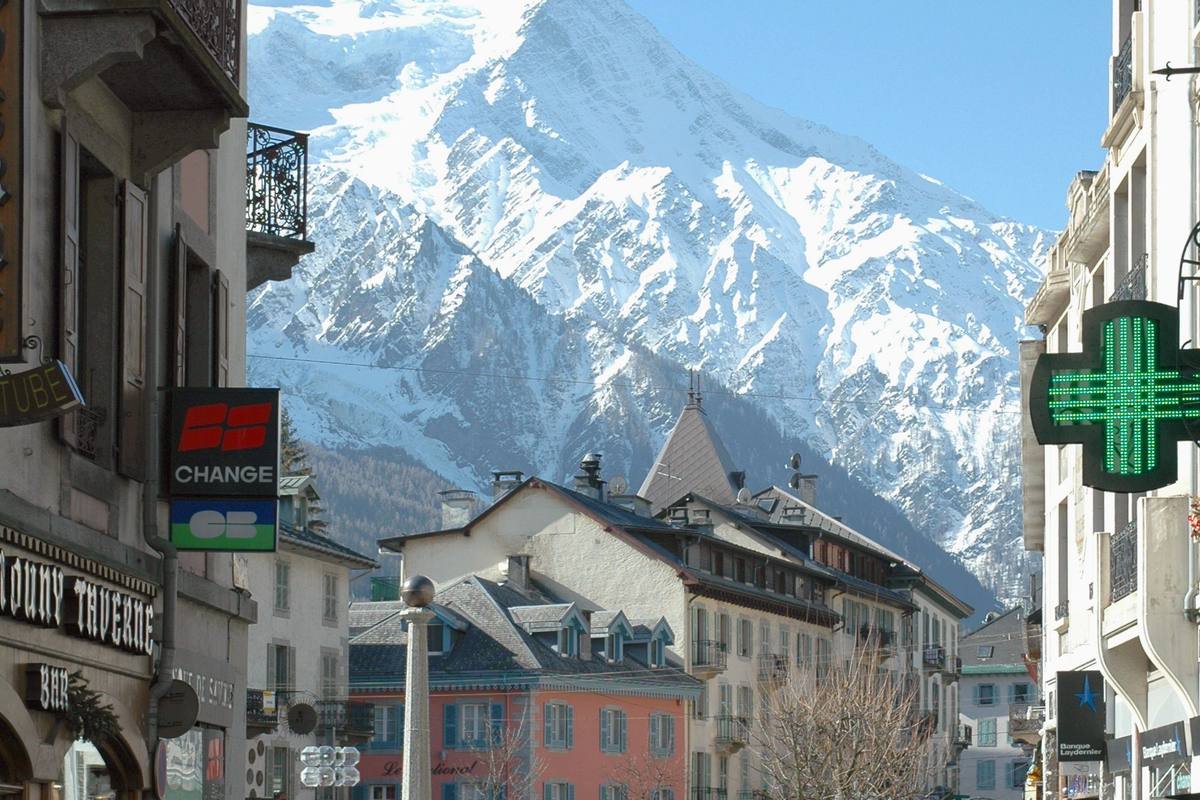
Chamonix-Mont-Blanc is where organized alpinism began, host of the first Winter Olympics in 1924, and it still feels like a town built by and for mountaineers. Mont Blanc is visible from the streets on a clear day, and the Aiguille du Midi cable car — the valley’s most famous single piece of infrastructure, climbing to roughly 3,800 m from a station a few minutes from the center — is deliberately absent from this page’s access matrix: Compagnie du Mont Blanc itself classifies it as an excursion site rather than a ski domain, and this page follows that distinction rather than inventing a looser one.
The town itself is a working year-round settlement of a little under 9,000 people, not a station that empties between seasons, threaded along a narrow valley floor with Mont Blanc’s glaciers on one side and the Aiguilles Rouges on the other. That narrowness is the reason the whole valley works the way it does — there is essentially one road and one railway running its length, which is exactly why a single, well-understood bus and rail network can plausibly replace a car here in a way it could not in a wider, more sprawling resort region.
Climbers, mountain guides and skiers mix here in a way that gives Chamonix a rougher, more international, less manicured feel. That is either the appeal or the drawback, largely depending on what kind of trip is being planned.
Source note: winter 2026/27 timetables for Chamonix Mobilité’s Skibus network were not yet published as of this verification (2026-08-18). Every Skibus frequency and season-window claim on this page reads off the most recently published season (2025/26) and should be rechecked pre-season.
Not sure?
Choose somewhere else if…
- Innsbruck
You want the same separate-sectors-on-public-transport structure with a real city underneath it. Innsbruck trades this valley's separate sectors for a university city, cheaper prices, and buses that are free outright rather than free only with a lift pass.
Full comparison - Morzine
Linked, ski-to-ski mileage matters more than big vertical. The Portes du Soleil connects a dozen sectors by lift rather than by bus.
Full comparison - Jungfrau Region
You want Swiss rail precision instead of a French valley bus network. Wengen, Grindelwald and Mürren are linked by cogwheel trains with no Skibus timetable to learn, but you pay Swiss prices throughout.
This base appears in
Sources & data notes
How this page was verified
Section verification
- Access matrixAugust 18, 2026
- Getting thereAugust 18, 2026
- Getting aroundAugust 18, 2026
- Where to stayAugust 18, 2026
Sources
- Guide Hiver Chamonix 2025-2026 — official winter network brochure — Chamonix Mont-Blanc Tourist Office / Chamonix Mobilité · operator timetable, cited not reproduced · retrieved
- SNCF Connect journey planner — Chamonix-Mont-Blanc to Vallorcine — SNCF Connect (SNCF Voyageurs) · operator timetable, cited not reproduced · retrieved
- Présentation des domaines skiables — Compagnie du Mont Blanc / Mont Blanc Natural Resort — Compagnie du Mont Blanc · official operator site, cited not reproduced · retrieved
- Ligne Chamonix–Courmayeur — fares and route — SAT (merged with Borini, September 2025) · operator fare page, cited not reproduced · retrieved
- Accès Courmayeur avec le forfait Mont Blanc Unlimited — Compagnie du Mont Blanc / Mont Blanc Natural Resort · official operator PDF, cited not reproduced · retrieved
- Practical information about the lifts — per-lift access pages — Chamonix Mont-Blanc Tourist Office · official destination site, cited not reproduced · retrieved
- Chamonix-Mont-Blanc commune — official site — Commune de Chamonix-Mont-Blanc · official commune site, cited not reproduced · retrieved
- Chamonix Mobilité — valley bus network operator site — Chamonix Mobilité · operator timetable, cited not reproduced · retrieved
- Chamonix Mobilité — shuttles and public transport overview — Chamonix Mont-Blanc Tourist Office · official destination site, cited not reproduced · retrieved
- La carte d'hôte — Chamonix valley guest card — Chamonix Mont-Blanc Tourist Office · official destination site, cited not reproduced · retrieved
- Transports de Martigny et Régions — Mont-Blanc Express (Swiss section) — TMR SA (Transports de Martigny et Régions) · operator site, cited not reproduced · retrieved
Images

Page last reviewed August 18, 2026. Transit routes, schedules and fares change between seasons — check the operator before you travel. Mountain specifications for the northeastern US are maintained separately on NESKIS.