Morzine, Avoriaz & the Portes du Soleil
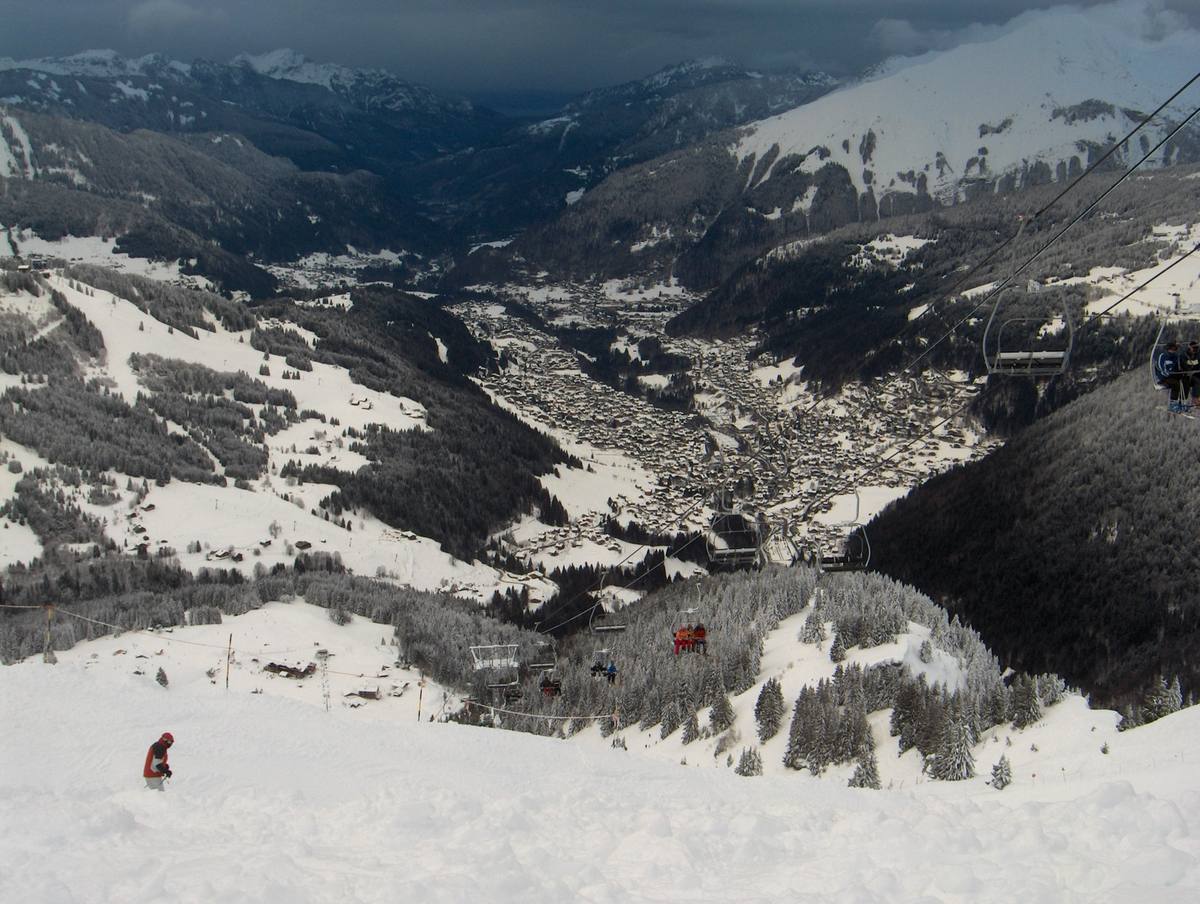
Two separate lift systems you can walk to, a four-minute cable car to a car-free station at 1,800 m that sits on the same commune, and a lift network that crosses into Switzerland — under a village base at roughly 1,000 m that loses its snow before anywhere else in the circuit.
The core trip works without a car, but a car materially expands your lodging, evening or mountain choices. Verified August 20, 2026.
Evenings21:25
At a glance
- Ski areas
- 14
- Within 30 min
- 6
- Closest
- 8 minWalk
- Reachable by transit
- 11 of 14
- Arriving from
- Geneva Airport1h 30m by public bus
- Groceries on foot
- YesYear-round town
The verdict
Verdict
Come for a working slate-roofed town below an enormous ski circuit. Choose between two bases. One is the village at 1,000 m. The other is a purpose-built car-free station at 1,800 m. Both sit inside the same commune, which is close to unique in the Alps. You can walk to a gondola from the village, ride the Prodains cable car up to Avoriaz in four minutes when the low snow gives out, and ski across an international border and back on one pass.
Do not come for reliable snow at village level. Morzine's own runs are the lowest of any major Portes du Soleil base and the bottom kilometer is the first thing to go. Do not come expecting the twelve linked resorts the marketing promises either: two of them are not on the lift-linked circuit at all, one is a single gondola, and the far Swiss end is a committed day out rather than a lunch stop.
Is this base for you?
Who this suits
Best for
- Intermediates who measure holidays in kilometers. The Portes du Soleil links Morzine through Avoriaz and Chatel into a cross-border circuit with enormous cruising mileage.
- Mixed groups with incompatible ski plans. One party can use Avoriaz's freestyle terrain while another cruises Les Gets, with free village transport returning both to Morzine.
- Families wanting a real town. The center has supermarkets, a pharmacy, schools and the Pleney gondola, rather than only the shops supplied by a purpose-built base.
Depends on you
- Morzine at about 1,000 meters. You get an old slate-roofed town and lifts on foot, while higher Avoriaz offers more dependable snow from a 1960s concrete resort station.
- The Portes du Soleil circuit. It rewards long point-to-point exploration across France and Switzerland, but remote sectors depend on making the final lift connections home.
- The anglophone seasonal scene. English-language jobs and services make a winter easier to enter, while the town can feel more like a British chalet destination than a French village.
The honest part
Things you should know
- 01
Morzine village sits at about 1,000 m and its own runs are the lowest of any major Portes du Soleil base. In a thin January the bottom kilometer off Le Pléney is slush by two o'clock and bare patches by March. The working response is to stop skiing home and download the gondola, or move the whole day to Avoriaz at 1,800 m — which is what everyone else does, which is why the Prodains queue exists at nine in the morning.
- 02
The "twelve resorts of the Portes du Soleil" is marketing, not a lift map. Saint-Jean-d'Aulps (Roc d'Enfer) and Abondance are not on the lift-linked circuit at all — reaching either means a road journey — and Montriond as a resort amounts to the single Ardent gondola. Buy the pass for the eight or nine places that are genuinely connected, and treat the other three as separate outings you have to plan.
- 03
The two lift systems you can walk to from the village are not connected to each other. Le Pléney feeds the Les Gets side; Super Morzine feeds the Avoriaz side. You commit at breakfast, and if you commit wrong the fix is the free Petit Train across town or a fifteen-minute walk in ski boots. Nothing about the piste map warns you, and it is the single most common first-day mistake here.
The access matrix
What you can ski from Morzine
Typical door-to-lift times in normal winter conditions. ● marks areas reachable on published transit during ski hours. Every row is dated below.
- On foot or skis
- Public transport
- Lift from town
- Needs a vehicle
| Ski area | Getting there | Time | Best for | Main drawback |
|---|---|---|---|---|
| Transit-served. Morzine – Le Pléney | WalkWalk from the village center · every free navette line ends at Le PléneyEvidence & assumptions for Morzine – Le PléneyEstimated on foot from Place du Baraty in the village center; the Pléney gondola base sits at the top of the village. Every free navette line also terminates at Le Pléney. Source [1] Navettes Morzine — winter free-shuttle timetable (20 Dec 2025 – 6 Apr 2026) — verified August 16, 2026 | [1] | Intermediates who want mileage, and anyone skiing straight from a village bed | The lowest base in the circuit — the bottom kilometer goes slushy or bare first |
| Transit-served. Super Morzine – Zore | WalkWalk across the Dranse · free Petit Train from Le Pléney ~08:30–17:50Evidence & assumptions for Super Morzine – ZoreEstimated on foot from the village center, across the Dranse. Super Morzine is NOT linked to Le Pléney — the free Petit Train runs between the two bases, roughly 08:30 to 17:50. Source [1] Navettes Morzine — winter free-shuttle timetable (20 Dec 2025 – 6 Apr 2026) — verified August 16, 2026 | [1] | Getting onto the Avoriaz side without queueing for the cable car | Three lifts and a traverse before you reach anything worth skiing |
| Transit-served. Morzine – Nyon | Resort shuttleFree navette Line N from Le Pléney · 7 min ride · first 08:10, last 17:30Evidence & assumptions for Morzine – NyonFree navette Line N, Le Pléney to Téléphérique de Nyon in 7 minutes (08:10 first departure, 17:30 last from Le Pléney). Door-to-lift figure includes a typical wait. Source [1] Navettes Morzine — winter free-shuttle timetable (20 Dec 2025 – 6 Apr 2026) — verified August 16, 2026 | [1] | A quieter way into the Chamossière ridge and the Les Gets link | Line N runs only every 20–30 minutes, so the wait is most of the journey |
| Transit-served. Ardent & Les Lindarets | Resort shuttleFree Montriond navette ligne M · ~every 30–60 min · last back from Ardent 18:15Evidence & assumptions for Ardent & Les LindaretsThe free Montriond navette, ligne M — Morzine–Lac de Montriond–Ardent on the commune's winter sheet — roughly every 30 to 60 minutes, twenty minutes on the bus, last run back from Ardent at 18:15. Its sister ligne Mbis never leaves Montriond, which catches people out on the way home. Door-to-gondola total is estimated. Source [4] Navettes de Montriond, lignes M et Mbis — winter timetable (12 Dec 2025 – 19 Apr 2026) — verified August 20, 2026 | [4] | The fastest way to the Châtel side and the Abricotine descent | One gondola is the entire resort — if Ardent is on wind hold, the day restarts |
| Transit-served. Vallée de la Manche | Resort shuttleFree navette Line E to L'Érigné · 17 min rideEvidence & assumptions for Vallée de la MancheFree navette Line E, Le Pléney to L'Érigné in 17 minutes. Marked cross-country trails in the Manche valley are free of charge; the Pléney-Chavannes nordic loop needs a paid pass. Source [1] Navettes Morzine — winter free-shuttle timetable (20 Dec 2025 – 6 Apr 2026) — verified August 16, 2026 | [1] | Free cross-country skiing with no pass and no lifts at all | 1,100–1,400 m and valley-bottom — the trails thaw early and often |
| Transit-served. Avoriaz | Cable carNavette Line A every 15 min from 08:00 · Prodains Express 4 min · skiers 08:45–17:15Evidence & assumptions for AvoriazFree navette Line A runs Le Pléney to Les Prodains every 15 minutes, 15 minutes end to end, first bus 08:00. Prodains Express (3S, 2013) takes 4 minutes; skiers 08:45–17:15, pedestrians from 07:00 to 21:00 Mon–Thu, midnight Fri–Sat and 22:00 Sun, with a 19:30–20:00 break. Source [2] Prodains Express cable car — Les Prodains to Avoriaz 1800 — verified August 16, 2026 | [2] | Altitude, freestyle terrain, and the hub of the linked skiing | Peak-morning queues at Prodains, and an exposed plateau where wind is a day-of check |
| Transit-served. Saint-Jean-d'Aulps | Public busBalad'Aulps Bus · €1.70 · stops at Grande Terche base · winter timetable unverifiedEvidence & assumptions for Saint-Jean-d'AulpsBalad'Aulps Bus, €1.70, with a stop at the Grande Terche gondola base. Journey time estimated and the winter timetable is not verified here — check before relying on it. Source [3] L'offre de transport — Haut-Chablais public transport summary — verified August 16, 2026 | [3] | Steep, quiet, uncrowded skiing under the Roc d'Enfer | Not on the lift circuit at all — you go by road, and you come back by road |
| Transit-served. Les Gets | Lift from townSki over Le Pléney on the linked pass · road fallback Y91/Y92 coach €1.70 · check times in DecemberEvidence & assumptions for Les GetsEstimated over Le Pléney and the Belvédère ridge to the Chavannes — the lift company sells Morzine and Les Gets as one linked domain on a single pass. The road fallback when the link closes is the Cars Région Y91 or Y92 coach, €1.70; their winter sheets are reissued each season, so check times in December. Source [5] Winter ski passes — Morzine-Les Gets and Portes du Soleil — verified August 20, 2026 | [5] | Tree skiing in bad visibility and a gentler, family-shaped mountain | Skiing over the top commits you to skiing back before the last lift |
| Abondance | DriveVia the D22 and Col du Corbier · a closed col roughly doubles the drive via ThononEvidence & assumptions for AbondanceEstimated by road via the D22 and the Col du Corbier. When the col is closed the detour via Thonon roughly doubles the drive. Current operating status not verified. Verified August 16, 2026 | A small, cheap, entirely local hill with no visitors on it | No lift link and no direct bus — and the Col du Corbier can be shut | |
| Transit-served. Champéry – Les Crosets | Lift from townLifts via Avoriaz and the Chavanette col · needs the full Portes du Soleil passEvidence & assumptions for Champéry – Les CrosetsEstimated via Avoriaz and the Chavanette col. Needs the full Portes du Soleil pass, not the Morzine–Les Gets one. Both the Swiss Wall and the parallel chair are weather-dependent. Source [9] Champéry — Portes du Soleil official resort page — verified August 20, 2026 | [9] | North-facing Swiss snow and the best views in the circuit | The Chavanette crossing is the pinch point, and Swiss prices apply at lunch |
| Transit-served. Châtel | Lift from townLigne M to Ardent, then lifts over Les Lindarets · no direct bus from MorzineEvidence & assumptions for ChâtelEstimated: the Montriond navette (ligne M) to Ardent, then the gondola and the Chaux Fleurie chain over Les Lindarets to Plaine Dranse. Châtel is not directly bus-linked to Morzine; the road route goes round via the Col du Corbier. Source [4] Navettes de Montriond, lignes M et Mbis — winter timetable (12 Dec 2025 – 19 Apr 2026) — verified August 20, 2026 | [4] | North-facing pitch at Linga and Pré-la-Joux | A chain of six or seven lifts each way, with no bus home if one of them stops |
| Transit-served. Morgins | Lift from townLifts two ways · via Les Crosets–Champoussin or Super-Châtel–Pas de MorginsEvidence & assumptions for MorginsEstimated. Reachable two ways — via Les Crosets and Champoussin, or via Super-Châtel and the Pas de Morgins — which is why it is more dependable than Torgon. Champéry, Les Crosets, Champoussin and Morgins are one operator's network on the Swiss side. Source [10] Morgins — Portes du Soleil official resort page — verified August 20, 2026 | [10] | A long point-to-point day and the quietest pistes on the Swiss side | Nearly two hours of lifts each way, so a late start ends the plan |
| La Chapelle-d'Abondance | Lift from townLift-linked only via Super-Châtel · plan a taxi budget for the returnEvidence & assumptions for La Chapelle-d'AbondanceEstimated. Lift-linked, but only through Châtel's Super-Châtel side; treat it as a one-way day with a taxi budget rather than a guaranteed round trip. Source [11] La Chapelle d'Abondance — Portes du Soleil official resort page — verified August 20, 2026 | [11] | Quiet pistes at the edge of the Portes du Soleil, on a good day | A single-thread return over Braitaz and Super-Châtel with no scheduled bus home |
| Torgon | Lift from townLifts out, no scheduled service back · turn round by early afternoonEvidence & assumptions for TorgonEstimated. A spur, not a loop, and there is no scheduled service back to Morzine from the Swiss Chablais. Turn round by early afternoon or plan on a long, expensive taxi. Source [12] Torgon — Portes du Soleil official resort page — verified August 20, 2026 | [12] | Lake Geneva views and the sense of having skied somewhere remote | The far end of the circuit — getting back to Morzine the same day is not assured |
Sourcing note. Morzine-side rows cite the registered winter navette timetable, the Prodains Express operator record and the Haut-Chablais transport authority’s records. The Ardent and Châtel approaches cite the Commune de Montriond’s lignes M/Mbis sheets, Les Gets cites the Morzine lift company’s linked-domain pass page with the Y91/Y92 coach records for the road fallback, and the Swiss rows cite the Portes du Soleil association and Swiss operator pages. Lift-chain journey times remain editorial estimates — the operators publish routes and passes, not door-to-door minutes.
Where to stay
Morzine village center is the default and the right answer for most people. It is a real town before it is a resort — supermarkets, a pharmacy, a school, a church with a slate spire, and bars that stay open in April. From Place du Baraty you can walk to the Pléney gondola in under ten minutes, and every free navette line in the valley begins at the Pléney base, so the whole shuttle network radiates from where you already are. The cost is altitude: you are at about 1,000 m, and in a poor year that is the difference between skiing to your door and walking the last few hundred meters.
The Super Morzine side, across the Dranse on the Route de la Plagne, is the better base if you intend to ski Avoriaz most days. It is quieter, slightly cheaper, and puts you on the correct lift system in the morning rather than the wrong one. The tradeoff is that the restaurants and the supermarkets are back over the bridge.
Avoriaz 1800 is the other philosophy entirely, and the unusual thing about Morzine is that you can pick it without changing valleys — Avoriaz sits on Morzine’s own commune. It is car-free, at altitude, ski-in from almost every door, and the snow is dependable in a way the valley’s is not. It is also a 1960s concrete station with no old town underneath it, evenings that are what the station provides and nothing else, and a cable car or a snow-chained road as the only way down.
Les Prodains is the compromise nobody advertises: the hamlet at the foot of the cable car, four minutes from Avoriaz’s lifts and fifteen minutes by free bus from Morzine’s restaurants. It is dead quiet at night. Montriond and Ardent put you next to the fastest access to the Châtel side, at the price of depending on the Montriond navette (lignes M and Mbis) for everything.
Getting there
There is no railway station in the valley, and that is the honest headline. Every arrival ends with a road leg.
Geneva airport is the usual gateway, roughly 75 to 90 minutes by road depending on the route and the traffic on a Saturday changeover. Scheduled shared shuttles and private transfer operators run the route all winter; this is the standard way in and it works without a car.
By rail, the nearest stations are Cluses (about 30 km) and Thonon-les-Bains (about 32 km), and both are connected onward by Cars Région coaches — line Y92 from Cluses, line Y91 from Thonon. It is a genuine car-free chain from Paris or Geneva, but it is a chain, and the final coach leg is infrequent enough that a missed connection costs you an afternoon. Journey times on those two coach lines are not verified here.
By road, the two approaches are via Cluses, Taninges and Les Gets, or via Thonon and the Vallée d’Aulps. Both are ordinary valley roads rather than passes, which is one of Morzine’s quiet advantages — there is no high col between you and the motorway.
Getting around
Start with the correction, because it shapes everything else. The Portes du Soleil markets itself as twelve linked resorts. It is not twelve. Saint-Jean-d’Aulps — the Roc d’Enfer, a genuinely good steep little area — is not on the lift-linked circuit; you reach it by road. Abondance is not linked to anything either. And Montriond, listed as a resort, is in practice the Ardent gondola and the village around it. What you are actually buying is a large, impressive, cross-border circuit of eight or nine connected areas, plus three separate places that happen to share a lift pass.
The second correction is local. Le Pléney and Super Morzine, the two lift systems you can walk to, are not connected to each other. Pléney sends you toward Les Gets; Super Morzine sends you toward Avoriaz. The free Petit Train shuttles between the two bases through the middle of town, roughly 08:30 to 17:50, and it exists precisely because this catches people out.
What works well is the free navette network. Morzine’s lines A, U, D, E, N and C all run from Le Pléney and cost nothing, and Montriond’s free lignes M and Mbis cover Montriond, the lake and the Ardent gondola — M from stops across the Dranse in Morzine, Mbis within Montriond only. Line A is the important one — Le Pléney to Les Prodains, every fifteen minutes, fifteen minutes end to end, first departure 08:00 and last bus back into the village at 21:25. That late service is unusual for a French ski village and it is what makes an evening in Avoriaz, or a late finish at the cable car, actually workable.
The Prodains Express is the spine of the whole system: a 3S cable car opened in 2013, four minutes bottom to top, skiers from 08:45 to 17:15 and pedestrians from 07:00 until 21:00 Monday to Thursday, midnight on Friday and Saturday and 22:00 on Sunday, with a service break between 19:30 and 20:00. Between Line A and the Prodains Express you can live in Morzine, ski Avoriaz, and eat dinner in either place without owning a car.
For the valley villages there is the Balad’Aulps Bus at €1.70 a journey, linking Morzine with Montriond, Essert-Romand, Saint-Jean-d’Aulps and further down the Vallée d’Aulps — it is the only public way to reach the Roc d’Enfer. Les Gets is not on it: the road link between Morzine and Les Gets is the Cars Région Y91/Y92 coach, also €1.70.
Where the car earns its keep is Abondance, the Col du Corbier route to Châtel when the lifts are shut, an early start on a powder morning, and the airport run on a changeover Saturday.
Who it suits
- Intermediates who measure a holiday in kilometers. This is the strongest case. The linked circuit is genuinely vast and almost all of it is blue and red — you can ski somewhere new every day for a week without repeating a lift.
- Mixed groups who cannot agree. One party skis Avoriaz’s freestyle terrain, another cruises Les Gets, a third goes to Switzerland for lunch, and everyone meets in Morzine at six.
- Families who want a town. A working village with shops and a hospital route beats a purpose-built station for anyone traveling with children who do not ski every day.
- Anyone deciding between village charm and altitude convenience. You can try both from the same base, which almost nowhere in the Alps allows.
It suits experts least. Avoriaz has serious off-piste and the Swiss Wall is a real pitch, but the circuit’s character is mileage, not steepness, and a week of it will bore a strong skier. It also suits anyone traveling in a warm early season badly — the valley snow is the first in the region to fail.
Living for a season
Morzine is a year-round commune of roughly 2,658 people, not a station that empties in April. Before tourism the economy was slate — the quarries are why the roofs look the way they do — and the town still has the institutional furniture of a real place: a medical center, schools, a supermarket you can walk to, and a summer mountain-biking economy that is nearly as large as the winter one. The nearest hospital is at Thonon-les-Bains, roughly fifty minutes down the valley.
The seasonal workforce here is unusually anglophone, because Morzine has been a British chalet-holiday town for decades. That is a double-edged fact. It means jobs are advertised in English and a season is easy to arrange socially; it also means the market is competitive and, since Brexit, that UK nationals need work authorization they did not previously need. Check your visa position before you book a flight — this is the single most common way a planned season falls apart.
Housing is tight in the way every desirable Haute-Savoie resort is tight: short-term letting has absorbed a large share of the stock, and the winter-let market prices for tourists rather than workers. Employer-provided accommodation is common and worth taking seriously.
What the town is like
Morzine looks like what it is: a Chablais slate town that grew into a resort rather than a resort that invented a town. The buildings are dark-roofed and low, the Dranse runs through the middle of it, and the street layout was not designed around a lift base. It is not picture-postcard in the way Megève is — there is plenty of 1970s and 1980s building along the valley floor — but it is recognisably a place where people live.
Twenty minutes up the mountain, Avoriaz is the deliberate opposite: Jacques Labro’s angular cedar-shingled towers on a shelf at 1,800 m, no cars, luggage moved by horse-drawn sledge, and an architectural argument that people either admire or find grim. That both of these exist inside one commune is the most interesting thing about the destination, and it is what you are really choosing between when you book.
The British presence is impossible to miss. A large share of the chalets, bars and ski schools are British-run, and in February half the conversations you overhear will be in English. Some people find that reassuring and some find it a reason to book elsewhere. Neither reaction should be a surprise on arrival.
Not sure?
Choose somewhere else if…
- Chamonix
You want serious mountains rather than a long cruising circuit, and you want a railway station in the valley. Chamonix has real vertical, real glaciers and a train that runs the length of the valley — but the skiing is split across separate areas you must bus between, and none of it is beginner-shaped the way Morzine is.
Full comparison - Bourg-Saint-Maurice
Arriving without a car is the point. Bourg has a mainline station with direct winter trains from Paris and London and a funicular to Les Arcs from the platform. Morzine has no railway at all — the last leg is always a bus or a transfer van from Geneva, Cluses or Thonon.
Full comparison - Davos & Klosters
You want the mountains linked by trains rather than by chairlifts. Davos gives you five separate ski areas joined by a dense Swiss rail and bus network at reliable altitude — slower between mountains than a lift chain, but it does not stop working when the wind gets up.
This base appears in
Sources & data notes
How this page was verified
Section verification
- Access matrixAugust 16, 2026
- Getting thereAugust 16, 2026
- Getting aroundAugust 16, 2026
- Where to stayAugust 16, 2026
Sources
- Prodains Express cable car — Les Prodains to Avoriaz 1800 — Avoriaz (avoriaz.com) · operator timetable, cited not reproduced · retrieved
- L'offre de transport — Haut-Chablais public transport summary — Communauté de communes du Haut-Chablais · public authority page, cited not reproduced · retrieved
- Winter ski passes — Morzine-Les Gets and Portes du Soleil — SAS Domaine de Loisirs de Morzine (ski-morzine.com) · operator page, cited not reproduced · retrieved
- Line Y91 timetable — Thonon-les-Bains / Morzine / Les Gets — Cars Région Haute-Savoie (Région Auvergne-Rhône-Alpes) · operator timetable, cited not reproduced · retrieved
- Line Y92 timetable — Cluses / Morzine — Cars Région Haute-Savoie (Région Auvergne-Rhône-Alpes) · operator timetable, cited not reproduced · retrieved
- Portes du Soleil Suisse SA — Champéry, Les Crosets, Champoussin, Morgins — Portes du Soleil Suisse SA · operator page, cited not reproduced · retrieved
- Champéry — Portes du Soleil official resort page — Association des Portes du Soleil · operator page, cited not reproduced · retrieved
- Morgins — Portes du Soleil official resort page — Association des Portes du Soleil · operator page, cited not reproduced · retrieved
- La Chapelle d'Abondance — Portes du Soleil official resort page — Association des Portes du Soleil · operator page, cited not reproduced · retrieved
- Torgon — Portes du Soleil official resort page — Association des Portes du Soleil · operator page, cited not reproduced · retrieved
- Northeast resort profiles — NESKIS · sibling property; mountain specifications maintained there · retrieved
Images
Page last reviewed August 20, 2026. Transit routes, schedules and fares change between seasons — check the operator before you travel. Mountain specifications for the northeastern US are maintained separately on NESKIS.