The best multi-mountain ski bases
The bases where one bed buys the most different skiing — ranked by published matrix size, with every row carrying a stated travel time by mode.
At a glance
| Base | Where | Car-free reach | Evenings | Car |
|---|---|---|---|---|
| Morzine, Avoriaz & the Portes du Soleil | France | 11 of 14 areas | Limited | |
| Salt Lake City as a Ski Base | United States | 7 of 12 areas | Good | |
| Echigo-Yuzawa: Skiing from the Shinkansen | Japan | 11 of 11 areas | Limited | |
| Bourg-Saint-Maurice & the Tarentaise | France | 10 of 11 areas | Limited | |
| Davos & Klosters | Switzerland | 10 of 10 areas | Limited | |
| Innsbruck as a Ski Base | Austria | 10 of 10 areas | Limited | |
| The Jungfrau Region: Wengen, Mürren, Grindelwald & Lauterbrunnen | Switzerland | 10 of 10 areas | Good | |
| North Conway & Mount Washington Valley | United States | 1 of 10 areas | None |
This ranking uses one number — lift-served areas in the destination’s published access matrix — and every row behind that number carries a travel time by mode. Big matrices built on honest rows win.
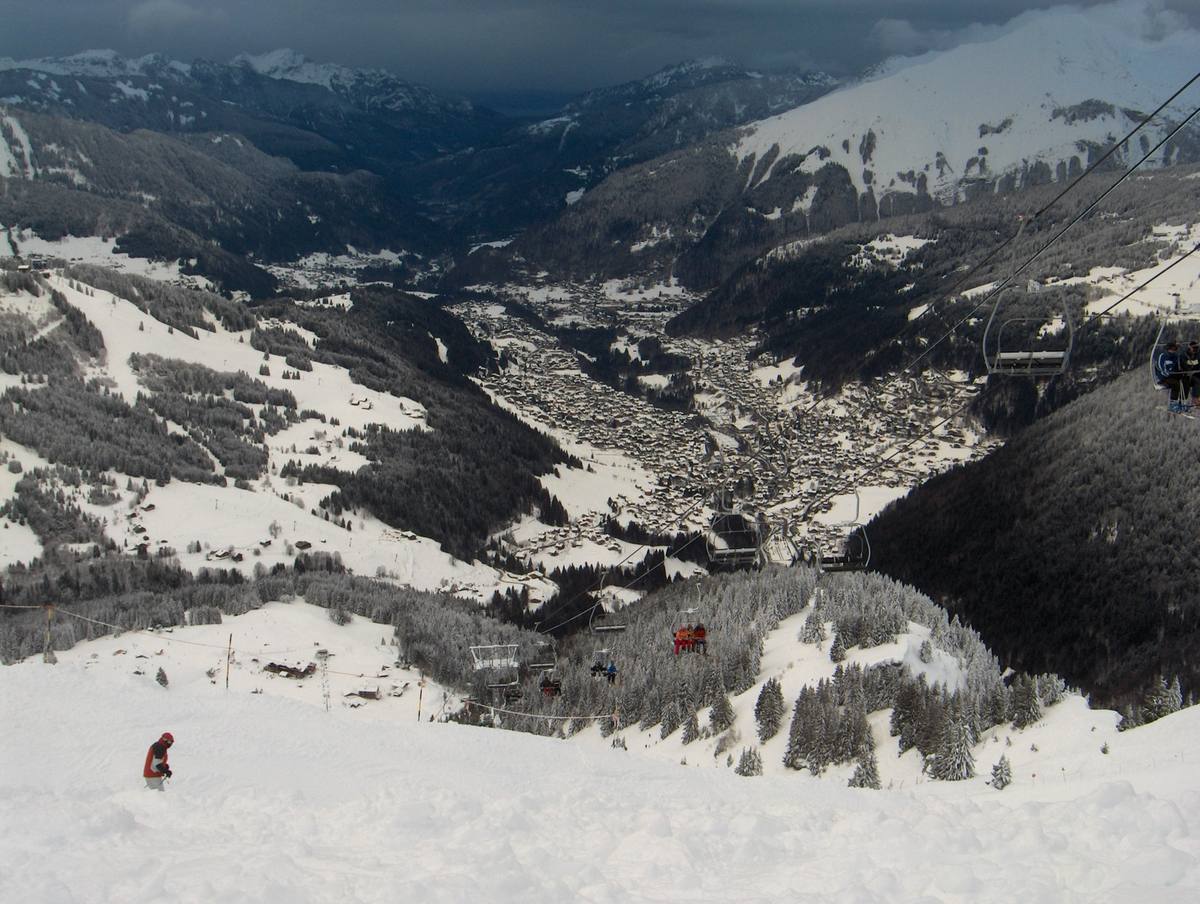
Morzine — 14 areas. The largest honest matrix on the site, spanning a lift domain that crosses into Switzerland — with the page itself flagging which “linked” resorts of the Portes du Soleil actually aren’t on the circuit.
Salt Lake City — 12 areas. Six major mountains inside an hour of a metro of 1.2 million. Nowhere else in North America is close; the page’s claim is that you could ski a different resort every day of a week without repeating.
Echigo-Yuzawa — 11 areas. Eleven lift-served areas hang off one railway station, one of them with its own Shinkansen platform 75 minutes from Tokyo. The densest rail-to-ski geometry in the world.
Bourg-Saint-Maurice — 11 areas. The Tarentaise — the highest concentration of major ski terrain in the world — from a valley rail terminus with a funicular in the station building.
Davos–Klosters — 10 areas. Six home mountains across two towns and four railway stations, plus neighbors; the matrix is rail-shaped rather than bus-shaped.
Innsbruck — 10 areas. Ten areas by published scheduled bus from one railway station — the existing comparisons publish distance; the page publishes time.
The Jungfrau Region — 10 areas. Three valleys of skiing from interconnected rail, including the two road-less villages.
North Conway — 9 areas. The Eastern anchor: five mountains within thirty minutes of one walkable village, nine in the matrix. No other base east of the Rockies has that density.
Considered and excluded
- Hakuba — eight areas on one shuttle line is a strong claim, but our Japan pick for breadth is Echigo-Yuzawa's eleven areas off one railway station.
- Vail & the Eagle Valley — eight matrix rows, but two giants dominate; it is a two-mountain destination with satellites, and its page frames it that way.
- The Berkshires — six to nine areas within reach, honestly counted, but they are small hills; that page sells the downtowns, not the density.