Echigo-Yuzawa: Skiing from the Shinkansen
Eleven lift-served ski areas hang off one railway station, one of them has its own Shinkansen platform 75 minutes from Tokyo, and the town behind it is stacked with half-empty bubble-era condo towers — the cheapest place on earth to spend a winter without a car.
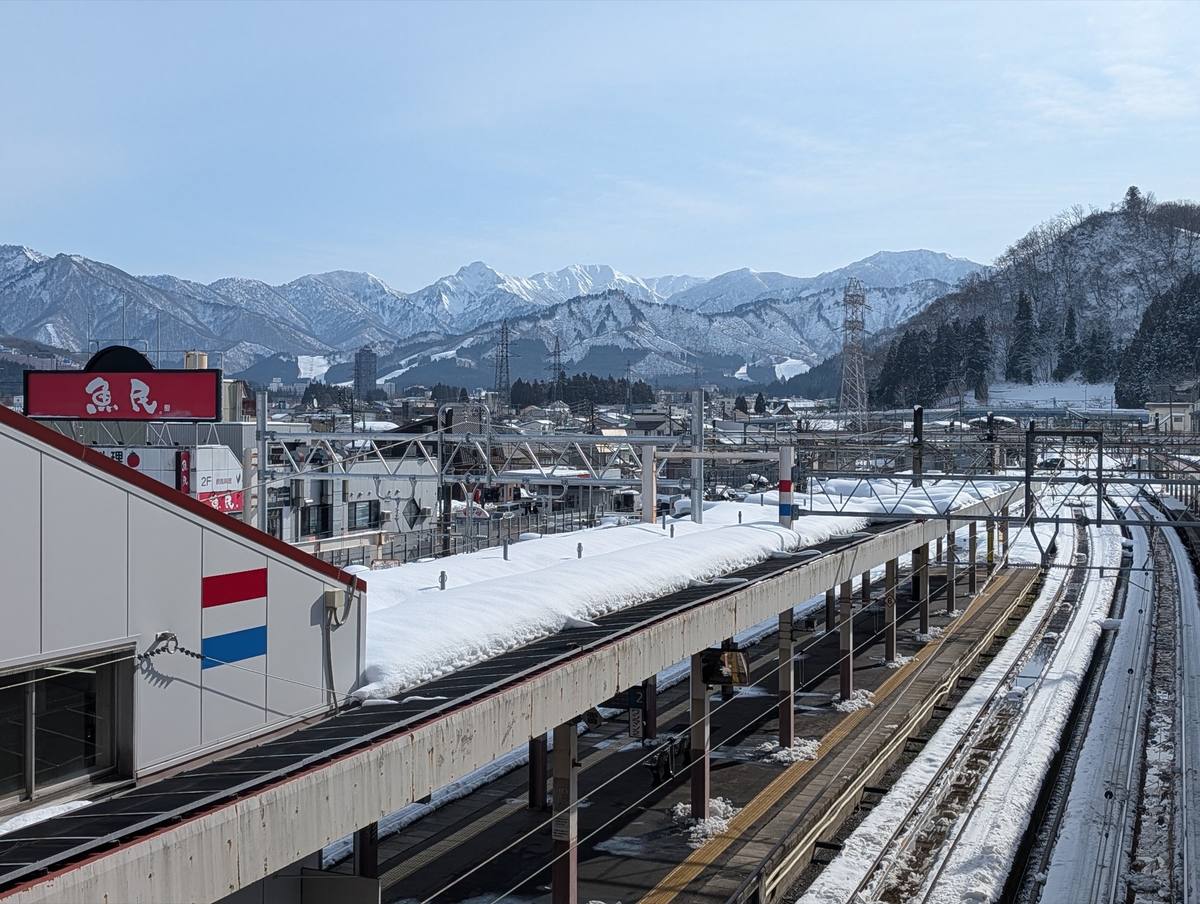
Car-free arrival is practical, daily needs are walkable or transit-served, and at least 80% of the ski areas in this page’s matrix are reachable on published transit during normal ski hours. Verified August 20, 2026.
EveningsResort day shuttles finish with the lifts — Ishiuchi advertises its station shuttle "until normal operations end" and Iwappara's last run reaches the station at 17:45 on weekdays, 18:35 at weekends; the paid Naeba-line bus returns as late as 20:20; Kandatsu's night-ski shuttle times remain unverified
At a glance
- Ski areas
- 11
- Within 30 min
- 8
- Closest
- 10 minResort shuttle
- Reachable by transit
- 11 of 11
- Arriving from
- Tokyo Station (Jōetsu Shinkansen)1h 17m by train
- Groceries on foot
- YesYear-round town
The verdict
Verdict
Come here if you do not own a car. Yuzawa has the densest concentration of lift-served skiing around a single railway station. One of those areas, GALA, has a Jōetsu Shinkansen platform at its base. It is about 75 minutes from Tokyo Station. Eleven areas, free resort shuttles from the station forecourt, two JR local stations that open onto snow, and an onsen town with supermarkets, a clinic and several hundred beds inside a walk. Nothing in the Alps matches the arrival.
Do not come for the skiing itself. The near cluster is low, warm and short on pitch; in a mild February the bottom third of Ishiuchi is slush, and the honest answer is a paid bus up to Kagura. Do not come for the evenings either — shuttles stop when the lifts do, much of the lodging stock is self-catering condo tower with nothing at street level, and the eating is a few blocks by the station. Hakuba skis better. Nothing gets you there faster than this.
Is this base for you?
Who this suits
Best for
- Short-trip skiers from Tokyo. The Joetsu Shinkansen reaches Echigo-Yuzawa in about 75 minutes, and GALA has a winter-only platform at the ski area itself.
- Beginners who want several gentle options. Yuzawa Nakazato, Joetsu Kokusai and Iwappara offer broad easy terrain reached by local train or station shuttle.
- Mixed groups with a non-skier. The onsen town has supermarkets, baths and the station's sake museum, so a day need not depend on following the resort shuttle.
Depends on you
- Eleven areas around one station. It is exceptional choice for a sampler, and a timetable-and- shuttle puzzle for anyone who would rather settle into one mountain.
- The bubble-era condo towers. They make heated apartments with rooftop hot springs unusually attainable, while leaving parts of town half-occupied and quiet on midweek evenings.
- The low near-town cluster. Ishiuchi, Iwappara, Kandatsu and Yuzawa Kogen are quick to reach, but warm storms send skiers toward higher Kagura and its paid bus.
The honest part
Things you should know
- 01
Gala-Yuzawa station only exists in winter. It opens in mid-December, shuts in early May, and only the Tanigawa services call there — roughly a dozen a day, some weekend-only. Miss one at Tokyo Station and you either wait an hour or ride to Echigo-Yuzawa and take a shuttle back up the hill, which undoes the entire point of the place.
- 02
The near cluster is low and wet. Ishiuchi, Iwappara, Kandatsu and Yuzawa Kogen all start close to the valley floor, and in a mild February the bottom third of every one of them is slush while it is snowing at Kagura's 1,845 m summit. The dependable snow is a 35-minute ride away on a paid bus, not a free shuttle.
- 03
Evenings are thin. Every resort shuttle stops when its lifts do, there is no network linking the areas to each other, and a large share of the lodging is self-catering bubble-era condo tower with nothing at street level. Dinner means the few blocks around the station, your own building's restaurant, or a konbini bag.
The access matrix
What you can ski from Echigo-Yuzawa
Typical door-to-lift times in normal winter conditions. ● marks areas reachable on published transit during ski hours. Every row is dated below.
- On foot or skis
- Public transport
- Lift from town
- Needs a vehicle
| Ski area | Getting there | Time | Best for | Main drawback |
|---|---|---|---|---|
| Transit-served. NASPA Ski Garden | Resort shuttleHotel shuttle ~3 min, NASPA guests only · others use the four-resort shuttle or a taxiEvidence & assumptions for NASPA Ski GardenThe hotel's access page states the shuttle ride at about three minutes from the station and labels it guests-only; anyone else uses the joint four-resort winter shuttle (NASPA is one of its four named operators) or a taxi up what the hotel calls a continuously climbing road. Door-to-lift figure is estimated. Source [3] NASPA New Otani access page (shuttle bus) — verified August 20, 2026 | [3] | Skiers only — no snowboards, so the pistes stay tidy | Small and priced as a hotel amenity; the hotel's own shuttle is for NASPA New Otani guests only |
| Transit-served. Yuzawa Kogen | WalkWalk 8–10 min from the West exit · ropeway every 10–20 minEvidence & assumptions for Yuzawa KogenThe operator puts the walk at 8–10 minutes from the station's West exit through the onsen street; the 166-person ropeway — its own claim of world's-largest-class — runs every 10–20 minutes and takes about seven minutes up. Source [4] Yuzawa Kogen winter ropeway page (観光ロープウェイ) — verified August 20, 2026 | [4] | A half-day you can start on foot from your own hotel | One 166-person ropeway is the only way up and the only way down when the lower runs ice over |
| Transit-served. GALA Yuzawa | Resort shuttleFree shuttle from Yuzawa beds · usually quicker than riding the Shinkansen one stopEvidence & assumptions for GALA YuzawaGala-Yuzawa is its own Jōetsu Shinkansen station — you walk out of the ticket gate into the ski center. From a bed in Yuzawa the free shuttle bus is usually quicker than riding one stop back up the line. Door-to-lift figure is estimated. Source [1] GALA Yuzawa Snow Resort access page — verified August 16, 2026 | [1] | Arriving from Tokyo and skiing the same morning without changing transport | Modest terrain that funnels everyone through one gondola, and the station exists only in ski season |
| Transit-served. Kandatsu | Resort shuttleFree shuttle ~7 min · 3–4 daytime departures · night-ski times unverifiedEvidence & assumptions for KandatsuFree shuttle, advertised at about seven minutes from the station with three or four daytime departures. Late night-ski shuttle times are unverified. Verified August 16, 2026 | Night skiing after a full day somewhere else | Genuinely small in daylight; the terrain will not hold a whole day | |
| Transit-served. Ishiuchi Maruyama | Resort shuttleFree shuttle from the East-exit rotary · ~10 min · runs until operations endEvidence & assumptions for Ishiuchi MaruyamaFree shuttles from the East-exit bus rotary, about 10 minutes per the resort's access page, which says its direct and in-resort loop buses run until normal operations end. Shares the Yuzawa Snow Link pass with GALA and Yuzawa Kogen. Source [5] Ishiuchi Maruyama access page (free shuttle buses) — verified August 20, 2026 | [5] | The largest of the near cluster and the one worth skiing twice | Low base elevation — the bottom third turns to slush or rain in a warm week |
| Transit-served. Iwappara | Resort shuttleFree shuttle from the East exit · 6–9 min · weekday 10:00–13:00 gap last winterEvidence & assumptions for IwapparaIwappara-Skijōmae on the JR Jōetsu Line sits well below the base — historic naming, not useful access. Use the free shuttle from the East-exit information office, across the crosswalk from the arcade: a 6–9 minute ride, no booking, running weekdays as well as weekends, though last winter's weekday table had no departures between 10:00 and 13:00. Source [6] Iwappara access page (free shuttle timetables) — verified August 20, 2026 | [6] | Long, wide, empty intermediate cruising | Almost nothing steep, and the JR station carrying its name is not actually at the lifts |
| Transit-served. Yuzawa Nakazato | TrainJōetsu Line to Echigo-Nakazato, station at the base · or free shuttle from YuzawaEvidence & assumptions for Yuzawa NakazatoEchigo-Nakazato station opens onto the base. A free shuttle bus from Echigo-Yuzawa also runs; both timings estimated door-to-lift. Source [2] Echigo-Yuzawa station timetable — verified August 16, 2026 | [2] | Beginners and families — the base area is effectively the station platform | Jōetsu Line locals run roughly hourly, so a missed train is a real cost on a short day |
| Transit-served. Maiko | Resort shuttleFree shuttle from the East exit · ~20 min to the hotel, ~30 to the day ski centerEvidence & assumptions for MaikoFree shuttle boards about 80 m right of the East exit at the tourist parking area; the operator states about 20 minutes to Maiko Kogen Hotel and about 30 to the day ski center, on separate hotel and ski-center routes. Source [7] Maiko Snow Resort winter access page (free shuttle) — verified August 20, 2026 | [7] | One long top-to-bottom descent and quieter weekends | Two separate bases — the shuttle to the day ski center runs longer than the one to the hotel |
| Transit-served. Kagura | Public busMinami-Echigo Kotsu bus from stand 1 · 5 weekday morning runs last winter · ¥460 + ¥100/bagEvidence & assumptions for KaguraMinami-Echigo Kotsu buses (formerly Minami-Echigo Kanko) from stand 1 at the East exit — a scheduled 18 minutes to the roadside Mitsumata stop, longer to Tashiro. Last winter's sheet had weekday morning departures at 5:35, 7:40, 8:20, 8:40 and 9:40, two more at weekends; ¥460 plus ¥100 per ski bag. Door-to-lift figure is estimated. Source [9] Kagura ski area winter access page (local bus timetable and station stand map) — verified August 20, 2026 | [9] | The best snow within reach — 1,845 m summit, 1,225 m of vertical, season to early April | A paid local bus rather than a free shuttle, and the Mitsumata ropeway queue at 09:00 is the day's real bottleneck |
| Transit-served. Joetsu Kokusai | TrainJōetsu Line to Jōetsukokusai-Skijōmae at the base · local service is sparseEvidence & assumptions for Joetsu KokusaiJōetsukokusai-Skijōmae station on the JR Jōetsu Line sits in front of the base. Local service is sparse — check the return before you commit. Source [2] Echigo-Yuzawa station timetable — verified August 16, 2026 | [2] | Sprawling beginner and intermediate terrain reached straight off a platform | Spread thin across a wide, low hill; a strong skier will be finished with it by lunch |
| Transit-served. Naeba | Public busMinami-Echigo Kotsu bus · scheduled 38 min · ¥700 + ¥100/bag · hotel shuttle guests-onlyEvidence & assumptions for NaebaMinami-Echigo Kotsu local buses reach the Naeba Prince Hotel stop in a scheduled 38 minutes (¥700 plus ¥100 per ski bag); winter expresses take about 45 because they loop through the Tashiro and Naeba forecourts. The hotel's own free station shuttle is for overnight guests only. Door-to-lift figure is estimated. Source [10] Naeba Prince Hotel / Naeba Ski Resort access page — verified August 20, 2026 | [10] | Big-resort infrastructure and the 5.5 km Dragondola link across to Kagura | An hour each way on a paid bus, and the Prince Hotel complex dominates the base to the exclusion of everything else |
Where to stay
The station area — Yuzawa Onsen is the default and, unusually, also the right answer. Echigo-Yuzawa station is not a park-and-ride on the edge of a resort; it sits in the middle of a working hot-spring town with two supermarkets, a pharmacy, a post office and several hundred beds inside a ten-minute walk. Every free resort shuttle in the valley leaves from the forecourt. If you are here to use the matrix rather than one mountain, stay within sight of the station and nowhere else.
Condo towers are the town’s defining lodging type and deserve a warning. Yuzawa built for a boom that ended in 1991, and the result is a skyline of fifteen-story blocks with onsen baths on the top floor, a lobby, and absolutely nothing else. Many are let nightly through the usual platforms. They are cheap, warm, and have their own hot spring; they are also self-catering, often half-occupied in midweek, and the walk back from town at nine in the evening in horizontal snow is part of the deal.
Slopeside at Naeba or Maiko makes sense only if you have decided the destination is that one mountain. Naeba Prince is a self-contained complex an hour down the valley — good skiing, no town, and a guest-only shuttle that leaves you dependent on it.
Ishiuchi has a pension district at the base with a handful of small owner-run places. It is a real alternative if you want to ski Ishiuchi hard and do not care about the onsen town, but it strands you from the rest of the valley in the evening.
Getting there
The Jōetsu Shinkansen from Tokyo Station reaches Echigo-Yuzawa in about 77 minutes on a Toki or Tanigawa service. That is faster than getting from central London to a decent hill, and it happens a dozen or more times a day.
The part almost nobody writes up properly: GALA Yuzawa has its own Shinkansen station. Gala-Yuzawa is a 1.8 km branch off the line at Echigo-Yuzawa, served by the Tanigawa services, and it opens only for the ski season — mid-December to early May. You walk out of the ticket gate, up an escalator, and you are in the ski center with the gondola in front of you. There is no bus, no transfer, no rental car counter. As of December 2024 there were generally between ten and thirteen departures a day, some running weekends only, so it is worth checking before you commit to a specific train.
From the airports it is less elegant but still simple. Narita or Haneda to Tokyo Station on the Narita Express or the Keikyū/Yamanote combination, then the Shinkansen — allow roughly three to four hours door-to-door from Narita, less from Haneda. Nothing on that chain requires a taxi or a car.
Getting around
Yuzawa runs on free resort shuttle buses leaving from the station forecourt. GALA, Ishiuchi Maruyama, Yuzawa Kogen and NASPA share a joint four-resort shuttle — the Blue Line and Orange Line in the operators’ naming — during the winter link-up period, running roughly every fifteen minutes at the morning and evening peaks. Kandatsu, Iwappara, Maiko and Yuzawa Nakazato each run their own free service. None of it costs anything and none of it needs booking.
Two areas are reached by JR local train instead. Echigo-Nakazato station opens more or less onto the base of Yuzawa Nakazato, and Jōetsukokusai-Skijōmae — the longest station name on the JR network — sits directly in front of Joetsu Kokusai. Both are on the Jōetsu Line, which runs roughly hourly. Check the return train before you buy a lift ticket.
Kagura and Naeba need a paid bus: Minami-Echigo Kotsu — still Minami-Echigo Kanko in most ski write-ups, the company renamed — from stand 1 at the East exit, five weekday morning departures between 5:35 and 9:40 and two more at weekends. This is the one part of the network that requires planning, and it is also the part that reaches the best skiing.
What none of it does is run in the evening. Shuttles finish with the lifts. There is no service linking the areas to each other, so a plan that involves skiing Kagura in the morning and Kandatsu under lights means coming back to the station in between. Kandatsu’s own night-ski shuttle is the only late service we found, and we have not verified its current timetable.
Editorial note: every shuttle and bus row is now backed by the operator’s own page except Kandatsu, whose site refuses connections from outside Japan; its row and its night-shuttle times rest on the NESKIS record until the operator’s page can be read. The resort pages verified in August describe the 2025–26 winter — the joint-shuttle period, the Iwappara and Naeba-line timetables and all fares need re-checking when the 2026–27 editions appear in late autumn.
Who it suits
- Anyone traveling without a car, by choice or otherwise. This is the strongest car-free ski proposition we have written up. Eleven areas, all of them reachable on a published service, from one station.
- Short-trip skiers from Tokyo. A Friday-night arrival and two full days is genuinely practical. So, more remarkably, is a day trip.
- Mixed groups where someone does not ski. The onsen town, the station’s sake museum and the bath complex give a non-skier a real day rather than a base-lodge chair.
- Beginners. Yuzawa Nakazato, Joetsu Kokusai and Iwappara are three of the gentlest big learning hills in Japan, and none needs a car.
It suits strong skiers least. Kagura holds up — 1,225 m of vertical and a season running to early April — but everything else in the valley is a low, groomed, intermediate hill, and a week here spent chasing steep terrain will be a week spent commuting to the same mountain.
Living for a season
Yuzawa is the cheapest place in the developed skiing world to spend a winter, and the reason is a thirty-five-year-old property crash. In the late 1980s the town was nicknamed Tokyo-to Yuzawa-mura — Yuzawa Village, Tokyo Prefecture — and developers threw up resort condominiums at a rate that assumed the boom would never stop. It stopped. Units that sold for fourteen million yen in 1990 have changed hands more recently in the low single-digit millions, and small older apartments have been listed for less than the price of a used car. The monthly building and onsen fees, typically fifteen thousand yen or so, are frequently larger than the amortized purchase price, which is exactly why they are cheap: you are buying an obligation, not an asset.
For a season-long stay this matters. Long-term rentals exist, they are not fought over, and no ski town in the Alps or North America will offer you a heated apartment with a hot spring on the roof inside walking distance of a Shinkansen station at anything like the price. The building will be dated, the corridors will be empty midweek, and management quality varies enormously — read the building’s fee schedule before anything else.
The practical side holds up too. Yuzawa is a year-round municipality, not a seasonal camp: there are supermarkets, a clinic, a town hall, and Minamiuonuma City’s hospital up the line. The constraint is legal rather than logistical — a non-Japanese national cannot simply turn up and work a season, and the visa question needs answering before the housing one.
What the town is like
Echigo-Yuzawa is an onsen town that acquired ski areas, not a ski resort that acquired a town, and the difference shows. The station building holds a sake tasting hall with a hundred-odd Niigata breweries, a standing bar, and a bath you can drop into between trains. The streets behind it are narrow, snow-tunneled from January onward, and lined with a mix of old ryokan, izakaya and shuttered bubble-era retail.
It is not pretty in the way Nozawa is pretty. The condo towers dominate every sightline and there is no attempt to disguise them. What it is instead is functional and lived-in: people are here in August as well as February, the snow-clearing is industrial, and the shops serve residents rather than only visitors. Kawabata set Snow Country here, and the novel’s opening line about emerging from a long tunnel into white is still, tediously, on every piece of local signage — but it is also still accurate, and the moment the Shinkansen breaks out of the Daishimizu tunnel into three meters of snow remains the best argument the place makes for itself.
Not sure?
Choose somewhere else if…
- Hakuba Valley
You want vertical and a big-mountain week. Happo-One alone has more sustained pitch than Yuzawa's entire near cluster. The price is a slower arrival — Shinkansen to Nagano then a bus — and a valley whose areas are strung along one road on a shuttle network that is considerably worse than Yuzawa's.
- Nozawa Onsen
You want the onsen town itself to be the reason you came. Nozawa is one good mountain and one genuinely beautiful village with free public baths, and both beat anything in Yuzawa on that axis. You give up the choice of eleven areas and the sub-90-minute arrival from Tokyo.
- Sapporo
You want the same car-free premise with far better snow. Sapporo's subway and bus network reaches Teine and Kokusai, Niseko is a coach ride out, and the city is a real city — at the cost of a flight to New Chitose instead of a train from Tokyo Station.
- Myoko Kogen
You want to wake up in an onsen village on the slope rather than beside a station. Akakura Onsen's lodges sit under a mountain shared by five separately run companies, and the resorts' own shuttles run until night skiing ends — at the cost of an arrival from Tokyo of three hours or more and a base split across a bus ride from the station.
Full comparison
This base appears in
Sources & data notes
How this page was verified
Section verification
- Access matrixAugust 16, 2026
- Getting thereAugust 16, 2026
- Getting aroundAugust 16, 2026
- Where to stayAugust 16, 2026
Sources
- GALA Yuzawa Snow Resort access page — GALA Yuzawa Snow Resort (JR East Group) · resort operator access page, cited not reproduced · retrieved
- Echigo-Yuzawa station timetable — East Japan Railway Company (JR East) · operator timetable, cited not reproduced · retrieved
- NASPA New Otani access page (shuttle bus) — NASPA New Otani (Echigo-Yuzawa resort hotel) · resort operator access page, cited not reproduced · retrieved
- Yuzawa Kogen winter ropeway page (観光ロープウェイ) — Yuzawa Kogen Ski Resort / Panorama Park · resort operator access page, cited not reproduced · retrieved
- Ishiuchi Maruyama access page (free shuttle buses) — Ishiuchi Maruyama Ski Resort · resort operator access page, cited not reproduced · retrieved
- Iwappara access page (free shuttle timetables) — Iwappara Ski Resort · operator timetable, cited not reproduced · retrieved
- Maiko Snow Resort winter access page (free shuttle) — Maiko Resort Co., Ltd. (舞子リゾート) · resort operator access page, cited not reproduced · retrieved
- Yuzawa–Mitsumata–Kaikake–Asagai–Seibu Crystal bus line (timetable and company profile) — Minami-Echigo Kotsu Bus Co., Ltd. (南越後交通バス株式会社, wholly owned by Echigo Kotsu) · operator timetable, cited not reproduced · retrieved
- Kagura ski area winter access page (local bus timetable and station stand map) — Prince Snow Resorts / Seibu Prince Hotels Worldwide (Kagura Ski Area) · resort operator access page, cited not reproduced · retrieved
- Naeba Prince Hotel / Naeba Ski Resort access page — Naeba Prince Hotel (Seibu Prince Hotels Worldwide) · resort operator access page, cited not reproduced · retrieved
- Northeast resort profiles — NESKIS · sibling property; mountain specifications maintained there · retrieved
Images
- Photo by KQuhen, licensed under CC BY-SA 4.0

Page last reviewed August 16, 2026. Transit routes, schedules and fares change between seasons — check the operator before you travel. Mountain specifications for the northeastern US are maintained separately on NESKIS.