The Hakuba Valley
Eight lift-served areas on one pass down a single valley, tied together by a free published shuttle — the widest car-free ski choice in Japan, sold at the price of a bus timetable that decides how your day goes.
The core trip works without a car, but a car materially expands your lodging, evening or mountain choices. Verified August 16, 2026.
Evenings22:09 from the Happo Bus Terminal on the Line VN night bus, 26 Dec–22 Feb only
At a glance
- Ski areas
- 8
- Within 30 min
- 2
- Closest
- 12 minWalk
- Reachable by transit
- 8 of 8
- Arriving from
- Tokyo Station3h 5m by train
- Groceries on foot
- YesYear-round town
The verdict
Verdict
Come to Hakuba to ski several different mountains without a car. You need not change hotels. The Hakuba Valley pass and free Line V shuttle make that work. Almost nowhere else in Japan combines Happo-One's Olympic pitch, Cortina's trees, Tsugaike's open upper slopes and Iwatake's easy cruising on one ticket from one bed in Happo. There is a functioning village underneath it too, with supermarkets, onsen, a train station and a year-round population, rather than a purpose-built base area.
Do not come for a quiet Japanese village. Happo and Echoland in midwinter are an Australian and Anglo resort town with English menus and the queues to match, and Nozawa Onsen will feel far more like Japan. Do not come expecting the shuttle to be fast either. Forty minutes each way to Cortina, last through services around 17:00, and skiing two areas in a day is almost never worth what it costs you in bus time.
Is this base for you?
Who this suits
Best for
- Intermediates who want variety. One Hakuba Valley pass covers eight areas, from Happo-One's long fall-line pistes to Iwatake and Tsugaike's easier cruising.
- Groups skiing at different speeds. Happo and Goryu have real pitch, while Iwatake, Tsugaike and the Iimori base give less aggressive skiers room to progress.
- Powder skiers with patience. Cortina and Norikura, at the north end of the valley, permit tree skiing that is more restricted at several Hakuba-side areas.
Depends on you
- Eight mountains on one pass. That is a week of distinct terrain if you enjoy sampling, and a daily shuttle decision if you would rather learn one linked resort.
- Happo and Echoland's international scene. English menus and a large foreign workforce make arrival easy, but feel unlike the quiet Japanese onsen village some travelers expect.
- Hakuba's scattered valley. Choosing Happo, Echoland, Goryu or Tsugaike lets you match the bed to a preferred mountain, while changing areas can mean a 35- to 41-minute Line V ride.
The honest part
Things you should know
- 01
The valley shuttle is the entire multi-area argument and it is slow. The published 2025–26 Line V timetable is 41 minutes from the Happo Bus Terminal to Cortina and 35 minutes to Goryu Escal Plaza, because the southbound route detours through Echoland. Core service runs roughly 07:30 to 17:00, the last buses are standing-room, and the Line V1 run to Sanosaka and Jiigatake is three services a day.
- 02
Happo-One's base is around 760 m, low for Japan, and the bottom third of the mountain shows it. In a warm spell the Nakiyama and Sakka run-outs go to slush by noon and boilerplate by four while the top of the Adam gondola is still fine, and the whole mountain funnels down two narrow lower trails at the end of the day.
- 03
Happo and Echoland in January and February are an Australian and Anglo resort town — English menus, English signage, and a seasonaire population that fills the bars and the lift queues. The Adam gondola backs up on a powder morning, the good restaurants need booking days ahead, and if you came to Japan for a Japanese village this is the wrong valley.
The access matrix
What you can ski from Hakuba
Typical door-to-lift times in normal winter conditions. ● marks areas reachable on published transit during ski hours. Every row is dated below.
- On foot or skis
- Public transport
- Lift from town
- Needs a vehicle
| Ski area | Getting there | Time | Best for | Main drawback |
|---|---|---|---|---|
| Transit-served. Happo-One | WalkWalk ~11–12 min from the Happo Bus Terminal · or free Line H, only every 45–60 minEvidence & assumptions for Happo-OneEstimated. Happo lodging spreads about 800 m along the road from the Happo Bus Terminal up to the Adam gondola, which is an 11–12 minute walk on the flat-ish road. Wadano beds are closer, Echoland beds are 25–30 minutes on foot. The free Line H village shuttle covers the same ground 08:00–17:00 but only every 45–60 minutes, so most people walk. Source [1] Hakuba Valley shuttle bus network — verified August 16, 2026 | [1] | Long fall-line pitch and the reason most people come | Base sits around 760 m, so the lower runs go slushy then icy in any warm spell |
| Transit-served. Hakuba Iwatake | Resort shuttleLine V, 8 min from the Happo terminal · free Line I-1 direct, 7 runs/day (2025–26)Evidence & assumptions for Hakuba IwatakeThe published 2025–26 Line V timetable gives 8 minutes from the Happo Bus Terminal to Iwatake. Free Line I-1 also runs direct from the terminal at 08:30, 09:30, 10:30 then 14:30, 15:05, 15:40 and 16:15. Add the walk at each end. Source [1] Hakuba Valley shuttle bus network — verified August 16, 2026 | [1] | Easy cruising, families, and the one day the wind shuts Happo down | Small and low-angle; a strong skier will have seen all of it by lunch |
| Transit-served. Tsugaike Kogen | Resort shuttleLine V, 23 min from the Happo terminal · free Line T-2 direct, 3 runs each wayEvidence & assumptions for Tsugaike KogenLine V is a published 23 minutes from the Happo Bus Terminal to the Tsugaike gondola. The free Line T-2 runs direct from the Happo gondola via the Mominoki and Tokyu hotels, but only around 08:00, 09:10 and 10:00 out, 14:15, 15:20 and 16:15 back. Source [1] Hakuba Valley shuttle bus network — verified August 16, 2026 | [1] | Wide open beginner and intermediate terrain, and deep snow up high | The huge lower field is flat, and the good upper terrain closes on wind and fog |
| Transit-served. Hakuba 47 | Resort shuttleLine V, or free Line F · lift-linked with Goryu, so one ride skis bothEvidence & assumptions for Hakuba 47Lift-linked with Goryu, so one shuttle ride buys both mountains. The free Line F also serves it. Hakuba 47 faces north and holds snow when Happo's lower slopes are done. Source [1] Hakuba Valley shuttle bus network — verified August 16, 2026 | [1] | Terrain park and north-facing trees that hold snow | Southbound Line V detours through Echoland, so the published run is 28 minutes for what is about 6 km of valley |
| Transit-served. Hakuba Sanosaka | Resort shuttleLine V1 out 07:25, back 16:42 · free Line R too · usually closes mid-MarchEvidence & assumptions for Hakuba SanosakaLine V1 runs Happo Bus Terminal 07:25 to Sanosaka 07:53, and back 16:42 to 17:16. Free Line R also serves it. Small mountain, low elevation, and it usually closes in mid-March — in 2026 it shut on 15 March while the northern areas ran another two weeks. Source [1] Hakuba Valley shuttle bus network — verified August 16, 2026 | [1] | Quiet weekday laps and a view straight down Lake Aoki | Only three Line V1 services a day each way, so a missed 16:42 bus means a taxi back up the valley |
| Transit-served. Hakuba Norikura | Resort shuttleLine V, 30 min published · free Line N too · lift-linked with CortinaEvidence & assumptions for Hakuba NorikuraPublished Line V time from the Happo Bus Terminal is 30 minutes. Lift-linked with Cortina, so most people ride the bus once and ski both. Free Line N also serves it. Source [1] Hakuba Valley shuttle bus network — verified August 16, 2026 | [1] | Tree runs and a different snow pattern at the north end of the valley | Short vertical for the ride, unless you pair it with lift-linked Cortina |
| Transit-served. Hakuba Goryu | Resort shuttleFaster via Line V to Hakuba 47 and skiing across · free Line L links the two basesEvidence & assumptions for Hakuba GoryuFaster if you take Line V to Hakuba 47 and ski across the ridge, or use the free Line L between the two bases. The Escal Plaza base building is the arrival point. Source [1] Hakuba Valley shuttle bus network — verified August 16, 2026 | [1] | Steep groomed pitch on Champion and a genuinely good beginner base at Iimori | The published 35-minute Line V ride is the worst time-per-kilometer in the valley because the route loops through Echoland |
| Transit-served. Hakuba Cortina | Resort shuttleShuttle north to Otari village · lift-linked with Norikura, so one ride skis bothEvidence & assumptions for Hakuba CortinaIn Otari village, not Hakuba. The whole resort funnels into the Hotel Green Plaza at the base, which makes lunch and the last bus both crowded. Lift-linked with Norikura. Source [1] Hakuba Valley shuttle bus network — verified August 16, 2026 | [1] | Tree skiing at the far north end of the valley, for anyone who will ride the shuttle for it | 41 minutes each way on Line V, and the tree runs draw every powder chaser in the valley by about 09:30 |
Where to stay
Hakuba is not one village, and the choice of base changes the trip more than it does in most ski destinations. Everything below is on the same lift pass and the same shuttle network; what differs is how far you walk, what is open at nine at night, and how much bus you eat.
Happo is the default and the right answer for most first visits. It is the largest lodging concentration in the valley, it sits at the hub of every shuttle line, and the Happo Bus Terminal is where the Nagano airport buses and the Alpico express from Nagano put you down. Lodging spreads roughly 800 meters along the road from the terminal up to the Adam gondola, so almost everything is a ten to fifteen minute walk from a lift. The cost is that Happo is also where the crowds are.
Echoland is a mile of bars, izakaya, rental shops and cheaper pensions on the flat below Happo. It has the best eating and drinking in the valley and the worst ski access — you are on the shuttle or a twenty-five minute walk before you reach a lift. Stay here if evenings matter more than mornings.
Wadano is the upper Happo hillside, above the bus terminal and below the Kokusai slope. It has the closest thing to ski-in lodging in Hakuba, the highest prices, and the fewest places to eat within walking distance. The Mominoki and Tokyu hotels are the anchors, and several shuttle lines start there rather than at the terminal.
Goryu and Iimori are quieter, cheaper and more family-shaped, with the Escal Plaza base building and the Iimori beginner area on the doorstep. The tradeoff is real — a Line V ride back to Happo is a published 33 to 35 minutes, so the rest of the valley becomes a project.
Tsugaike Kogen is a separate village 20 km up the valley, over the line into Otari. It gets more snow than Happo, it is quiet, and it is genuinely isolated after dark. There is no night bus north of Hakuba Station.
Getting there
The standard route is the Hokuriku Shinkansen from Tokyo Station to Nagano, about 80 minutes on a Kagayaki and around 100 on a Hakutaka, then the Alpico express bus from the east exit of Nagano Station. The bus stop is a ten-minute walk from the platforms, the run to the Happo Bus Terminal is a published 70 minutes, and the winter fare is ¥3,500 one way. Some departures are reservation-only. Allow about three hours door to door from Tokyo Station, and more if you are connecting from Narita or Haneda.
Direct airport buses from Narita and Haneda to Hakuba exist and run in winter, but they take five to six hours and are a matter of preference rather than speed.
The JR Oito Line reaches Hakuba Station from Matsumoto in 95 to 120 minutes. It is slow, scenic and useful mainly if you are coming up from the Kansai side rather than Tokyo.
Driving from Tokyo is roughly four hours via the Nagano Expressway. A car is genuinely useful here, but it also means snow tires, chains on Route 148 in a storm, and paid parking at most base areas.
Getting around
The Hakuba Valley pass covers every area in the matrix above and the shuttle is free with it — ¥800 a ride otherwise. That combination is the reason to come, and it is worth understanding exactly what it buys.
Line V is the through service, north–south, Cortina to Goryu via the Happo Bus Terminal. Southbound in the 2025–26 core season the first bus leaves Cortina at 07:30 and the last arrives at Goryu at 18:23; northbound the first leaves Hakuba 47 at 06:30. The published Happo Bus Terminal times are 8 minutes to Iwatake, 23 to Tsugaike, 30 to Norikura, 41 to Cortina, 28 to Hakuba 47 and 35 to Goryu. Note the asymmetry — Goryu is closer than Cortina in kilometers and further in minutes, because the southbound route detours through Echoland. Line V1 runs south to Sanosaka, Kashimayari and Jiigatake three times a day.
The free resort shuttles are usually better for a single destination. Line H loops Happo village, Line I runs the terminal to Iwatake, Line T-2 runs Happo to Tsugaike, Line F to Hakuba 47, Line G to Goryu, Line L between 47 and Goryu, Line N to Norikura, Line R to Sanosaka. Most run three services out in the morning and three back in the afternoon. They are quicker than Line V and much less forgiving of a missed departure.
The Line VN night bus runs Kamishiro–Misorano–Echoland–Happo–Wadano–Hakuba Station, four round trips, last southbound departure 22:09 from the Happo Bus Terminal. It only operates 26 December to 22 February. After that, Happo to Echoland at eleven at night is a walk or a taxi.
Transfer times in the matrix are door-to-lift from central Happo — the published ride plus the walk at each end, but not the wait for the next bus. Add the headway yourself; it is often the larger number.
One caveat on sourcing. Every figure above is read off the operator timetables for the 2025–26 season, and the rows and the night-bus claim now cite the registered Hakuba Valley shuttle record that hosts those timetable sheets. Check the operator’s page for the following season’s sheets before relying on specific times.
Who it suits
- Intermediates who want variety. The strongest case for the valley. Eight areas on one pass, each with a different aspect and a different snow story, all reachable without a car.
- Groups who ski at different speeds. Happo and Goryu have real pitch, Iwatake and Tsugaike have wide easy terrain, and everyone can meet in Happo for dinner.
- Powder skiers with patience. Cortina and Norikura get the valley’s deepest snow and permit tree skiing that most Japanese resorts do not. You will be on the 07:30 bus with everyone else.
It suits experts chasing sustained steep terrain least. Happo has the best fall line in Japan and about four days of it. It also suits people looking for cultural immersion poorly — the valley’s winter economy is built around English-speaking visitors and it shows.
Living for a season
Hakuba runs one of the largest foreign seasonal workforces in Japan, mostly Australian, New Zealand and British, mostly on working-holiday visas. That is worth planning around rather than assuming: work authorization for a winter here is a visa question first and a job question second, and the hospitality operators who hire foreign staff fill their rosters in the northern-hemisphere summer.
The village supports the life. There are supermarkets and convenience stores in Hokujo near Hakuba Station and in Happo, public onsen in every hamlet, and a year-round population that does not vanish in April — Hakuba has a substantial summer economy in hiking and cycling. The nearest full hospital is down-valley in Omachi rather than in the village itself.
Housing is the constraint. Short-term rental demand and a decade of foreign investment in the Happo and Wadano areas have thinned the long-term market considerably, and employer housing is the norm for seasonal staff rather than the exception. Start looking well before the season, and expect to share.
What the town is like
Hakuba is a working Japanese village that has had an international ski resort grafted onto it, and the seams are visible everywhere. Hokujo, around the station, is ordinary rural Nagano — a supermarket, a post office, a hardware store, farm sheds. Echoland, two kilometers away, is a strip of English-language bars where you can go a week without hearing Japanese. Happo sits between the two, with the ski jumps from the 1998 Olympics still standing above it and a Lawson at the bottom of the hill.
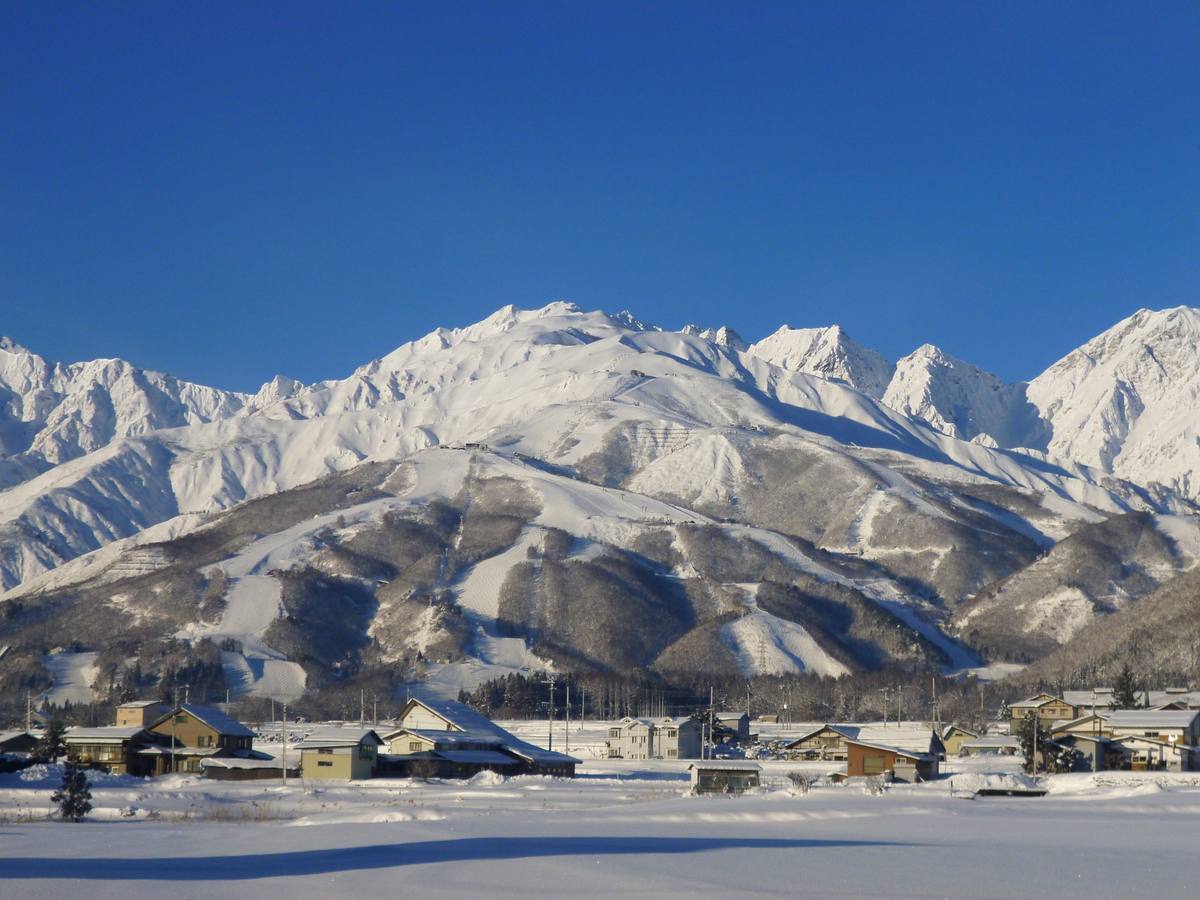
The valley wall behind it does most of the work. The Hakuba range rises straight off the valley floor to nearly 3,000 meters, which is why the snow is what it is and why Happo has the vertical it has. It is also why the weather turns fast — the upper lifts at Happo and Tsugaike go on hold in wind often enough that you should have a second plan every day, which conveniently is the same argument for the pass and the bus.
Not sure?
Choose somewhere else if…
- Nozawa Onsen
You want one mountain, one walkable village and no bus timetable at all. Nozawa's terrain is smaller than Happo's and there is nothing else to ski from it, but the town is a working onsen village you can cross on foot and the lifts start at the edge of it.
Full comparison - Sapporo
Car-free actually matters more than lift-served variety. A Sapporo base gives you real metro-and-bus transit, a full city at night and day trips to several Hokkaido areas — at the cost of long commutes and no ski-in lodging anywhere.
- Chamonix
You want the same shape of destination with more vertical. Chamonix is also a multi-area valley strung along one bus route, but the areas are far bigger and steeper. Hakuba wins on snowfall, food and price; Chamonix wins on scale.
This base appears in
Sources & data notes
How this page was verified
Section verification
- Access matrixAugust 16, 2026
- Getting thereAugust 16, 2026
- Getting aroundAugust 16, 2026
- Where to stayAugust 16, 2026
Sources
- Hakuba Valley shuttle bus network — HAKUBA VALLEY (Hakuba Valley Tourism Association) · operator timetable, cited not reproduced · retrieved
- Northeast resort profiles — NESKIS · sibling property; mountain specifications maintained there · retrieved
Images
- Photo by Ski Mania, licensed under Public domain

Page last reviewed August 16, 2026. Transit routes, schedules and fares change between seasons — check the operator before you travel. Mountain specifications for the northeastern US are maintained separately on NESKIS.