Ski trips from Tokyo
Four bases on two Shinkansen corridors out of the same Tokyo Station — a ~77-minute straight shot up the Jōetsu line to eleven ski areas around one station, and three Hokuriku-line trips that trade extra minutes for a village, a cluster and a valley, each finishing on a bus or a local train.
At a glance
| Base | Where | Car-free reach | Evenings | Car |
|---|---|---|---|---|
| Echigo-Yuzawa: Skiing from the Shinkansen | Japan | 11 of 11 areas | Limited | |
| Nozawa Onsen: One Mountain, Thirteen Free Baths | Japan | 3 of 3 areas | Limited | |
| Myoko Kogen: Five Ski Areas, One Small Station | Japan | 5 of 5 areas | Limited | |
| The Hakuba Valley | Japan | 8 of 8 areas | Limited |
Leaving from Tokyo, the ski decision starts at a single concourse: every base in this guide is reached from Tokyo Station, on one of two Shinkansen lines. The Jōetsu Shinkansen is the speed play — about 77 minutes to Echigo-Yuzawa, where eleven ski areas hang off the arrival station itself. The Hokuriku Shinkansen trades minutes for choice of place: Nozawa Onsen, Myoko Kogen and the Hakuba Valley leave that line at three different stations, at two to just over three hours, and every one of those trips finishes on a bus or a local train. Every time below is the verified figure from that base’s own page. This page settles the ride out of Tokyo — for how each base then works day to day without a car, Ski without a car in Japan is the companion, and Hakuba vs Nozawa Onsen argues that one pairwise choice in full.
The Jōetsu Shinkansen — one seat to the snow
One base rides this line, and it leads this page because the train does not just reach the snow — at one ski area it stops inside it.
Echigo-Yuzawa — ~77 minutes from Tokyo Station on the Jōetsu Shinkansen
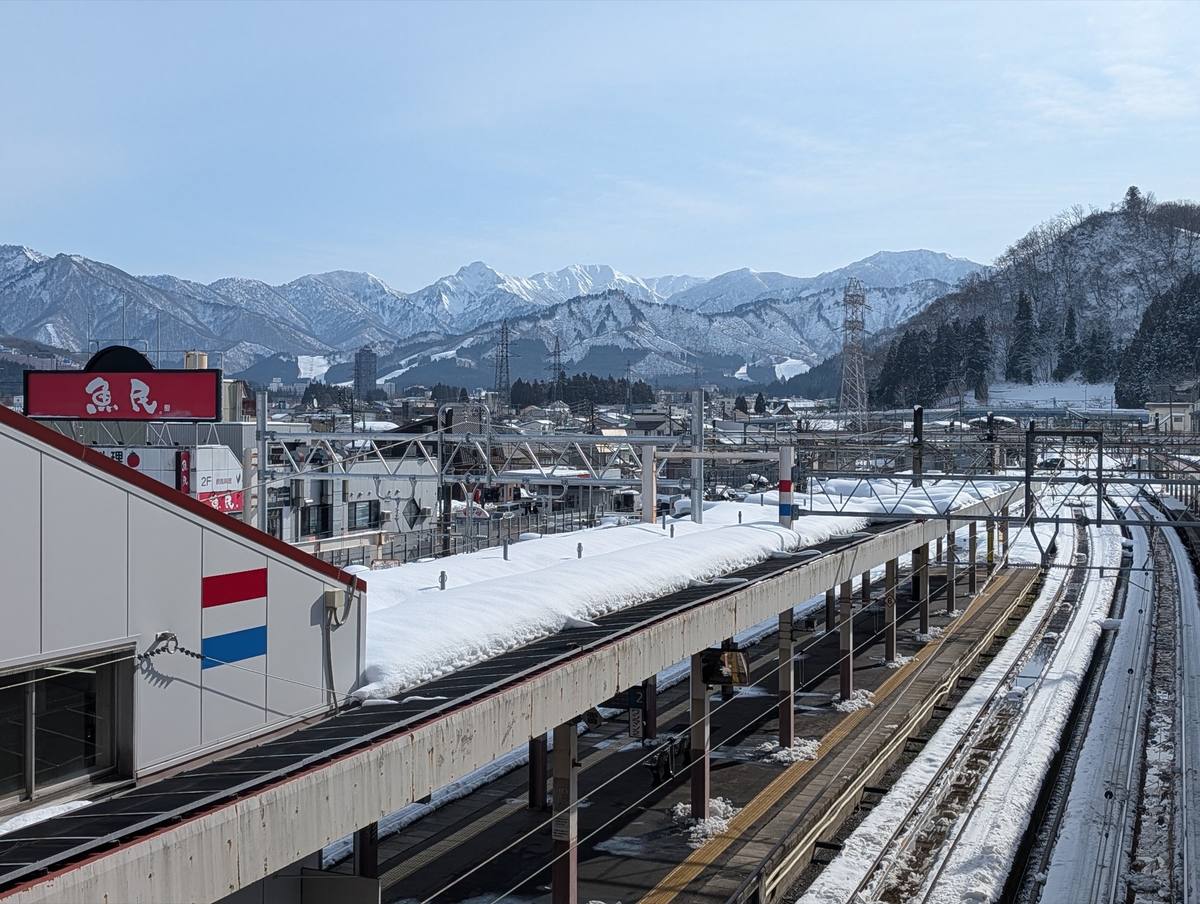
The Toki and Tanigawa services reach Echigo-Yuzawa in about 77 minutes, a dozen or more times a day, and the town at the end is the guide’s densest arrival: eleven lift-served ski areas, all reachable on a published service — free shuttles from the station forecourt, two JR local stations that open onto snow, and a paid 35-minute bus to Kagura, the best snow within reach. It is the only base here whose page rates a car unnecessary. The detail its page says almost nobody writes up properly: GALA has its own Shinkansen station, served by the Tanigawa only, open mid-December to early May with roughly a dozen calls a day, some weekend-only — you walk out of the ticket gate, up an escalator, and the gondola is in front of you. Miss your train at Tokyo Station, though, and you either wait an hour or ride to Echigo-Yuzawa and take a shuttle back up the hill. The page’s honesty cuts both ways: the near cluster is low and warm — slush across its bottom thirds in a mild February — the shuttles stop when the lifts do, and its verdict on the corridor rivalry is blunt: Hakuba skis better; nothing gets you there faster than this. A Friday-night arrival and two full days is genuinely practical, and so, more remarkably, is a day trip.
The Hokuriku Shinkansen — three bases, three transfer stations
Three bases share the Hokuriku line and leave it at three different stations — Iiyama for Nozawa, Joetsumyoko for Myoko, Nagano for Hakuba. In order of distance, the extra time buys a thousand-year-old onsen village, a five-company ski cluster around one small station, and the widest car-free ski choice in Japan. One booking rule comes before any of them: the corridor’s fastest train, the Kagayaki, calls at Nagano but not at Iiyama or Joetsumyoko, so it is the right train only for Hakuba’s bus connection — for the other two, both pages say to book a Hakutaka, and the Nozawa page warns that the wrong train name strands you in Nagano.
Nozawa Onsen — ~125 minutes from Tokyo Station via Iiyama, Shinkansen then dedicated bus
A Hakutaka reaches Iiyama in roughly 100 minutes, and the Nozawa Onsen Liner — a dedicated bus, ¥600, ten round trips a day on a winter timetable running December 13 to March 29 — covers the last leg to Nozawa Onsen in a published 25 minutes. The two timetables are not synchronized, so the page’s own advice is to allow at least two hours from Tokyo Station and budget for a wait. One name trap before booking anything: the JR Iiyama Line stops at a station called Togari–Nozawa Onsen, and despite the name it has no bus connection to the village — the Liner departs only from Iiyama Station. Its page’s first line of advice is to come for the village, not the mountain count: one real mountain, mostly a walk from lodging, above thirteen free public baths run by a community association since the Edo era, with the bath trail in a yukata as close to the main evening activity as the village has. Two more mountains, Togari and Madarao, are reachable on Nagaden winter buses — but exactly twice a day each, December 20 to March 1 only. The last Liner out of the village is 19:35 and the last inbound arrival 21:45; the bus, as the page puts it, does not run around a dinner reservation.
Myoko Kogen — ~141 minutes from Tokyo Station via Joetsumyoko, Shinkansen then local rail
The same Hakutaka runs on to Joetsumyoko — the Shinkansen leg alone is about 1 hour 46 to 1 hour 50 — where the Echigo Tokimeki Railway’s Myoko Haneuma Line continues direct to Myoko-Kogen Station: a published 33 minutes, ¥790, roughly 19 departures a day spaced unevenly between 05:16 and 22:47 with a midday gap of about an hour and three-quarters. The catch Myoko Kogen states up front is that the station is not the base: most lodging sits in Akakura Onsen, roughly 5 km away and not a walk anyone should attempt, so a municipal bus (¥380, a published 15 to 20 minutes) closes the gap — door to door from Tokyo Station, the page budgets three to three and a half hours in the best case and up to four and a half realistically. What the trip buys is five separately operated ski companies within reach of one small station, every one with a published, dated path by shuttle, bus or local train. Two caveats exactly as the page carries them: every municipal winter bus figure reads off the 2024–25 timetable, the most recently published winter edition, and the last bus back from Akakura to the station leaves at 18:45 while the last outbound train runs until 22:13 — a roughly three-and-a-half-hour gap with no scheduled transit on that leg.
The Hakuba Valley — ~185 minutes from Tokyo Station via Nagano, Shinkansen then express bus
This is the one trip where the Kagayaki earns its speed: about 80 minutes to Nagano, against roughly 100 on a Hakutaka. From Nagano’s east exit — the bus stop is a ten-minute walk from the platforms — the Alpico express runs a published 70 minutes to the Happo Bus Terminal, ¥3,500 one way in winter, with some departures reservation-only; the Hakuba Valley’s page says to allow about three hours door to door. The longest ride in this guide ends at its widest choice: eight lift-served ski areas on one pass down a single valley, tied together by a shuttle that is free with the pass and ¥800 a ride without it. The page is equally plain about the price. The through shuttle is slow — a published 41 minutes from the Happo terminal to Cortina — core service runs roughly 07:30 to 17:00, and the night bus that stretches evenings to a 22:09 last departure operates only December 26 to February 22. Direct winter buses from Narita and Haneda exist too, at five to six hours — its page calls them a matter of preference rather than speed.
Considered and excluded
- Sapporo — its published gateway is New Chitose Airport; from Tokyo that is a flight to Hokkaido, not a Shinkansen seat, and its own page weighs the choice in exactly those terms.