Myoko Kogen: Five Ski Areas, One Small Station
Five separately run ski companies cluster around one small station — three free customer shuttles, a paid cross-resort service and a municipal bus network, each timed here by mode and minute.
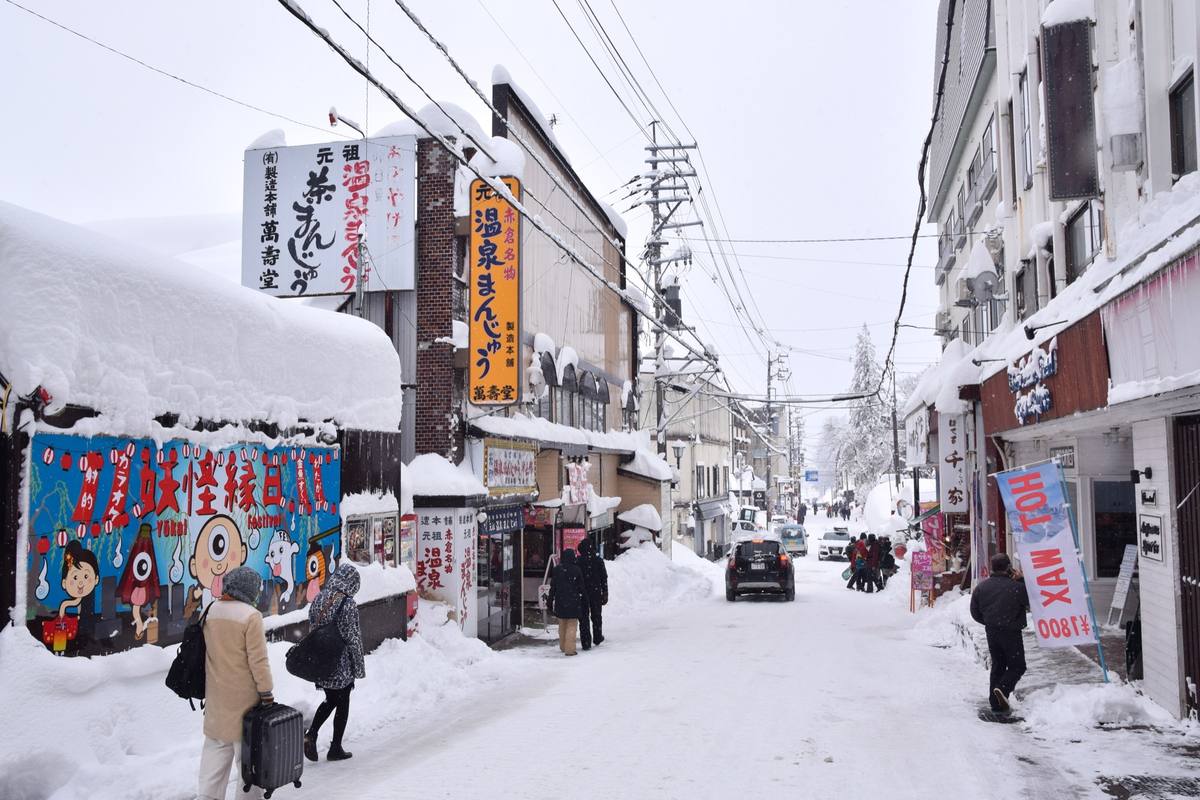
The core trip works without a car, but a car materially expands your lodging, evening or mountain choices. Verified August 18, 2026.
Evenings18:45 — the last municipal Akakura Line bus back to Myoko-Kogen Station (2024–25 season, the most recently published winter timetable); the last outbound Echigo Tokimeki train from the station runs until 22:13, leaving a roughly 3.5-hour gap with no scheduled transit on the station-to-Akakura leg
At a glance
- Ski areas
- 5
- Within 30 min
- 5
- Closest
- 18 minPublic bus
- Reachable by transit
- 5 of 5
- Arriving from
- Tokyo Station2h 21m by train
- Groceries on foot
- YesYear-round town
The verdict
Verdict
Come to Myoko Kogen for real transit complexity handled honestly. Five separately operated ski companies — Akakura Onsen, Akakura Kanko, Ikenotaira, Suginohara and Seki Onsen — sit within reach of one small station, and every one of them has a published, dated path: AKAKAN's continuously rotating morning shuttle, Alpen Blick's six-round-trip fixed timetable, a paid cross-resort service, and a municipal bus network that predates skiing here by decades. A direct Hokuriku Shinkansen and Echigo Tokimeki Railway connection reaches the station car-free from Tokyo in well under half a day.
Do not expect one resort. Akakura Onsen and Akakura Kanko share a bus stop and a combined lift pass but nothing else administratively, Suginohara's own municipal stop gets only two direct departures a day, and Seki Onsen needs a train transfer before its bus even starts. Do not expect current winter timetables either — every municipal figure here reads off the last published winter schedule, because the 2026–27 edition has not posted yet.
Is this base for you?
Who this suits
Best for
- Visitors who want genuine transit complexity handled with real, dated minutes — five separately run companies, each with a published path, mapped here by mode.
- Travelers comfortable reading a bus timetable instead of assuming one continuous resort — Akakura Onsen and Akakura Kanko share a bus stop but are run by two different companies.
- Anyone happy building a day around a fixed schedule — Alpen Blick's six-round-trip shuttle and the Seki/Tsubame Onsen Line both run on published, dependable timetables.
Depends on you
- A two-node base, roughly 5 km apart and not walkable — Akakura Onsen carries the lodging, Myoko-Kogen Station carries the transit hub, and most trips touch both in the same day.
- Five separately operated ski companies rather than one linked resort. A combined lift pass covers Akakura Onsen and Akakura Kanko only, not the other three areas in this matrix.
- Winter bus timetables that read one to two seasons old at any given time. The municipal network republishes each December, and this page's frequency figures wait on that same clock.
The honest part
Things you should know
- 01
Every municipal bus figure on this page — the Akakura Line, the Suginosawa Line and the paid Mt. MYOKO Shuttle — reads off the most recently published winter timetable, the 2024–25 season. Myoko City's current 2026 PDFs cover April through November only, and no 2026–27 winter edition exists yet to check the numbers against.
- 02
The destination's own base splits into two nodes roughly 5 km apart and not walkable between: Akakura Onsen, where most lodging concentrates, and the Myoko-Kogen Station district, where every municipal bus and the only inbound train arrive. Most trips touch both ends of that gap in the same day.
- 03
Evening transit out of the base stops early. The last confirmed municipal bus back to Myoko-Kogen Station leaves at 18:45, while the last outbound train from the station runs until 22:13 — a roughly 3.5-hour gap in which the station-to-Akakura leg has no scheduled public transit at all.
- 04
Suginohara and Seki Onsen are reachable without a car, but only just. Suginohara's direct municipal stop gets 2 of the route's 9 daily departures, and Seki Onsen needs a one-stop train transfer to a different station before its own bus even starts.
The access matrix
What you can ski from Myoko Kogen
Typical door-to-lift times in normal winter conditions. ● marks areas reachable on published transit during ski hours. Every row is dated below.
- On foot or skis
- Public transport
- Lift from town
- Needs a vehicle
| Ski area | Getting there | Time | Best for | Main drawback |
|---|---|---|---|---|
| Transit-served. Akakura Onsen | Public busMunicipal Akakura Line · ¥380 · 9 round trips/day on the 2024–25 table · figures two seasons oldEvidence & assumptions for Akakura OnsenMyoko City municipal Akakura Line (赤倉線), run under contract by Myoko Hub Net Co.; ¥380 one-way, a year-round route. Nine round trips a day on the most recent winter-specific timetable (2024–25 season); the current 2026 PDF is a pre-winter edition only, valid April through November. Route, operator and fare are reconfirmed current; only the run-time and frequency figures are two seasons old. Source [1] Myoko area winter bus/shuttle timetable and map, 2024-25 season — verified August 18, 2026 | [1] | The primary lodging cluster most Myoko trips are built around, on the same municipal bus as every other row in this matrix | Winter run-times read off the most recently published seasonal timetable, the 2024–25 season — Myoko City's current bus PDFs cover April through November only, and no 2026–27 winter schedule exists yet to check the 15–20 minute figure against |
| Transit-served. Seki Onsen | TrainTrain to Sekiyama, then Seki/Tsubame Onsen Line bus · ¥440 · 7 round trips/day year-roundEvidence & assumptions for Seki OnsenLocal train one stop from Myoko-Kogen to Sekiyama Station (関山駅), then the municipal Seki/Tsubame Onsen Line (関・燕温泉線) bus, ¥440, 7 round trips a day — published on a single full-fiscal-year timetable (2026-04-01 to 2027-03-31) with no separate winter edition, re-verified 2026-08-18 against the current PDF and unchanged. The roughly 15-minute bus leg is published from Sekiyama Station; the one-stop train connection is this page's estimate, not an operator-published figure. Source [4] Seki/Tsubame Onsen Line timetable PDF (R8, full fiscal year) — verified August 18, 2026 | [4] | A separately operated onsen-village ski area on the most reliably current timetable of any row here, since its schedule runs year-round with no winter cutover to go stale | No bus reaches Seki Onsen from Myoko-Kogen Station directly — every trip needs a one-stop Echigo Tokimeki local train transfer to Sekiyama Station first, and that connecting train leg is not separately timed by any source checked |
| Transit-served. Ikenotaira Onsen | Resort shuttleFree Alpen Blick shuttle from the station · 6 round trips/day · published 21 minEvidence & assumptions for Ikenotaira OnsenIkenotaira Onsen Alpen Blick runs its own free shuttle, station–spa–ski resort–hotel: published departures from Myoko-Kogen Station at 8:47, 10:37, 11:47, 14:22, 15:32 and 16:32, a published 21 minutes to the ski-resort stop (14 to the spa stop, 28 to the hotel). Last return leaves the hotel at 16:00, back at the station by 16:30. The municipal Suginosawa Line also reaches an Alpen Blick Spa stop in about 8 minutes, but that stop is the bathhouse, not the lift base. Off-season the shuttle drops to reservation-only for hotel guests. Source [3] Ikenotaira Onsen Alpen Blick — access and shuttle timetable — verified August 18, 2026 | [3] | A fully scheduled, fixed resort shuttle rather than a headway to estimate — six round trips a day, published to the minute from the station | Only six round trips a day on a fixed schedule, the last one leaving the station at 16:32 — miss it and the municipal bus alternative only reaches the spa stop, not the ski-area stop itself |
| Transit-served. Akakura Kanko | Public busAkakura Line bus, then free AKAKAN shuttle · continuous 8:00–10:00, then ~every 30 minEvidence & assumptions for Akakura KankoMunicipal Akakura Line bus to the Akakura Onsen stop (see that row), then AKAKAN, Akakura Kanko Resort's own free customer shuttle: continuous rotating service 8:00–10:00, then roughly every 30 minutes from 10:00, with extra runs on weekends and holidays including Dec 30–Jan 3. AKAKAN's own headway is dated for the 2025–26 season, the freshest posted anywhere in the network; 2026–27 not yet posted. Source [2] Akakura Kanko Resort access and AKAKAN free shuttle — verified August 18, 2026 | [2] | A short shuttle hop from the same bus-stop cluster as Akakura Onsen, with a continuously rotating morning departure that needs no timetable to catch | Akakura Kanko is a separate company from Akakura Onsen — the municipal bus only reaches the Akakura Onsen stop, so this row also depends on AKAKAN, the resort's own free shuttle, to close the last stretch |
| Transit-served. Myoko Suginohara | Public busSuginosawa Line · ¥480 · only 2 of 9 daily runs reach the ski-area stop (2024–25 table)Evidence & assumptions for Myoko SuginoharaMunicipal Suginosawa Line (杉野沢線), ¥480 to the direct stop, 9 round trips a day on the most recently published winter timetable (2024–25 season) but only 2 continue to the ski-area stop. Alternative: the paid Mt. MYOKO Shuttle (Myoko Hub Net Co.), ¥1,000 flat, roughly 8 round trips a day with a large midday gap — but it departs from the Akakura Onsen stop, not Myoko-Kogen Station, so reaching it means riding the Akakura Line first. Route and fare are reconfirmed current; the frequency figures are two seasons old, same as the Akakura Line. Source [1] Myoko area winter bus/shuttle timetable and map, 2024-25 season — verified August 18, 2026 | [1] | A separately run resort with its own municipal bus stop, for visitors willing to time arrival to one of the two daily direct departures | Only 2 of the municipal Suginosawa Line's 9 daily departures reach the ski-area stop directly — the other 7 end one stop short, leaving a walk or a transfer to the paid Mt. MYOKO Shuttle to close the gap |
Where to stay
Lodging concentrates in Akakura Onsen, an onsen village of ryokan, pensions and Australian- and internationally run lodges climbing the slope toward the ski bases. It is the base this page is built around, and the municipal bus connecting it to Myoko-Kogen Station is also the first leg of three of the five rows in the matrix above.
Akakura Kanko, also called Shin-Akakura, is a newer, more hotel-dense cluster a short shuttle hop further on, anchored by the Akakura Kanko Resort hotel. It shares a bus-stop cluster and a combined lift pass with Akakura Onsen, but is a separately operated company with its own official site and its own free shuttle, AKAKAN.
The Myoko-Kogen Station district is not really a place to stay — it is the transit hub, roughly 5 km from Akakura Onsen and not a walk anyone should attempt, and every train and municipal bus on this page passes through it.
Ikenotaira Onsen, home to the Alpen Blick resort, has its own smaller onsen-lodging cluster, reachable by the resort’s own shuttle or the municipal Suginosawa Line, but sits outside this page’s primary base.
Getting there
The car-free route runs the Hokuriku Shinkansen from Tokyo Station to Joetsumyoko, then the Echigo Tokimeki Railway’s Myoko Haneuma Line the rest of the way. Book a Hakutaka service — Joetsumyoko is a regular stop for it, but the faster Kagayaki does not call there at all. The name to watch for is Hokuriku Shinkansen, not the separate Joetsu Shinkansen to Niigata City. The Shinkansen leg itself runs roughly 1 hour 46 minutes to 1 hour 50 minutes.
From Joetsumyoko, the Myoko Haneuma Line runs direct to Myoko-Kogen Station, no transfer, in a published 33 minutes for ¥790. Roughly 19 departures a day run toward Myoko-Kogen, unevenly spaced between 05:16 and 22:47 with a gap of about 1 hour 45 minutes around midday.
An alternate approach runs via Nagano: the same Hokuriku Shinkansen to Nagano, then Shinano Railway’s Kita-Shinano Line direct to Myoko-Kogen, roughly 44 to 49 minutes, about 17 trains a day at irregular intervals rather than a strict hourly clock.
From Myoko-Kogen Station, the municipal Akakura Line bus covers the last stretch to Akakura Onsen in a published 15 to 20 minutes for ¥380 — or a taxi, commonly cited at 10 to 15 minutes but with no operator-published fare confirmed. Door-to-door from Tokyo Station to Akakura Onsen runs roughly three to three and a half hours in the best case, three and a half to four and a half hours realistically.
Getting around
Myoko Kogen’s base is really two places joined by a bus route: Akakura Onsen, where most lodging sits, and Myoko-Kogen Station, roughly 5 km away and not a walk anyone should attempt. The municipal Akakura Line connects them, and is also the first leg toward three of the five ski areas above.
Within Akakura Onsen and Akakura Kanko, evening mobility is real — Akakura Onsen’s own circulator and Akakura Kanko’s AKAKAN shuttle both run, in the resorts’ own words, until night-skiing ends. Leaving the base is a different story. The last confirmed municipal bus back to Myoko-Kogen Station departs at 18:45; the last outbound Echigo Tokimeki train from the station does not leave until 22:13. Rail service runs nearly three and a half hours later than the connecting bus, stranding anyone without a taxi or resort shuttle on the station-to-Akakura leg specifically, not on the train.
Ikenotaira, reached by Alpen Blick’s own fixed shuttle or the municipal Suginosawa Line, and Suginohara, on the same municipal line further out, both work without a car, though Suginohara’s direct stop gets only two of the route’s nine daily departures. Seki Onsen is the outlier: no municipal bus reaches it from Myoko-Kogen Station at all, only from Sekiyama Station, one stop away by local train.
Groceries follow the same two-node pattern as everything else. A small Yamazaki convenience store sits on Akakura Onsen’s main street; anything more substantial means the Dai-Ichi supermarket near the station, reachable by the same municipal bus but not on foot.
Who it suits
- Visitors who want genuine transit complexity handled with real, dated minutes. Five separately run companies, three free shuttles, a paid cross-resort service and a municipal bus network, mapped here by mode rather than left as a single vague distance.
- Travelers comfortable reading a bus timetable instead of assuming one continuous resort. Akakura Onsen and Akakura Kanko share a bus stop and a combined lift pass; the other three areas are entirely separate trips.
- Anyone happy building a day around a fixed schedule. Alpen Blick’s six-round-trip shuttle and the Seki/Tsubame Onsen Line both run on published, dependable timetables rather than a loose headway.
It suits visitors who want to unpack once and never think about a bus stop again least. Even the primary base splits across two nodes a bus ride apart, and three of the five areas mean reading a timetable rather than walking out the door.
Living for a season
Myoko has drawn a foreign season-worker community for years, smaller than Niseko’s but real, concentrated in Akakura Onsen’s mix of ryokan, pensions and Australian- and internationally run lodges. As with any winter here, work authorization is a visa question before it is a job question — a tourist entry does not cover employment.
Myoko City is the administrative authority behind every municipal bus line here, putting Akakura Onsen inside a real, year-round incorporated city rather than a purely seasonal base. This pass did not independently verify the nearest regional hospital or clinic the way it verified transit timetables, so treat healthcare access as an open question to confirm directly.
What the town is like
Myoko Kogen reads less like one resort than five neighbors sharing a mountain and a bus network. Akakura Onsen is the closest thing to a center — an onsen village of ryokan and pensions climbing the slope, with a season-worker mix that has made a modest international scene without becoming Niseko’s. Akakura Kanko, a short shuttle hop on, is newer and more hotel-dense, anchored by the Akakura Kanko Resort hotel.
The rest of the cluster sits at a genuine remove. Ikenotaira has its own smaller onsen-lodging pocket; Suginohara and Seki Onsen read as day-trip mountains rather than places anyone bases a whole stay around. What ties the five together is not a lift pass — only Akakura Onsen and Akakura Kanko share one — but the municipal bus network radiating from Myoko-Kogen Station, the same infrastructure that gets skiers to the mountain and gets everyone else to the supermarket.
Source note: every municipal bus frequency and run-time figure on this page — the Akakura Line, the Suginosawa Line and the paid Mt. MYOKO Shuttle — reads off the most recently published winter timetable, the 2024–25 season. Myoko City’s current PDFs cover April through November only, and the operator network has posted a fresh winter edition in early December for four straight years running, so a 2026–27 revision should follow the same pattern. The Seki/Tsubame Onsen Line and both inter-city rail legs (Echigo Tokimeki Railway, Shinano Railway) are current as of this verification (2026-08-18) and do not carry this caveat.
Not sure?
Choose somewhere else if…
- Nozawa Onsen
You want one mountain and a compact historic onsen village entirely on foot, with a single-node base rather than the station-and-village split Myoko asks you to manage.
- Hakuba Valley
You want a valley-wide lift pass linking multiple areas under one free shuttle network, rather than five separately run companies stitched together mainly by public transit.
- Echigo-Yuzawa
Speed from Tokyo matters most. Yuzawa's own Shinkansen platform reaches the valley in about 75 minutes, at the cost of the low, warm base elevation across its near cluster.
Full comparison
This base appears in
Sources & data notes
How this page was verified
Section verification
- Access matrixAugust 18, 2026
- Getting thereAugust 18, 2026
- Getting aroundAugust 18, 2026
- Where to stayAugust 18, 2026
Sources
- Myoko area winter bus/shuttle timetable and map, 2024-25 season — Myoko Tourism Management (area DMO) · operator timetable, cited not reproduced · retrieved
- Akakura Kanko Resort access and AKAKAN free shuttle — Akakura Kanko Resort (赤倉観光リゾート) · resort operator access page, cited not reproduced · retrieved
- Ikenotaira Onsen Alpen Blick — access and shuttle timetable — Alpen Blick Resort (Arai & Associates Co., Ltd.) · resort operator access page, cited not reproduced · retrieved
- Seki/Tsubame Onsen Line timetable PDF (R8, full fiscal year) — Myoko City government / Myoko Tourism Management · operator timetable, cited not reproduced · retrieved
- Akakura Line / Suginosawa Line timetable PDF (R8, pre-winter edition) — Myoko City government / Myoko Tourism Management · operator timetable, cited not reproduced · retrieved
- Myoko City municipal bus routes and public transportation — Myoko City government · municipal transit authority page, cited not reproduced · retrieved
- Echigo Tokimeki Railway full system timetable (Myoko Haneuma Line) — Echigo Tokimeki Railway Co., Ltd. · operator timetable, cited not reproduced · retrieved
- Shinano Railway timetable — Kita-Shinano Line (Nagano-Myoko-Kogen) — Shinano Railway Co., Ltd. · operator timetable, cited not reproduced · retrieved
- Joetsumyoko station timetable — East Japan Railway Company (JR East) · operator timetable, cited not reproduced · retrieved
- Winter bus service — Myoko Hub Net Co. — Myoko Hub Net Co. · operator tourism-facing page, cited not reproduced · retrieved
- Myoko Tourism Management — access overview and local bus line names — Myoko Tourism Management (area DMO) · tourism board access page, cited not reproduced · retrieved
- Hokuriku Shinkansen line overview (Tokyo – Nagano – Kanazawa – Tsuruga) — East Japan Railway Company (JR East) · operator timetable, cited not reproduced · retrieved
Images
.jpg)
Page last reviewed August 18, 2026. Transit routes, schedules and fares change between seasons — check the operator before you travel. Mountain specifications for the northeastern US are maintained separately on NESKIS.