Zell am See
A gondola that begins inside a real lake town, not a bus ride from one, paired with a legislated province-wide free-transit ticket that covers the one corridor — Zell am See to Kaprun — the trip actually needs a bus for.
The core trip works without a car, but a car materially expands your lodging, evening or mountain choices. Verified August 18, 2026.
EveningsThe Kaprun-internal Dorfbus D, the shuttle that actually reaches Maiskogel and Lechnerberg, makes its last run at 17:10 from the Maiskogelbahn stop (17:22 at Lechnerberglift) — lift-hours-bound. The SVV line 660 itself runs later, with a last Zell am See Postplatz departure of 19:20 and a last return by 20:15. Latest of all is the Pinzgauer Lokalbahn narrow-gauge train, with a last departure of 22:02 from Zell am See (22:57 back from Fürth-Kaprun) — not yet cross-checked against a winter 2026/27 timetable, which was not published as of this verification.
At a glance
- Ski areas
- 4
- Within 30 min
- 2
- Closest
- 7 minWalk
- Reachable by transit
- 4 of 4
- Arriving from
- Salzburg Airport2h 15m by train
- Groceries on foot
- YesYear-round town
The verdict
Verdict
Come for a gondola that starts inside town, not at a parking lot on its edge. Walk from the lakefront to the cityXpress valley station and ride straight up — no transfer, no shuttle required. The Guest Mobility Ticket, the same legislated program already verified for Bad Gastein, is now confirmed by name for this valley too, covering the one bus leg the trip needs: Postbus line 660 to Kaprun's glacier and beginner terrain, running every 15 minutes at midday in season. The Pinzgauer Lokalbahn narrow-gauge train runs the same corridor hourly to nearly 11pm, later than any ski shuttle.
Do not come for a large roster: four honestly countable access chains is a small matrix, and Saalbach's bigger linked terrain is reachable only by already being on skis, not by any car-free chain from town. Do not expect evening lift access either — the shuttle reaching Maiskogel and Lechnerberg stops mid-afternoon, so a car or taxi still beats transit after lift close. And do not treat Kaprun as part of the same walk: it is a separate village and lodging market, a bus ride from the lake.
Is this base for you?
Who this suits
Best for
- Car-free arrivals who want the walk-to-lift claim to be literal: the cityXpress gondola starts inside the town center, not at a remote base area or a parking lot.
- Anyone who wants a genuine year-round lake town underneath the skiing, not a purpose-built resort village that empties out each spring.
- Guests who want the free-transit case backed by a legislated province-wide program, not a resort perk — the same Guest Mobility Ticket already verified for Bad Gastein, now confirmed by name for this valley too.
Depends on you
- A four-row matrix, not a large roster — genuinely smaller than a linked mega-resort, with Saalbach's bigger terrain reachable only by already being on skis.
- A split-base valley: the lake town and Kaprun's glacier-and-beginner side are two different lodging markets connected by a bus, not one contiguous village.
- Evening mobility that is corridor-strong but lift-access-early — the town-to-town bus and train run well past dinner, but the shuttle that actually reaches the lift bases stops by mid-afternoon.
The honest part
Things you should know
- 01
The matrix holds four distinct access chains — smaller than a flagship roster like Innsbruck's ten — because Saalbach's much larger lift-linked terrain is reachable only by already being on skis at Schmittenhöhe, not by any car-free chain a town-based arrival could take.
- 02
The Kaprun-internal Dorfbus D, the shuttle that actually reaches Maiskogel and Lechnerberg, makes its last run at 17:10 — genuinely lift-hours-bound, with no evening or après service on that specific last-mile connector.
- 03
Three of the four rows — Kitzsteinhorn, Maiskogel, Lechnerberg — depend on the Zell am See–Kaprun bus corridor; only the in-town Schmittenhöhe gondola needs no transit leg at all.
- 04
Every frequency on this page reads off the most recently published timetables (line 660 valid 22.05.2026–12.12.2026, Dorfbus D valid 20.12.2025–06.04.2026) rather than a confirmed winter 2026/27 schedule — ÖBB's own live journey planner would not yet accept a winter 2026/27 query date as of this write-up.
The access matrix
What you can ski from Zell am See
Typical door-to-lift times in normal winter conditions. ● marks areas reachable on published transit during ski hours. Every row is dated below.
- On foot or skis
- Public transport
- Lift from town
- Needs a vehicle
| Ski area | Getting there | Time | Best for | Main drawback |
|---|---|---|---|---|
| Transit-served. Schmittenhoehe | WalkWalk to the cityXpress valley station · runs continuously through lift hoursEvidence & assumptions for SchmittenhoeheWalk via Schmittenstraße from the lakefront/Altstadt core to the cityXpress valley station (roughly 5–8 minutes), then the Schmittenhöhebahn AG gondola continues direct to the 1,328 m mid-station — the gondola ride itself is mountain content and is not counted in the minutes above. No timetable to check: cityXpress runs continuously through lift operating hours. Source [1] cityXpress — the in-town gondola to Schmittenhöhe — verified August 18, 2026 | [1] | Zero-transfer arrivals staying near the lakefront or Schmittenstraße | This walk only reaches the Schmittenhöhe side of the ski area — Kitzsteinhorn, Maiskogel and Lechnerberg all still need the separate 660 bus chain to Kaprun |
| Transit-served. Maiskogel | Public busLine 660 to Kaprun Maiskogelbahn · 21 min from Postplatz, 18 from BahnhofEvidence & assumptions for MaiskogelSame line 660, alighting at "Kaprun Maiskogelbahn (Sigm.-Thun-Str.)": 21 minutes from Postplatz, 18 from Bahnhof. The K-ONNECTION 3-lift chain and the Kaprun-internal Dorfbus D both continue from this stop. Source [2] Line 660 timetable — Zell am See–Kaprun — verified August 18, 2026 | [2] | A short, frequent hop to Kaprun's own local hill and the K-ONNECTION base | This is the same 660 line Kitzsteinhorn and the rest of the Kaprun corridor share — a delay upstream at Zell am See or an earlier Kaprun stop pushes back this leg too |
| Transit-served. Lechnerberg | Resort shuttleLine 660 + Dorfbus D (every 20 min) · last connection from Maiskogelbahn 17:10Evidence & assumptions for LechnerbergTwo legs, not one: line 660 to "Kaprun Maiskogelbahn" (21 min), then the Kaprun-internal Dorfbus D (Maiskogelbahn–Lechnerdorf–Lechnerberglift–Ortsmitte loop) onward to "Lechnerberglift" (12 more minutes). Dorfbus D runs every 20 minutes daily in season and is free for everyone within Kaprun regardless of lift ticket; last departure from Maiskogelbahn is 17:10, reaching Lechnerberglift by 17:22. Source [5] Dorfbus D timetable — Kaprun village circulator — verified August 18, 2026 | [5] | Families and first-timers, once you plan around the two-leg village connection | A two-leg chain, not a single through-line — the connecting Dorfbus D runs only every 20 minutes and makes its last trip at 17:10, well before dinner |
| Transit-served. Kitzsteinhorn | Public busPostbus 660 direct · every 30 min, 15 min midday in core season · free with lift ticket in lift hoursEvidence & assumptions for KitzsteinhornPostbus line 660 (SVV/ÖBB Postbus, a year-round regional line — not a "660/K" variant as an earlier pass of this research logged) runs direct from Zell am See Postplatz to the "Kaprun Kitzsteinhorn Bergbahn" stop at the K-ONNECTION valley station: 34 minutes from Postplatz, 31 from Bahnhof. The separate, Kaprun-internal circulator branded line K never leaves the village. Every 30 minutes off-peak, boosted to every 15 minutes 11:20–14:20 in the core season, free during lift hours with a valid lift ticket. Source [2] Line 660 timetable — Zell am See–Kaprun — verified August 18, 2026 | [2] | Glacier-season skiers riding a direct, frequent bus to the highest terrain in the matrix | At 34 minutes each way this is the longest ride in the matrix, and both the boosted 15-minute frequency and the fare-free-with-lift-ticket rule apply only inside the core 20.12.2025–06.04.2026 lift season and lift operating hours |
Where to stay
Zell am See’s lodging market splits into two real places, not one village with several neighborhoods. The lakefront and pedestrianized Altstadt, closest to the Schmittenstraße approach to the cityXpress valley station, is the shortest possible path from bed to lift — walk out the door, walk to the gondola, no bus or car in between. The lake itself is the town’s defining public space, the setting for the promenade, dining terraces and the evening scene rather than a backdrop to it.
Kaprun, roughly 6 km south, is a separate village with its own lodging market, favored by skiers who prioritize the glacier and the beginner terrain over the lake setting. It is reachable from Zell am See on the 660 bus (see the access matrix above) but is not an extension of the town — a guest optimizing for zero-transfer skiing should stay near Schmittenstraße; one optimizing for glacier season length or a quieter base might choose Kaprun and treat Zell am See as the day-trip lake town instead.
Getting there
Salzburg Airport is the practical gateway. Obus line 2 runs the airport directly to Salzburg Hauptbahnhof in about 23 minutes, every 15–20 minutes. From there, a direct ÖBB regional service (R3 or D-class) reaches Zell am See with no change, in roughly 1 hour 39 minutes to 1 hour 46 minutes on a live journey-planner query — consistent with the province’s December 2025 timetable change, which introduced an hourly R3 Salzburg–Saalfelden service through this corridor. Both legs sit entirely inside Salzburg province, so both are covered by the Guest Mobility Ticket for overnight guests. The full airport-to-town chain runs an estimated two to two and a half hours end to end; that combined figure has not been independently verified as a single stitched itinerary this pass, though each leg is grounded on its own.
Munich Airport is a secondary gateway with more flights but likely a longer chain; this pass did not research a specific route or duration for it, so treat it as an open question rather than an estimate.
From the town side, the cityXpress gondola’s valley station is a walk from the lakefront and Altstadt core via Schmittenstraße — the town’s defining access fact. No transfer, no shuttle, no parking lot: this is the one ski area in the matrix reachable entirely on foot.
Getting around
The core mobility fact is the same legislated program already verified for Bad Gastein: the Guest Mobility Ticket, funded by a mandatory lodging levy (€0.50 per night today, rising to €1.10 from 1 May 2027) and free to every overnight guest anywhere in Salzburg province. It is now confirmed by name for this valley, on the destination’s own page, covering train, Postbus and specifically “the Pinzgau local railway.”
Saalbach deserves a plain answer, because the map implies more than the timetable delivers: you can ski from Zell am See to Saalbach’s linked circuit only by already being on skis — no car-free chain runs there from town.
The one leg the trip needs a bus for is the Zell am See–Kaprun corridor, served by Postbus line 660 — a plain, year-round SVV/ÖBB regional line, not the “660/K” branded variant an earlier pass of this research logged. K and D are separate, Kaprun-internal-only circulators that never leave the village. The 660 runs every 30 minutes off-peak, boosted to every 15 minutes through the middle of the day in the core season, and is free to any rider boarding with a valid lift ticket during lift hours, free outright within Kaprun regardless of ticket, and covered for any overnight guest by the Guest Mobility Ticket.
Evening service is a genuine two-tier picture. The Kaprun-internal Dorfbus D, the shuttle that actually reaches Maiskogel and Lechnerberg, makes its last run at 17:10 from the Maiskogelbahn stop — lift-hours-bound, with nothing later on that connector. But the 660 line itself keeps running well past that: its last weekday departure from Zell am See is 19:20, with the last return reaching Zell am See by 20:15. Later still, the Pinzgauer Lokalbahn narrow-gauge train runs the same corridor roughly hourly, daily, with a last departure of 22:02 from Zell am See (22:57 back from Fürth-Kaprun) — the latest-running option in the valley, and one the Guest Mobility Ticket covers by name.
Groceries and everyday services are a non-issue in town: Zell am See is Pinzgau’s district capital, with a year-round population near 10,000, not a resort village that empties out each spring.
Who it suits
- Zero-transfer arrivals. A walk from the lakefront to a gondola that starts inside town, not at a remote base area or a parking lot.
- Guests who want the free-transit case to be structural. The Guest Mobility Ticket is a legislated provincial program, confirmed by name for this valley, not a seasonal hotel perk.
- Travelers who want a real, year-round lake town underneath the skiing, not a purpose-built village that exists only for winter.
It suits roster-chasers and late-evening lift-access seekers least. Four access chains is a genuinely small matrix, and the shuttle that actually reaches the Kaprun-side lift bases stops in the mid-afternoon — a guest planning a late glacier day or a beginner-hill evening session is better served by a car or taxi than by transit alone.
Living for a season
Zell am See is a real district capital, not a seasonal camp — groceries, services and a year-round population near 10,000 sit around the lake regardless of season.
Non-EU citizens need a work permit before a season here is relevant, the same Austria-wide rule that applies at every other Austrian destination on this site. This pass did not assess seasonal housing pressure specifically for Zell am See-Kaprun, so treat availability and cost as an open question to raise directly with employers or agencies rather than an assumption either way.
What the town is like
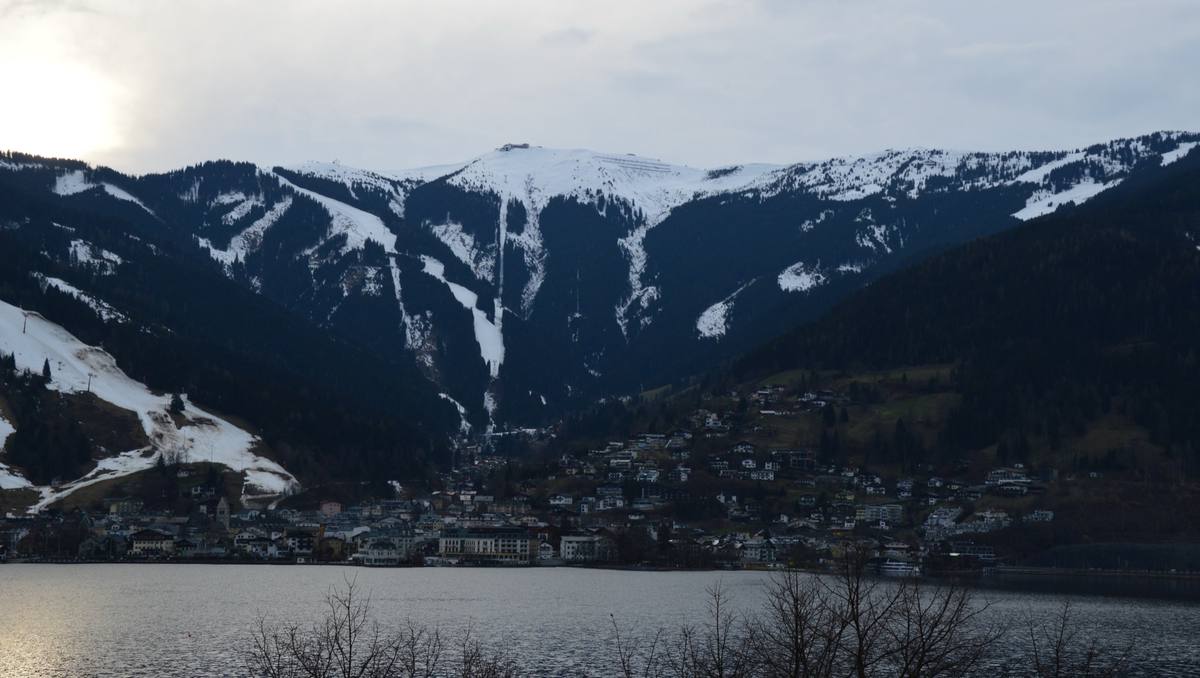
Zell am See sits on the western shore of the Zeller See, a genuine lake town first and a ski base second — the promenade, the dining terraces and the evening scene all face the water, not a slope. Kaprun, the smaller village down-valley, is a different place entirely: quieter, glacier-adjacent, and its own lodging market rather than a neighborhood of Zell am See. The two are connected by the same 660 bus that carries skiers to the Kaprun-side ski areas, but they do not feel like the same town, any more than a lake resort and its nearest ski village usually do.
Source note: winter 2026/27 timetables for the Pinzgauer Lokalbahn, line 660 and the Kaprun-internal Dorfbus D were not yet published as of this verification (2026-08-18). Every frequency and departure-time claim on this page reads off the most recently published editions — line 660 valid 22.05.2026–12.12.2026, Dorfbus D valid 20.12.2025–06.04.2026, Pinzgauer Lokalbahn valid 14.12.2025–12.12.2026 — and should be rechecked pre-season.
Not sure?
Choose somewhere else if…
- Bad Gastein
You want a bigger, still-legislated-free matrix — six honestly countable access chains in one valley, including a toll road folded into the same free ticket — over a four-row matrix split across two towns.
- Innsbruck
You want a full city underneath the skiing and a much bigger roster. Innsbruck's ten lift-served areas beat this four-row matrix outright, at the cost of longer bus rides and no legislated free-transit ticket covering the fare.
This base appears in
Sources & data notes
How this page was verified
Section verification
- Access matrixAugust 18, 2026
- Getting thereAugust 18, 2026
- Getting aroundAugust 18, 2026
- Where to stayAugust 18, 2026
- Living for a seasonAugust 18, 2026
Sources
- cityXpress — the in-town gondola to Schmittenhöhe — Zell am See-Kaprun Tourismus GmbH · destination organization page, cited not reproduced · retrieved
- Line 660 timetable — Zell am See–Kaprun — Salzburger Verkehrsverbund GmbH (Salzburg Verkehr) · operator timetable, cited not reproduced · retrieved
- Ski bus — Kitzsteinhorn / K-ONNECTION — Gletscherbahnen Kaprun AG · operator page, cited not reproduced · retrieved
- Directions and parking — Maiskogel — Gletscherbahnen Kaprun AG · operator page, cited not reproduced · retrieved
- Dorfbus D timetable — Kaprun village circulator — Gletscherbahnen Kaprun AG / Gemeinde Kaprun · operator timetable, cited not reproduced · retrieved
- Pinzgauer Lokalbahn timetable — Zell am See–Fürth-Kaprun corridor — Salzburg AG (operated on behalf of Land Salzburg; SVV line 230) · operator timetable, cited not reproduced · retrieved
- Guest Mobility Ticket — Zell am See-Kaprun — Zell am See-Kaprun Tourismus GmbH · destination organization page, cited not reproduced · retrieved
- Ski bus network — line map and structure — Zell am See-Kaprun Tourismus GmbH · destination organization page, cited not reproduced · retrieved
- Guest Mobility Ticket — free public transport for overnight guests — Salzburger Verkehrsverbund GmbH (Salzburg Verkehr) · operator product page, cited not reproduced · retrieved
- 2026 timetable changes in Salzburg province — ÖBB (Österreichische Bundesbahnen) · operator timetable notice, cited not reproduced · retrieved
- Getting to and from the airport — public transport — Salzburg Airport (Salzburger Flughafen GmbH) · operator page, cited not reproduced · retrieved
- Live ÖBB Scotty journey-planner query — Salzburg Hbf to Zell am See — ÖBB (Österreichische Bundesbahnen) · operator timetable tool, cited not reproduced · retrieved
Images
- Photo by Amichielsen, licensed under CC BY-SA 4.0

Page last reviewed August 18, 2026. Transit routes, schedules and fares change between seasons — check the operator before you travel. Mountain specifications for the northeastern US are maintained separately on NESKIS.