Bariloche as a Ski Base
One lift-served mountain, reached from downtown by an ordinary SUBE-paid city bus that no English-language guide has ever mentioned — the wedge this page exists to publish, in a destination too thin on ski areas, and too undocumented on bus times, to call it more than that.
The core trip works without a car, but a car materially expands your lodging, evening or mountain choices. Verified August 18, 2026.
At a glance
- Ski areas
- 3
- Within 30 min
- 2
- Closest
- 20 minDrive
- Reachable by transit
- 1 of 3
- Arriving from
- San Carlos de Bariloche Airport (BRC)30 min by public bus
- Groceries on foot
- YesYear-round town
The verdict
Verdict
Come for one real mountain, reached without a rental car. Cerro Catedral is Bariloche's only lift-served ski area, and a municipal bus — línea 55, SUBE-paid, roughly hourly — runs straight from the downtown terminal to the lift base, a routing no English-language guide checks; PowderQuest's own Catedral page recommends only a rental car, a remise or a hotel shuttle. Underneath the ski trip is a genuine year-round Patagonian city on a beautiful Andean lake, not a resort built for one season.
Do not come for depth, and do not come expecting certainty. This is a one-mountain destination whose second and third matrix rows only prove a negative — Piedras Blancas and the Centro de Ski Nórdico both sit car-only on the same dead-end road up Cerro Otto — and the one bus that matters publishes no first or last departure time anywhere; Mi Bus's own timetable page has been down all season. Every authoritative source here is in Spanish, and several still-live tourism sites describe a discontinued second route as current. Bring patience and June-through-September dates, not a fixed itinerary.
Is this base for you?
Who this suits
Best for
- Skiers who want one serious Andean mountain without a rental car — a SUBE card and about an hour's patience are what separate downtown from Cerro Catedral's lift base.
- Anyone chasing Southern Hemisphere skiing in the Northern Hemisphere's off-season. Bariloche's winter runs June through September, opposite the Alps' or the Rockies' calendar.
- Visitors who want a real lakeside city underneath the ski trip. Bariloche is a year-round Patagonian regional capital with a hospital and supermarkets, not a purpose-built resort village.
Depends on you
- One mountain, one bus line. Cerro Catedral is genuinely reachable without a car, but there is no second real ski area to rotate to inside the same trip.
- A Spanish-only information environment. Every authoritative transit source is in Spanish, which rewards a visitor comfortable navigating that and frustrates one expecting an English timetable.
- An unpublished bus schedule. Hourly service is verified for the current season, but nobody publishes a first or last departure time, which suits an improviser far better than a planner.
The honest part
Things you should know
- 01
Mi Bus publishes no first or last departure time for línea 55 anywhere online — the operator's own timetable page has returned a dead link all season — so building a ski day around the return trip means guessing, or calling Transporte Amancay directly rather than checking a website.
- 02
This is functionally a one-mountain destination. The second and third access-matrix rows — Piedras Blancas (beginner runs and sledding) and the Centro de Ski Nórdico (cross-country) — are real, distinct ski areas, but neither is a second lift-served mountain and neither has any public transit, so a week here is largely a week on Catedral.
- 03
Every authoritative source on Bariloche's transit is Spanish-language only, and several still-live Spanish tourism sites keep describing a bus route that was discontinued in October 2025 — following one of them today risks sending a visitor to the wrong stop.
- 04
Most international visitors land at Buenos Aires's Ezeiza (EZE), not the Aeroparque (AEP) that actually flies to Bariloche — a roughly 40 km transfer across the city that is easy to underestimate and was not independently timed for this page.
The access matrix
What you can ski from Bariloche
Typical door-to-lift times in normal winter conditions. ● marks areas reachable on published transit during ski hours. Every row is dated below.
- On foot or skis
- Public transport
- Lift from town
- Needs a vehicle
| Ski area | Getting there | Time | Best for | Main drawback |
|---|---|---|---|---|
| Piedras Blancas | DriveDrive (estimate) · no Mi Bus line reaches it · a marketed downtown shuttle claim is unverifiedEvidence & assumptions for Piedras BlancasPiedras Blancas sits on Cerro Otto's east side, roughly 5–9 km from downtown: a beginner-oriented complex of drag lifts, a small groomed "Winter Park" ski section, and sledding/tubing runs, not a full-scale mountain. Mi Bus's published route roster confirms the absence of any line here — a verified negative, not an oversight. The concessionaire's own marketing occasionally references a shuttle from Mitre/Villegas downtown, but that claim was not reconciled against the roster this pass, so treat it as unverified rather than book against it. 20 minutes is an estimate for the drive from downtown, not independently timed. Source [5] Mi Bus — San Carlos de Bariloche (operator site and line roster) — verified August 18, 2026 | [5] | Beginner slopes and sledding close to town, for groups mixing skiers with young kids | No public transit reaches it at all — Mi Bus's own full route roster lists no line to this side of Cerro Otto, so it is a car, a remis, or an arranged tour van |
| Centro de Ski Nórdico | DriveDrive, 1 km past Piedras Blancas · no bus line this far up · open late June–mid-OctoberEvidence & assumptions for Centro de Ski NórdicoA genuinely distinct third ski area, not a rebranding of Piedras Blancas: cross-country ("esquí de fondo") trails and snowshoeing, per the operator's own site, one kilometer past Piedras Blancas on the same access road (Km 1 of Av. de los Pioneros, then 5 km to Piedras Blancas, then 1 km further) — roughly 6–7 km from downtown by road. Mi Bus's route roster, already cited for Piedras Blancas, confirms no line reaches this far up Cerro Otto's flank either. 25 minutes is this dossier's own estimate for the drive from downtown, a few minutes past Piedras Blancas' own 20-minute estimate on the same road, not independently timed. Operates winter season only (late June to mid-October per the operator). Source [9] Centro de Ski Nórdico Bariloche — cómo llegar — verified August 18, 2026 | [9] | Cross-country skiing and snowshoeing on marked trails, for visitors who want a nordic day beyond Catedral's lift-served terrain | No public transit reaches it either — it sits a kilometer past Piedras Blancas on the same dead-end road up Cerro Otto, and the operator's own site offers only a paid private transfer, never a scheduled one |
| Transit-served. Cerro Catedral | Public busMi Bus línea 55 · roughly hourly plus reinforcements · first/last times unverified · SUBE card onlyEvidence & assumptions for Cerro CatedralLínea 55 (Mi Bus, municipal concession to Transporte Amancay SRL) runs Terminal–Centro–Villa Catedral via Av. de los Pioneros — the only routing since 1 Oct 2025, per the municipality's own route-change notice and independent regional press dated the same week. Frequency is verified at roughly hourly plus demand-based reinforcements for the current (2026) winter season, per the municipal transport office. First/last departure times and headway are NOT verified: línea 55's own timetable page 404s on every URL tried, with no usable web archive since 2019. Several still-live Spanish tourism sites, and a freshly dated aggregator PDF, still describe a second Bustillo-avenue branch that was discontinued the same date — do not use them for routing. SUBE card required; no cash on board. 45 minutes is this dossier's own estimate, not a timetabled figure. Source [3] El servicio de transporte al Cerro Catedral suma información para usuarios de cara a la temporada invernal — verified August 18, 2026 | [3] | The region's one full-scale ski area, and a rare Andean mountain reachable by an ordinary city bus | Mi Bus publishes no first or last departure time anywhere — its own timetable page has returned a dead link all season, so you cannot plan the end of a ski day in advance |
Where to stay
Centro Cívico and downtown is the default base, and for most visitors the right one. San Carlos de Bariloche is a real city of well over a hundred thousand people, not a resort built around one lift, so downtown supplies the bus terminal, the SUBE card office, a genuine restaurant scene, and Mitre street’s chocolate shops and craft-beer bars — plus the stop where línea 55 starts its run out to Catedral.
Av. Bustillo and the Circuito Chico, the lakeside road running west toward Llao Llao, is the pricier alternative: hotel and cabaña country with Nahuel Huapi lake views and a shorter drive to the Catedral turnoff, at the cost of Centro’s density and nightlife.
Villa Catedral, the small cluster of cabañas and hotels at the foot of the lifts, suits anyone who would rather not ride línea 55 twice a day. Independent sources converge on the bus terminating inside the Villa Catedral base area itself — next to the small commercial center and the lift base, not a remote parking lot — but no official source states a precise stop-to-lift walking distance, and Catedral Alta Patagonia’s own site is silent on public transit entirely. Treat “at the foot of the lifts” as the honest general picture, not a measured number.
Getting there
The gateway is San Carlos de Bariloche Airport (BRC), on RP80 a short drive east of downtown. Mi Bus línea 72 runs Centro↔Aeropuerto in about 30 minutes on the same SUBE card as the ski bus — confirmed on both the municipal transport page and Mi Bus’s own site — so arrival itself needs no rental car.
Getting to BRC is the harder part. Aerolíneas Argentinas, Flybondi and JetSmart all fly Buenos Aires’s Aeroparque (AEP) direct to Bariloche, commonly quoted around two to two and a half hours — but that figure is aggregator-sourced, not from an airline’s own timetable, so re-check it before booking. The real trap is that most international travelers land at Ezeiza (EZE) instead, roughly 40 km away across the city — a transfer that is easy to underestimate and was not independently timed for this page. Budget real slack for it. Seasonal links also run from Santiago and Puerto Montt in Chile. There is no passenger rail to Bariloche.
Keep the calendar straight: the ski season runs June to September, the reverse of the Northern Hemisphere’s.
Getting around
Cerro Catedral, the one full-scale ski area here, is reached by línea 55 (Mi Bus, municipal concession to Transporte Amancay SRL): Terminal–Centro–Villa Catedral via Av. de los Pioneros. That has been the only routing since 1 October 2025, when the municipality retired a second branch that ran via Av. Bustillo — confirmed by the municipality’s own notice and by independent regional press dated the same week. Frequency for the current season is verified at roughly hourly plus demand-based reinforcements, per the municipal transport office.
What isn’t verified, even after a dedicated re-check, is exactly when the first and last buses run: Mi Bus’s own posted timetable for línea 55 has returned a dead link all season, and no other official source publishes clock times. Several still-live Spanish tourism sites, and a freshly dated aggregator PDF, keep describing the old two-branch service as current — it hasn’t been since 1 October 2025, and following one of those pages risks the wrong stop, not just a stale schedule. Ride SUBE only — no cash on board — and treat “roughly hourly” as a planning estimate, not a guarantee, until someone confirms a printed timetable or calls Transporte Amancay directly.
Cerro Otto, the hill overlooking downtown, has its own cable car, but it’s a sightseeing gondola to a rotating café, not a ski lift — no row above for that reason, and Mi Bus’s route roster confirms no line reaches it. Piedras Blancas, on Cerro Otto’s east side, is different again: beginner drag lifts, a small “Winter Park” ski section and sledding, not a real second mountain — reaching it takes a car, a remis, or a tour van. One kilometer further up the same access road sits the Centro de Ski Nórdico, a genuinely distinct third ski area — cross-country trails and snowshoeing rather than an alpine run — reachable by the same car/remis/tour-van route or the operator’s own paid transfer; no bus reaches this far up Cerro Otto’s flank either.
Bariloche’s other Andean skiing sits outside this page’s boundary. Villa La Angostura and its ski area, Cerro Bayo, are roughly 85–95 km away by infrequent interurban coach and belong to a future destination of their own, not to a Bariloche day trip; San Martín de los Andes and Cerro Chapelco, some 200 km off, are unrelated.
Who it suits
- Skiers who want one real Andean mountain without a rental car. Cerro Catedral is reachable start to finish on a SUBE-paid city bus, at a frequency the municipality itself verifies as roughly hourly.
- Southern Hemisphere chasers. Bariloche’s season runs June through September, opposite the Northern Hemisphere’s, making it one of the few ways to ski through an Alps-or-Rockies off-season without continuing on to Australia or New Zealand.
- Travelers who want a real city, not a resort village. Downtown Bariloche is a working Patagonian regional capital of well over a hundred thousand people, with a hospital, supermarkets, chocolate shops and a lake, not a settlement built to service one lift.
It suits schedule-dependent planners least. Nobody — not the operator, not the municipality — publishes when the first or last bus actually runs, and every authoritative source describing any of it is in Spanish.
Living for a season
Bariloche is a genuine year-round city — a regional capital in Río Negro province with a population well into six figures, a hospital, schools and an economy that does not fold when the lifts stop — which puts it in different territory from a purpose-built resort village that empties out every spring.
Two things this page cannot responsibly answer yet. First, housing: there is no current, citable figure for Bariloche’s rental market here, so this page carries no housing-market warning either way — do not read that as an all-clear. Second, work authorization: Argentina is a foreign country to most of this site’s readers, and any non-Argentine taking paid seasonal work here needs to sort the correct visa category first; this research pass did not get far enough to name the specific route, so treat it as homework rather than a solved problem.
One operational note for a long stay: groceries and daily errands read as walkable from Centro lodging in a real Patagonian city, though that specific claim rests on general local knowledge rather than an independently checked source this pass.
What the town is like
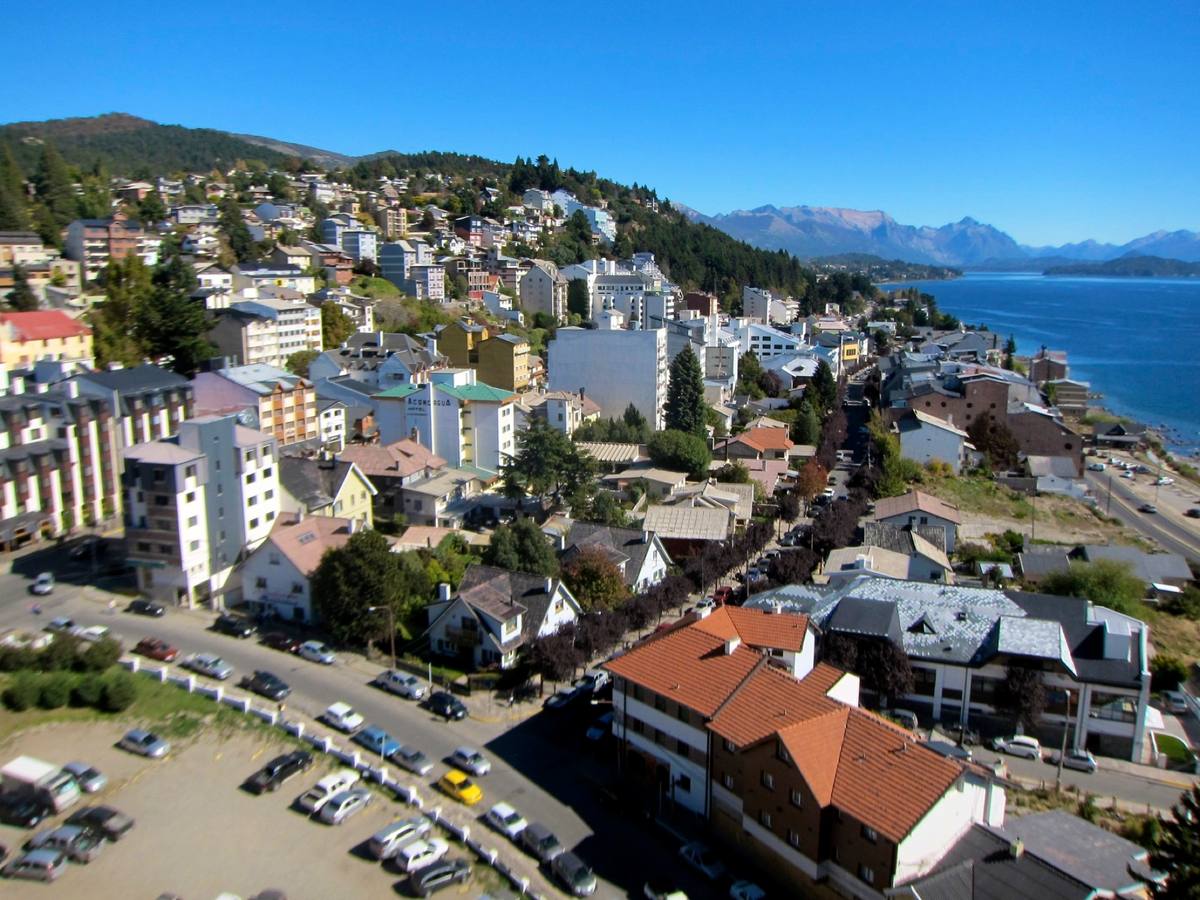
San Carlos de Bariloche sits on the southern shore of Lake Nahuel Huapi, inside the national park of the same name, with the Andes rising directly behind it — the setting alone would justify the flight even without the skiing. The Centro Cívico, a cluster of stone-and-cypress civic buildings from the 1930s built in a deliberately Alpine style, set the architectural tone that much of downtown still follows: steep roofs, exposed timber and stonework that reads more like a Swiss or Bavarian town than most of Argentina.
That Alpine self-image is not just architecture. Bariloche is Argentina’s chocolate capital, with artisanal shops lining Mitre street downtown, and a beer culture — Patagonian craft brewing arguably starts here — to match. It is also, underneath the postcard, an ordinary regional capital: a university, a nuclear-research institute, a fruit and tourism economy, and traffic that has nothing to do with ski season.
Winter — June to September — is when the mountain-town persona takes over: shorter days, lake-effect snow squalls, and Cerro Catedral’s summit visible from Centro Cívico on a clear afternoon.
Sourcing note: every claim here traces to sources/bariloche.json. All primary and official
sources are Spanish-language — no reliable English-language source covers Bariloche’s transit. Two
figures are deliberately left unpublished rather than guessed: línea 55’s first/last departure time
(the operator’s timetable page is down) and any specific Villa Catedral stop-to-lift walking
distance (no source states one). These are standing, disclosed gaps, not oversights — see the
drawbacks and Getting around above — and should be re-checked on a normal seasonal cadence rather
than held against publication. The AEP–BRC flight time is aggregator-sourced, not from an airline’s
own timetable, and should be re-confirmed before it is quoted to a reader making a booking
decision.
Not sure?
Choose somewhere else if…
- Innsbruck
You want this same "real city plus a lift-served mountain by bus" idea with ten timetabled routes instead of one, and every schedule published in a language you probably already read.
- Salt Lake City
You want to skip the rental car from a real city, but with an English-language everything, a hub airport, and a published bus timetable instead of a dead link.
- Chamonix
You want a valley-bus, multi-mountain structure that is actually timetabled end to end, and you are willing to trade Patagonia's Andean lake for the Mont Blanc massif.
This base appears in
Sources & data notes
How this page was verified
Section verification
- Access matrixAugust 18, 2026
- Getting thereAugust 18, 2026
- Getting aroundAugust 18, 2026
- Where to stayAugust 18, 2026
- Living for a seasonAugust 18, 2026
Sources
- Aviso importante sobre la línea 55 a Catedral — Municipalidad de San Carlos de Bariloche — Bariloche Informa · municipal press notice, cited not reproduced · retrieved
- Cambió el recorrido de la línea 55 — ANBariloche (independent regional news outlet) · independent news article, cited not reproduced · retrieved
- El servicio de transporte al Cerro Catedral suma información para usuarios de cara a la temporada invernal — Municipalidad de San Carlos de Bariloche — Bariloche Informa · municipal press release, cited not reproduced · retrieved
- Transporte Urbano de Pasajeros — Municipalidad de San Carlos de Bariloche · official municipal transport page, cited not reproduced · retrieved
- Mi Bus — San Carlos de Bariloche (operator site and line roster) — Transporte Amancay SRL (Mi Bus) · operator site, cited not reproduced · retrieved
- Public transportation — Bariloche Turismo (official municipal tourism board) · official tourism-board page, cited not reproduced · retrieved
- Aeropuertos Argentina — Bariloche (BRC): líneas aéreas — Aeropuertos Argentina (airport concessionaire) · official operator site, cited not reproduced · retrieved
- Piedras Blancas Bariloche (official complex site) — Piedras Blancas (private concessionaire) · operator site, cited not reproduced · retrieved
- Centro de Ski Nórdico Bariloche — cómo llegar — Centro de Ski Nórdico (private concessionaire) · operator site, cited not reproduced · retrieved
Images

Page last reviewed August 18, 2026. Transit routes, schedules and fares change between seasons — check the operator before you travel. Mountain specifications for the northeastern US are maintained separately on NESKIS.