Banff & Lake Louise
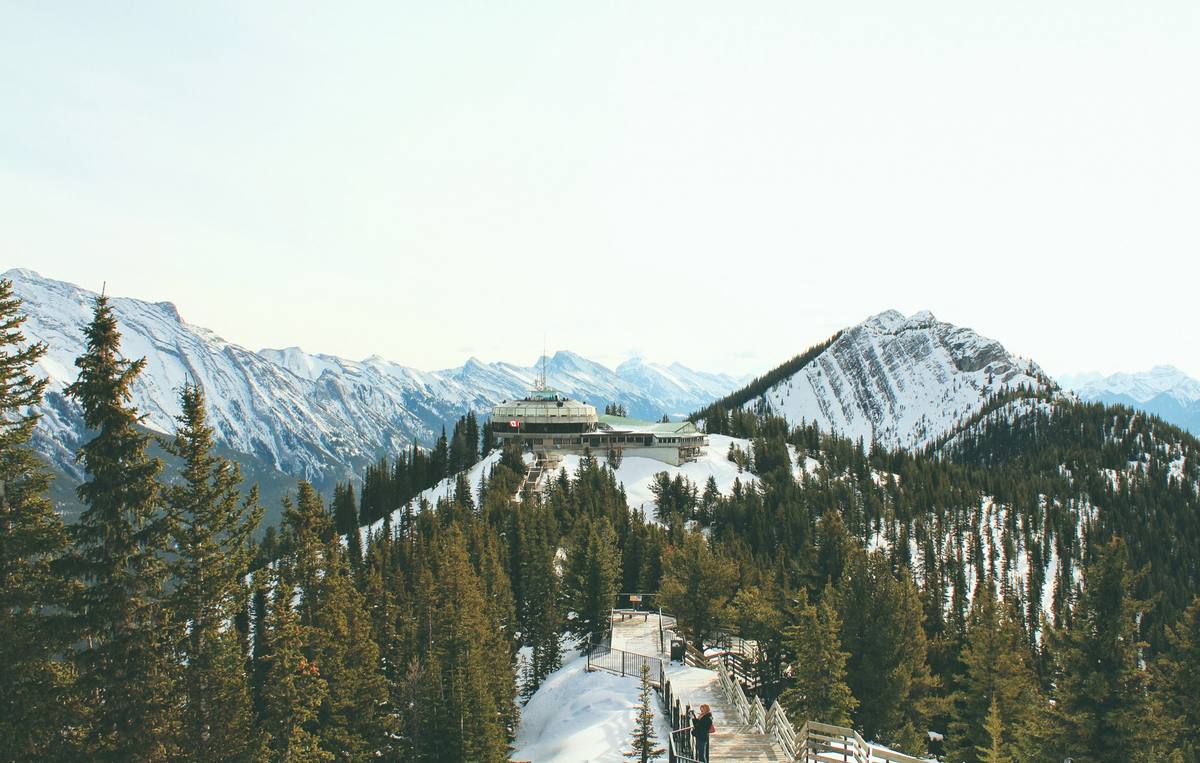
Three lift-served mountains, every one of them reachable on a free shuttle from a hotel doorstep — the strongest car-free ski base in North America, sitting inside a national park that will not let you buy your way in.
Car-free arrival is practical, daily needs are walkable or transit-served, and at least 80% of the ski areas in this page’s matrix are reachable on published transit during normal ski hours. Verified August 20, 2026.
EveningsLast ski shuttle off Sunshine 18:30 in winter 2025/26; Roam Route 3 to Canmore leaves Banff until 23:29 daily
At a glance
- Ski areas
- 5
- Within 30 min
- 4
- Closest
- 15 minPublic bus
- Reachable by transit
- 4 of 5
- Arriving from
- Calgary International (YYC)1h 55m by public bus
- Groceries on foot
- YesYear-round town
The verdict
Verdict
Come for three real mountains from one walkable town. You will not need a rental car. Nothing else in North America works this cleanly. Shuttles run from your hotel door to Norquay, Sunshine and Lake Louise, a bus in from Calgary airport, two supermarkets and a hospital on foot, and track-set Nordic trails on a town bus route. It also handles a mixed group without compromise — Norquay for a half day and night skiing, Sunshine for the long season, Lake Louise when you want scale.
Do not come for slopeside. Banff is a town twenty to sixty minutes from every lift, and a week here means real time on buses. Do not come if cold defeats you: the upper mountains at Sunshine and Lake Louise are high, treeless and continental, and a January morning at minus twenty-five is ordinary rather than remarkable. And do not come planning to buy in — the park's eligible residency rule makes that impossible unless you work here.
Is this base for you?
Who this suits
Best for
- Car-free ski groups. Hotel-door shuttles reach Norquay, Sunshine and Lake Louise, while Roam covers Banff townsite and the Tunnel Mountain Nordic trailhead.
- Mixed alpine ambitions. Norquay supplies half days and night skiing, Sunshine the long season, and Lake Louise the scale and the back bowls.
- Visitors who need a functioning town after skiing. Banff Avenue puts two supermarkets, the bus depot, the hospital and most restaurants within about ten minutes on foot.
Depends on you
- A national-park townsite. Fixed boundaries and eligible-residency rules prevent speculative sprawl and second-home buying, but also make ownership unavailable unless you work here.
- The SkiBig3 shuttle model. Holding SkiBig3, Ikon, Mountain Collective or Rocky Mountain Passport access makes the buses free; a non-skier or other ticket holder may need a taxi.
- Three separate mountains. You can match Norquay, Sunshine or Lake Louise to the day's plan, but none is skiable from town and the longest hotel-door trip takes about an hour.
The honest part
Things you should know
- 01
The car-free case rests entirely on the ski shuttles, and the SkiBig3 buses to Sunshine and Lake Louise are free only with a lift product — a SkiBig3 ticket or pass, Ikon, Mountain Collective or Rocky Mountain Passport. Turn up with a single-day ticket bought elsewhere, or be the non-skier in the group, and you are paying for a taxi. Norquay's own shuttle is the exception; it carries anyone.
- 02
Sunshine is a two-stage arrival and the second stage can fail. The bus drops you in a parking lot 8 km west of town, and the only way to the skiing is an 18-minute gondola. When that gondola goes on wind hold you are standing in a lot with a lift ticket you cannot use and no way home until the next scheduled bus.
- 03
Banff's bed supply is frozen by law and will not improve. The townsite is 3.93 square kilometers with boundaries fixed by federal Order in Council, commercial floor space has been capped since 1998, and the eligible residency rule blocks speculative building and buying. Demand keeps climbing against a supply that cannot move, and February room rates show it.
The access matrix
What you can ski from Banff
Typical door-to-lift times in normal winter conditions. ● marks areas reachable on published transit during ski hours. Every row is dated below.
- On foot or skis
- Public transport
- Lift from town
- Needs a vehicle
| Ski area | Getting there | Time | Best for | Main drawback |
|---|---|---|---|---|
| Transit-served. Tunnel Mountain Winter Trails | Public busRoam Route 2 · year-round · time is a bus-plus-walk estimateEvidence & assumptions for Tunnel Mountain Winter TrailsRoam's own Route 2 page confirms year-round service between Tunnel Mountain, downtown Banff and the Fairmont Banff Springs; Parks Canada lists the route as the transit access for the Tunnel Mountain trailhead. Roughly 8 km of loops, of which about 2.6 km at Trailer Court are lit after dark. The 15 minutes is a bus-plus-walk estimate from central Banff Avenue — Roam publishes no journey time for the hop. Source [3] Banff Local Route 2 – Tunnel Mountain – Fairmont — verified August 20, 2026 | [3] | Track-set Nordic skiing, including lit evening loops | Low, forested and flat — no views and no descent worth the name |
| Transit-served. Mt. Norquay | Resort shuttleNorquay's own free shuttle on two Banff hotel loops · no lift ticket requiredEvidence & assumptions for Mt. NorquayNorquay runs its own free shuttle on two Banff hotel loops, and unlike the SkiBig3 buses it does not require a lift ticket. The drive itself is about 10 minutes; the rest is the pickup loop. Norquay is the only Banff area with night skiing. Source [1] Shuttle service — Mt. Norquay — verified August 16, 2026 | [1] | Half days, night skiing, and steep front-side pitch | The smallest of the three by a wide margin, and the switchbacked access road is the first thing to close in a storm |
| Transit-served. Banff Sunshine | Resort shuttleHotel shuttle · pickups 07:40–10:45, returns 13:00–18:30 · winter 2025/26 timesEvidence & assumptions for Banff SunshineWinter 2025/26 shuttle departed Banff hotels between 07:40 and 10:45, returning from Sunshine at 13:00, 14:15, 15:30, 16:45 and 18:30. The base area is 8 km (5 mi) west of town by Sunshine's own reckoning; the gondola runs 10 minutes to Goat's Eye and 18 minutes to the village. Source [2] SkiBig3 Ski Shuttle — Banff hotels to all three resorts — verified August 16, 2026 | [2] | A long season and high, open alpine terrain | The bus only reaches a parking lot — you still owe an 18-minute gondola ride to reach the skiing |
| Canmore Nordic Centre | DriveDrive only in winter · parking needs a Kananaskis Conservation PassEvidence & assumptions for Canmore Nordic CentreRoam Route 3 links Banff and Canmore year-round, but the routes that serve the Nordic Centre itself (Route 5 May–October, Route 12 reduced to downtown and Palliser Lane from late September) do not run there in ski season. Parking also requires a Kananaskis Conservation Pass. Drive time is an estimate. Verified August 16, 2026 | Serious Nordic skiing at a purpose-built race venue | The one thing on this page you genuinely cannot reach on transit in winter | |
| Transit-served. Lake Louise | Resort shuttleFree shuttle · hotel pickups 07:20–11:10 · winter 2025/26; Roam 8X serves the village, not the hillEvidence & assumptions for Lake LouiseFree shuttle picked up at Banff hotels from 07:20 to 11:10 in winter 2025/26, with returns at 08:20, 12:15, 14:00, 15:30, 16:30 and 17:30. The 60 minutes is an estimate — the operator publishes pickup times but not arrivals; the drive alone is about 45–50 minutes. Roam's Route 8X also links Banff and Lake Louise year-round (CAD 12.50 adult in 2026), but it serves Lake Louise Village and the lakeshore, not the ski hill. Source [2] SkiBig3 Ski Shuttle — Banff hotels to all three resorts — verified August 16, 2026 | [2] | Scale, and the back bowls | 57 km each way on the Trans-Canada, and the front face is bitterly cold and wind-scoured in midwinter |
Where to stay
Banff townsite is the answer for almost everyone, and the reason is mechanical rather than aesthetic: the ski shuttles pick up at hotel doors here and nowhere else. The two shuttle loops between them serve the Fairmont Banff Springs, the Mount Royal parking lot, Banff Park Lodge, Canalta Lodge, Banff Caribou Lodge, the Fox, the Kenrick, Ptarmigan Inn and Banff Rocky Mountain Resort. Book somewhere on a loop and the car question disappears. Book somewhere clever and cheap that is not on one, and you have quietly bought yourself a cold walk in the dark every morning.
Banff Avenue and the streets immediately west — Bear, Wolf, Caribou — are the practical core. Two supermarkets, the bus depot, the hospital and most of the restaurants are inside a ten-minute walk of each other.
Tunnel Mountain, up the hill northeast of town, is where the larger condo-style properties sit. It is quieter, it is on Roam Route 2, and the track-set Nordic loops start there. It is also a genuine hill: walking back up after dinner in February is a decision, not a stroll.
Lake Louise Village is a separate proposition, not a suburb. Staying there puts you next to the best terrain and an hour from any real town. Roam’s Route 8X does link the village and Banff year-round — CAD 12.50 adult each way in 2026, reservations recommended in summer — but it is a regional bus to a town an hour away, so choosing Lake Louise as a base still means choosing to stay there.
Getting there
Calgary International is the gateway and it is a good one: a major hub with direct transatlantic service, roughly two hours out by bus. Banff Airporter and the Brewster Express both run scheduled services from inside the terminal, multiple departures daily, and both will drop at Banff hotels. Reported journey times cluster between 1h45 and 2h00 depending on road conditions; budget two hours in winter and more after a storm on the Bow Valley stretch.
Driving from Calgary is about ninety minutes on the Trans-Canada. It is a fast, dull, four-lane road that becomes genuinely dangerous in a whiteout, and the RCMP close it more often than visitors expect.
Everyone entering the park needs a Parks Canada pass, checked at the highway gates. It is a per-day or annual charge and it applies whether you arrive by car or by bus.
Getting around
This is what Banff is for. Three alpine areas, three free shuttle networks, no car.
Mt. Norquay runs its own bus on two hotel loops and does not ask to see a lift ticket. Sunshine and Lake Louise are served by the SkiBig3 shuttles, which are complimentary with a SkiBig3 ticket or pass, Ikon, Mountain Collective or Rocky Mountain Passport — that condition is the single most important operational fact on this page, and it is the thing most write-ups skip. In winter 2025/26 the Sunshine buses left Banff hotels between 07:40 and 10:45 and came back at 13:00, 14:15, 15:30, 16:45 and 18:30. The Lake Louise buses picked up from 07:20 to 11:10 and returned at 08:20, 12:15, 14:00, 15:30, 16:30 and 17:30. Seats are first-come; the schedules change without notice; check the app the night before.
Inside town, Roam is a real transit system rather than a resort courtesy bus. Routes 1 and 2 cover the townsite year-round, Route 2 reaches the Tunnel Mountain trailheads, Route 3 runs to Canmore daily until 23:29 on the current schedule, and Route 8X links Banff with Lake Louise Village year-round at CAD 12.50 adult each way. What Roam does not do is serve the ski hills: no route reaches the Sunshine, Norquay or Lake Louise base areas, so every ski leg belongs to the resort shuttles above.
The honest gap is Nordic. The town trails are excellent and bus-served, but the Canmore Nordic Centre — the region’s serious cross-country venue, with snowmaking and lit trails — has no winter transit link from Banff. Nakiska, over in Kananaskis, is roughly seventy-five minutes by car with no transit at all; it is a Calgary day-trip hill and this page deliberately leaves it out of the matrix rather than pretending it belongs to Banff.
Who it suits
- Anyone who does not want to drive. The strongest case, and close to unique in North America. Fly to Calgary, take a bus, take shuttles for a week, fly home. No rental, no parking, no icy pre-dawn drives.
- Mixed-ability groups. Norquay for a half day and a first-timer, Sunshine for a long steady season, Lake Louise for someone who wants terrain. All from the same bed.
- Long-season skiers. Sunshine typically runs from November into late May, which is a longer window than almost anything else on this site.
It suits slopeside purists least. If your ideal is clicking out at the door of your room, Banff is the wrong shape entirely — you are commuting twenty to sixty minutes each way, every day.
Living for a season
Banff has a constraint no other destination on this site has, and it is worth understanding before you plan anything.
The town sits inside Banff National Park, and under the National Parks Lease and License of Occupation Regulations you must be an eligible resident to live there. In practice that means your primary employment is in the park, or you operate a business inside the park whose day-to-day running requires your presence, or you fall into one of a small number of related categories (retired eligible residents, dependants, and so on). Parks Canada enforces this with statutory declarations at sale and mortgage, and on demand; a false declaration is a criminal offense.
The consequences are worth spelling out. You cannot move to Banff and then look for work — the job comes first, legally as well as practically. You cannot buy a place to use on weekends. There is no investor market, no second-home market, and therefore no speculative construction to loosen supply. The townsite boundary is fixed by federal Order in Council at 3.93 square kilometers and commercial floor area has been capped since 1998. Housing is correspondingly severe: most seasonal workers are in employer employee housing, and the line for anything else is long.
Non-Canadians need a work permit before any of this becomes relevant. The usual route for a ski season is International Experience Canada — check current eligibility and quotas well before you book anything, because the permit, not the job, is the binding constraint.
The compensation is that Banff is a genuine year-round town of roughly eight thousand people, not a seasonal camp. There is a hospital, a school, a library and a summer economy larger than the winter one. A season here is a life rather than a stint.
What the town is like
Banff Avenue is a tourist street and does not apologize for it: souvenir shops, outdoor brands, and in high season a sidewalk crowd that has nothing to do with skiing. Behind it, on Bear and Wolf and Caribou, there is an ordinary small town with a hardware store, a grocery run and residents who have been there thirty years.
The setting does most of the work. Cascade Mountain closes the north end of the main street and Mount Rundle the south; the Bow River runs a block off the strip; elk wander the golf course. It is spectacular in a way that photographs badly and reads as cliché until you are standing in it.
What is unusual is how little of the town is negotiable. The boundary cannot move, the commercial space cannot grow, and the people who live there have to work there. That produces a place with a stable resident population and an unusually strong civic culture — and, simultaneously, the tightest housing market of any ski town covered on this site. Both facts come from the same rule.
Source note: the Norquay row cites the operator’s own shuttle page, and the Sunshine and Lake Louise rows cite the registered SkiBig3 hotel-shuttle record — which publishes no departure times, so the times in those notes are the winter 2025/26 pattern, not confirmed by the cited source. The Tunnel Mountain row cites Roam’s Route 2 page, and the Canmore evening claim cites Roam’s Route 3 schedule; the Sunshine distance and the 8X facts rest on the registered Sunshine access and Roam 8X records. Roam publishes no ski-hill routes, so no Roam source can confirm or deny the resort-shuttle departure times.
Not sure?
Choose somewhere else if…
- Canmore
You want the same three mountains without the park's rules. Canmore sits outside the national park boundary, so there is no eligible residency test, property is genuinely purchasable and beds are cheaper — at the cost of a 25-minute drive to Banff, a park pass every time you enter, and no ski shuttle from your door.
- Whistler
You want one enormous mountain and a village you can ski back into, and you will trade Banff's cold, dry continental snow for maritime storms that sometimes arrive as rain at the base.
Full comparison - Salt Lake City
Car-free multi-mountain access is the whole point of the trip. Salt Lake puts four canyons on scheduled public buses with a major hub airport forty minutes from the lifts, against Banff's two-hour bus and shuttles that depend on holding a lift ticket.
This base appears in
Sources & data notes
How this page was verified
Section verification
- Access matrixAugust 16, 2026
- Getting thereAugust 16, 2026
- Getting aroundAugust 16, 2026
- Where to stayAugust 16, 2026
- Living for a seasonAugust 16, 2026
Sources
- Shuttle service — Mt. Norquay — Mt. Norquay · official operator page, cited not reproduced · retrieved
- SkiBig3 Ski Shuttle — Banff hotels to all three resorts — SkiBig3 · official operator page, cited not reproduced · retrieved
- Banff Local Route 2 – Tunnel Mountain – Fairmont — Roam Transit (Bow Valley Regional Transit Services Commission) · official operator page, cited not reproduced · retrieved
- Canmore – Banff Regional Route 3 — Roam Transit (Bow Valley Regional Transit Services Commission) · operator schedule, cited not reproduced · retrieved
- Lake Louise – Banff Express Route 8X — Roam Transit (Bow Valley Regional Transit Services Commission) · operator schedule, cited not reproduced · retrieved
- Getting here — Banff Sunshine Village — Banff Sunshine Village · official operator page, cited not reproduced · retrieved
- Northeast resort profiles — NESKIS · sibling property; mountain specifications maintained there · retrieved
Images
.jpg)
Page last reviewed August 16, 2026. Transit routes, schedules and fares change between seasons — check the operator before you travel. Mountain specifications for the northeastern US are maintained separately on NESKIS.