Vail, Avon & the Eagle Valley
Two of Colorado's largest mountains linked by a free town bus, a fare-free county bus and a free gondola — the most complete car-free ski chain in the American Rockies, wrapped around the most expensive village in it.
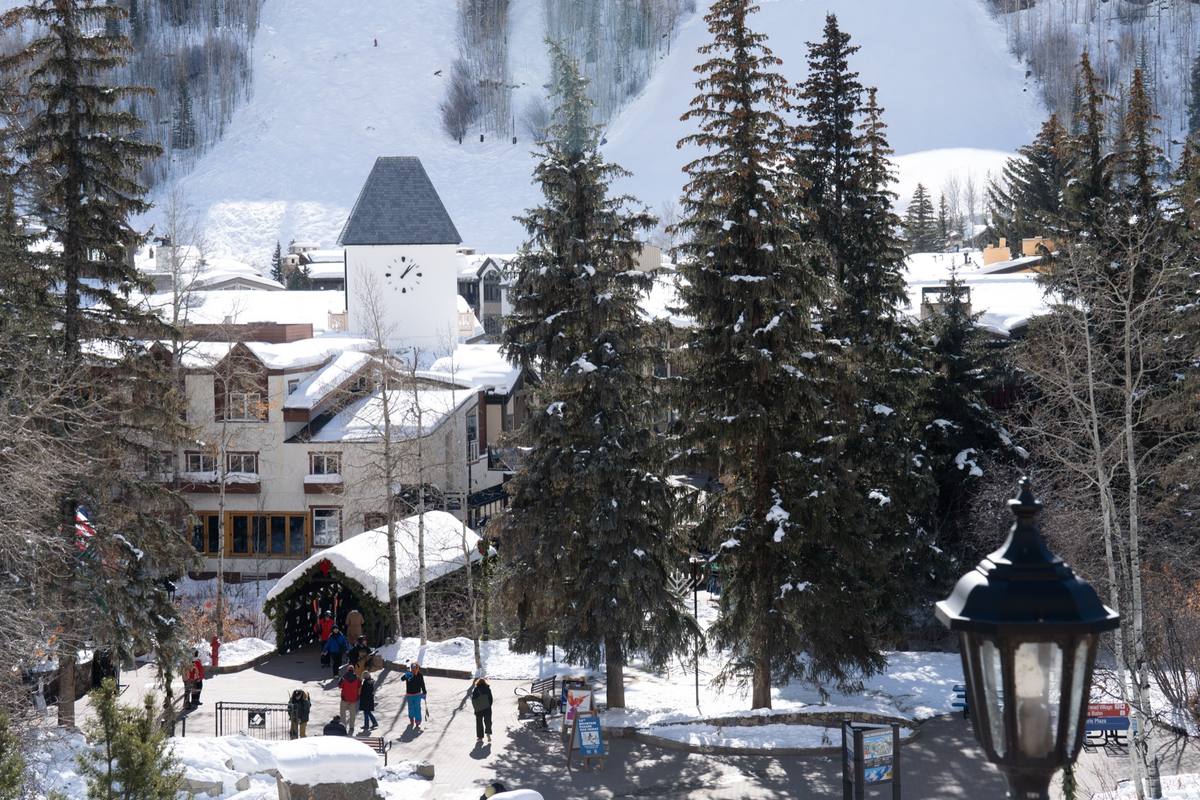
Car-free arrival is practical, daily needs are walkable or transit-served, and at least 80% of the ski areas in this page’s matrix are reachable on published transit during normal ski hours. Verified August 20, 2026.
EveningsVail Transit's West Vail evening bus runs to 2 a.m. on the summer 2026 grid, the 2 a.m. departure by request only; the winter 2026-27 schedule was not published as of 20 August 2026. Core Transit's Highway 6/Valley spine finishes with a 1:05 a.m. departure from Vail running through to Gypsum.
At a glance
- Ski areas
- 8
- Within 30 min
- 3
- Closest
- 10 minPublic bus
- Reachable by transit
- 7 of 8
- Arriving from
- Denver International (DEN)2h 30m by public bus
- Groceries on foot
- YesYear-round town
The verdict
Verdict
Come for two big mountains and the American Rockies' strongest car-free ski week. Vail runs a free town bus year-round. Its winter in-town shuttle comes every five to ten minutes. Core Transit carries you fare-free down the valley to EagleVail, Avon, Minturn and Edwards. A free gondola lifts you off Avon Station onto Beaver Creek. And Bustang runs fifteen times a day from Denver Union Station to a stop in the middle of Vail for the price of a bus ticket. No other Colorado base assembles that whole chain.
Do not come if the budget is tight and you refuse to sleep down-valley. Vail Village is among the most expensive lodging in North America, and the cheap beds in Eagle and Gypsum sit forty-five minutes and a transfer from the gondola. Do not come for quiet, either: I-70 runs through the middle of this valley, CDOT meters the Eisenhower Tunnel eastbound on Sunday afternoons, and Vail Pass shuts in storms.
Is this base for you?
Who this suits
Best for
- Colorado visitors who do not want to drive. Bustang reaches Vail, the town bus runs every five to ten minutes in winter, and Core Transit links Beaver Creek and down-valley towns.
- Mixed-ability groups. Beaver Creek's lower mountain serves beginners while Vail's Back Bowls and Blue Sky Basin give experts an enormous full-day objective.
- Budget-conscious skiers willing to trade minutes for money. Edwards, Eagle and Gypsum offer ordinary services and lower-cost beds on the same Core Transit valley spine.
Depends on you
- Vail Village's designed Alpine setting. Its pedestrian lanes are genuinely pleasant and place lifts on foot, while the town was purpose-built in the 1960s rather than grown organically.
- Vail and Beaver Creek on one valley bus. Epic holders gain two large mountains without driving, while anyone seeking independent areas will find both under the same corporate system.
- The long Eagle Valley. West Vail, Avon, Edwards, Eagle and Gypsum progressively add ordinary shops and cheaper beds, while each step west lengthens the daily trip to Vail Mountain.
The honest part
Things you should know
- 01
Vail Village is one of the most expensive places to sleep in North America, and the price does not stop at the bed — lift tickets, ski storage, a sandwich at the top of Gondola One and a parking space in the village all carry the same premium. The valley's answer is to move down it, which works, but a Vail Village week bought at full rate is a genuinely different order of expense from Summit County or Winter Park.
- 02
I-70 runs straight through this valley, and it is the problem as well as the access. Eastbound on a Sunday afternoon is the corridor's defining frustration: CDOT meters the Eisenhower Tunnel when volumes exceed capacity, which is most weekends and worst between about one and six in the afternoon, and a two-hour drive back to Denver routinely becomes four. Vail Pass itself closes repeatedly through the winter for storms, avalanche control and crashes, which takes the whole Summit County half of this matrix off the table for the day.
- 03
The valley is forty miles long and the cheap beds are at the far end. A room in Eagle or Gypsum can cost a fraction of Vail Village, but it is a 45-minute Core Transit ride to the Vail Transportation Center each way on a Valley schedule that thins to hourly in the evening, and Gypsum is one of only three destinations where Core Transit still charges a fare. Budget the commute, not just the rent.
The access matrix
What you can ski from the Eagle Valley
Typical door-to-lift times in normal winter conditions. ● marks areas reachable on published transit during ski hours. Every row is dated below.
- On foot or skis
- Public transport
- Lift from town
- Needs a vehicle
| Ski area | Getting there | Time | Best for | Main drawback |
|---|---|---|---|---|
| Transit-served. Vail Mountain | Public busWalk under 10 min from most Village beds · free In-Town Shuttle every 5–10 min, last season's gridEvidence & assumptions for Vail MountainEstimated, not measured. From most Vail Village lodging the Gondola One base is a walk of under ten minutes; the free In-Town Shuttle links Golden Peak, Vail Village and Lionshead every five to ten minutes on the winter grid. Verify the 2026-27 schedule at vail.gov — as of 20 August 2026 only the summer grid was published, and it carries no In-Town tab, so the winter frequency is last season's pattern. Source [4] Town of Vail Bus Information — verified August 20, 2026 | [4] | Back Bowls and Blue Sky Basin — a single mountain that fills the whole week | Everything at the base — lift ticket, lunch, ski storage, a bed — is priced at the top of the American market |
| Transit-served. Vail Nordic Center | Public busFree Golf Course bus route · twice an hour on the summer grid · winter times unpostedEvidence & assumptions for Vail Nordic CenterEstimated. At the Vail Golf & Nordic Clubhouse, 1775 Sunburst Drive, served by the Golf Course route of the free Town of Vail bus from the Vail Transportation Center — the summer 2026 grid shows a Club House stop twice an hour, with winter times unpublished in August. Run by the Vail Recreation District, with its own trail fee separate from any lift ticket. Source [5] Summer Bus Schedule 2026 — Town of Vail — verified August 20, 2026 | [5] | Groomed skate and classic track without leaving the free bus network | Valley-floor trails at 8,200 feet, so they thaw and refreeze early — the 2025-26 season closed on 10 March |
| Transit-served. Copper Mountain | Drive or shuttleCar-free: Bustang West Line to Frisco + Summit Stage · about 2 hours door-to-lift each wayEvidence & assumptions for Copper MountainEstimated by car over Vail Pass. Car-free it is Bustang West Line from the Vail Transportation Center to Frisco Transit Center (published as roughly 40 minutes, 15 round trips daily, year-round) then fare-free Summit Stage to Copper — budget about two hours door-to-lift each way and check the last westbound Bustang before you commit. Source [1] Bustang West Line — Denver Union Station to Grand Junction — verified August 16, 2026 | [1] | Naturally divided terrain — beginners west, experts east — and the closest big mountain over the pass | Vail Pass sits between you and it, and it closes for storms, avalanche work and crashes through the winter |
| Transit-served. Breckenridge | Drive or shuttleCar-free: Bustang to Frisco + free Summit Stage · about 2¼ hours each wayEvidence & assumptions for BreckenridgeEstimated by car via I-70 and CO-9. Car-free is Bustang West Line to Frisco, then the fare-free Summit Stage Breckenridge route — around two and a quarter hours each way. CDOT's Snowstang serves Breckenridge from Denver but not from Vail, and it runs weekends and holidays only. Source [2] Transit / Summit Stage — free county-wide bus — verified August 16, 2026 | [2] | A day that ends in a real Main Street rather than a base village | The busiest resort town in Colorado on a weekend, reached over the corridor's two worst chokepoints |
| Transit-served. Beaver Creek | Public busVail Transit + fare-free Core Transit to Avon + free Riverfront Express gondolaEvidence & assumptions for Beaver CreekEstimated door-to-lift by transit from Vail Village. Chain is Vail Transit to the Vail Transportation Center, Core Transit Highway 6 or Valley route to Avon Station (fare-free), then a 400-foot walk to the free Riverfront Express gondola — a three-minute ride to Beaver Creek Landing and the chairlifts. By car from Vail Village it is roughly 25-30 minutes to the Beaver Creek base. The Avon/Beaver Creek Connector into Beaver Creek Village is seasonal and run by Town of Avon Transit with Core Transit; winter 2026-27 timings were not published in August 2026. Source [6] Highway 6 Route — bus schedule — verified August 20, 2026 | [6] | Shorter lift lines than Vail, and beginner and lower-intermediate terrain | Two operators and a gondola between you and the snow, so a missed connection costs half an hour |
| Transit-served. Keystone | Drive or shuttleCar-free: Bustang to Frisco + Summit Stage X Flyer · night session means drivingEvidence & assumptions for KeystoneEstimated by car via I-70 and US-6. Car-free is Bustang West Line to Frisco then the fare-free Summit Stage X Flyer / Swan Mountain Flyer. Night skiing and the transit chain are mutually exclusive; if you want the evening session you are driving. Source [2] Transit / Summit Stage — free county-wide bus — verified August 16, 2026 | [2] | Night skiing, on the days Keystone runs it — check the calendar before you drive | Nearly an hour each way by car, and the night session strands you well after the last bus back over Vail Pass |
| Ski Cooper | DriveCore Transit Leadville route is commuter-shaped · Ski Cooper is not a listed stopEvidence & assumptions for Ski CooperEstimated by car from Vail Village via Minturn, US-24 and Battle Mountain. Core Transit runs Vail to Leadville over Tennessee Pass, but the published pattern is morning northbound into Vail and evening southbound home, and Ski Cooper is not listed as a stop; the Leadville route is also one of the three where a fare still applies. All three facts are from the operator's current route page; re-check when the winter schedule posts. Source [8] Leadville Route — route overview — verified August 20, 2026 | [8] | Cheap lift tickets, no crowd, and gentle terrain at the top of Tennessee Pass | Core Transit's Leadville route is shaped for commuters into Vail, so it is no use for getting out to the hill in the morning |
| Transit-served. Arapahoe Basin | Drive or shuttleCar-free: Bustang to Frisco + X Flyer · allow 2½ hours each wayEvidence & assumptions for Arapahoe BasinEstimated by car via I-70 and US-6 over Loveland Pass. Car-free is Bustang West Line to Frisco then the fare-free Summit Stage X Flyer / Swan Mountain Flyer; allow two and a half hours each way. Arapahoe Basin is an Ikon Pass destination on the 2025-26 list; eligibility has changed in recent seasons, so check the current one. Source [2] Transit / Summit Stage — free county-wide bus — verified August 16, 2026 | [2] | Steep, high, unmanicured terrain and a long spring season | The furthest point in this matrix and the most exposed — an hour each way plus Loveland Pass weather on top of Vail Pass |
Sourcing note. The Bustang and Summit Stage claims on this page cite CDOT and Summit County directly. Town of Vail transit and Core Transit (the former ECO Transit, now run by the Eagle Valley Transportation Authority) are now in the source register: the In-Town, West Vail and Golf Course claims cite vail.gov’s bus pages, and the valley-bus, fare and Leadville claims cite coretransit.org’s route pages and schedule PDFs, all read on 20 August 2026. Still unregistered: avon.org for the Riverfront Express gondola and vailrec.com for the Nordic Center’s own operation — those two claims ride on the resort-profile fallback until they are added. One live caveat throughout: in August 2026 both operators were publishing summer grids only (Vail’s runs 8 June to mid-December, Core’s 12 April to 21 November), so every winter frequency below is last season’s pattern and needs re-checking in November.
Where to stay
This is the whole decision, and it is worth more thought here than in almost any other American ski destination, because the valley runs forty miles and the price runs with it.
Vail Village is the reason people come and the reason they complain. It is a pedestrian core of faux-Tyrolean buildings around the base of Gondola One, and it works exactly as advertised: you walk to the lift, you walk to dinner, you never touch a vehicle. It is also priced at the absolute top of the North American market, and in February you will pay for the privilege of being fifty meters closer to the gondola than someone in Lionshead.
Lionshead is the second base, ten minutes west on the free In-Town Shuttle, with its own gondola. Newer, blockier and marginally cheaper.
West Vail is where the town’s own workforce shops. The City Market on the North Frontage Road is the practical supermarket for anyone staying in Vail, the lodging is ordinary, and the West Vail bus routes run to two in the morning on the summer grid. If you want Vail without Vail Village pricing but with Vail Village access, this is it.
Minturn sits over the shoulder on US-24, a former Denver & Rio Grande railroad town that never became a resort and does not pretend to be one. Locals like it for exactly that reason. Core Transit’s Minturn route links it to Vail fare-free, but the service is a commuter route, not a ski shuttle — check the last bus before you plan an evening.
Avon is the functional base for Beaver Creek and the most under-rated bed in the valley. It has a City Market and a Walmart Supercenter, both walkable from town; it has Avon Station, which is both a Bustang stop and a Core Transit hub; and it has the Riverfront Express gondola, four hundred feet away, which is free and puts you on Beaver Creek in three minutes. You get the mountain and a normal grocery bill.
Edwards, Eagle and Gypsum are where the workforce actually lives. Edwards has the Riverwalk and a real restaurant scene; Eagle and Gypsum are ordinary Colorado towns with ordinary Colorado prices and the airport. All three are on Core Transit’s Valley route. All three cost you a commute — from Eagle it is about forty-five minutes each way to Vail, and Gypsum is one of the three destinations where Core Transit still charges a fare.
Getting there
Denver International is where nearly everyone lands. The commercial answer is a mountain bus — Epic Mountain Express and its competitors run shared vans daily to Vail, Avon and Beaver Creek, advertised at roughly two and a half hours and priced per seat rather than per vehicle. The public answer is cheaper and slower: RTD’s A Line from the airport to Denver Union Station, then the Bustang West Line, which runs fifteen times a day in each direction, year-round, and stops at the Vail Transportation Center on the South Frontage Road, Avon Station, and the Chambers park-and-ride in Eagle. The first eastbound leaves Vail at 6:30 a.m. and the last westbound reaches Vail at 7:35 p.m. Nothing about this is a ski shuttle; it is ordinary state intercity bus, which is precisely why it is reliable.
Eagle County Regional Airport (EGE) is thirty-odd miles west of Vail and about thirty-five minutes by road, with seasonal service that thickens sharply in winter. It is the better arrival if you can get a fare — but check the schedule before booking a connection, because the route map shrinks in the shoulder seasons. Core Transit’s Valley route serves EGE directly; it is one of the three trips on the network where a fare is charged.
Driving from Denver is about two hours in good conditions on I-70. Read the drawbacks before you assume that number holds on a Sunday.
Getting around
Vail runs one of the largest free bus systems in the United States — the town’s own description — and it is the single fact that makes this destination work. Service is free, year-round, and covers the In-Town Shuttle between Golden Peak, Vail Village and Lionshead every five to ten minutes in winter, plus outlying routes to West Vail, East Vail, Sandstone, Lions Ridge and the Golf Course at fifteen to thirty minutes at peak. The evening West Vail bus runs past midnight and the final departure is at two in the morning by request. Real-time arrivals are at ride.vail.gov.
Beyond the town line, Core Transit — the agency Eagle County riders knew as ECO Transit — is now fare-free on almost everything. Fares apply only to and from EGE, Gypsum and Leadville; everything else, including the Valley route from Vail to Edwards and Eagle, the Highway 6 local between Vail and Edwards via EagleVail and Avon, and the Minturn route, is free to board. No cash is taken on board, so download the app or ride the free routes.
Beaver Creek is reached from Avon two ways, both free: the Riverfront Express gondola from Avon Town Center to Beaver Creek Landing, three minutes, open to the public in winter; and the seasonal Avon/Beaver Creek Connector, run by Town of Avon Transit with Core Transit, into Beaver Creek Village itself.
The gap is Summit County. Bustang plus Summit Stage genuinely gets you to Copper, Breckenridge, Keystone and Arapahoe Basin and back the same day, but it is a two-to-two-and-a-half-hour chain each way with a transfer at Frisco, and CDOT’s weekend-only Snowstang serves those mountains from Denver rather than from Vail. Treat those rows as achievable, not casual.
Who it suits
- Anyone who does not want to drive in Colorado. This is the strongest case in the state and one of the strongest in the country. Arrive by bus, ski two large mountains, buy groceries and go out in the evening without ever holding a key.
- Mixed-ability groups. Beaver Creek’s lower mountain is the gentlest good beginner terrain in the valley; Vail’s Back Bowls will hold a strong skier for a week. Same bed, different mountain, one free gondola in between.
- Budget-conscious skiers willing to trade minutes for money. Edwards, Eagle and Gypsum are a different economy from Vail Village and they are all on a fare-free bus.
It suits least the skier chasing steep, technical terrain. Vail is enormous and the Back Bowls are genuinely good in the right week, but the fall line here is gentler than Little Cottonwood or Jackson, and if that is what your trip is about you are paying a premium for acreage you do not want.
Living for a season
The valley supports a real year-round economy — two Vail Resorts mountains, a regional hospital in Vail, an airport in Gypsum, a school district, and towns down-valley that do not empty in April. Getting hired is not the hard part.
Housing is. Eagle County has been in an openly acknowledged workforce housing shortage for years: the county’s own assessment puts the shortfall in the thousands of units, the Town of Vail buys deed restrictions on existing homes through its InDEED program specifically to keep them occupied by people who work here, and it broke ground in 2026 on a large locals-only rental project. Take employer housing if it is offered; if it is not, look down-valley and start in the summer. The county’s housing assessment is not yet in this site’s source register, so the warning above rests on reporting rather than on a figure we have verified ourselves.
What the town is like
Vail is not an old town. It was built from nothing in the 1960s in a deliberately Alpine idiom, and the seams show: the village is a pedestrian stage set that happens to be genuinely pleasant to walk around, sitting immediately below an interstate. You hear I-70 from parts of it. That is the honest character of the place — a very well-run resort municipality with a highway through its middle and a mountain that justifies both.
The rest of the valley is more interesting than the village. Minturn is a railroad town with a main street that predates skiing by seventy years. EagleVail and Avon are ordinary, functional and full of people who work up the hill. Eagle and Gypsum are high desert rather than alpine, dry and sunny and noticeably warmer, and they look nothing like the postcard.
What holds it together is the bus. Very few American ski regions have a transit spine that a resident actually uses; this one does, which is why the valley reads as a single place rather than as a resort with satellites.
Not sure?
Choose somewhere else if…
- Summit County
You want to be based at the mountains instead of commuting to them. Breckenridge, Keystone, Copper and Arapahoe Basin are strung along one valley with a fare-free county bus, the beds cost markedly less than Vail Village, and you are on the correct side of Vail Pass when it shuts — at the cost of a much higher base elevation and no mountain the size of Vail.
- Winter Park & Fraser
You want to skip I-70 entirely. Winter Park is reached over Berthoud Pass on US-40 rather than through the Eisenhower Tunnel, and it is the one Colorado resort with a scheduled ski train from Denver Union Station — a single seated leg instead of a bus plus a transfer, and no Sunday afternoon metering to sit in.
- Salt Lake City
Density beats village life for you. Salt Lake puts six major mountains inside an hour of a metro of 1.2 million, with an airport you leave by light rail and city prices for everything — but you sleep in a suburb, you commute up a canyon every morning, and there is no walk home in ski boots at the end of it.
This base appears in
Sources & data notes
How this page was verified
Section verification
- Access matrixAugust 16, 2026
- Getting thereAugust 16, 2026
- Getting aroundAugust 16, 2026
- Where to stayAugust 16, 2026
Sources
- Bustang West Line — Denver Union Station to Grand Junction — Colorado Department of Transportation · operator schedule, cited not reproduced · retrieved
- Transit / Summit Stage — free county-wide bus — Summit County Government, Colorado · official operator page, cited not reproduced · retrieved
- Snowstang — Denver Union Station to Breckenridge — Colorado Department of Transportation · operator schedule, cited not reproduced · retrieved
- Town of Vail Bus Information — Town of Vail, Colorado · municipal transit authority page, cited not reproduced · retrieved
- Summer Bus Schedule 2026 — Town of Vail — Town of Vail, Colorado · operator schedule, cited not reproduced · retrieved
- Highway 6 Route — bus schedule — Core Transit (Eagle Valley Transportation Authority) · operator schedule, cited not reproduced · retrieved
- Valley Route — bus schedule — Core Transit (Eagle Valley Transportation Authority) · operator schedule, cited not reproduced · retrieved
- Leadville Route — route overview — Core Transit (Eagle Valley Transportation Authority) · operator page, cited not reproduced · retrieved
- Avon/Beaver Creek Connector — route overview — Core Transit (Eagle Valley Transportation Authority) · operator page, cited not reproduced · retrieved
- FAQs — fares and zero-fare service — Core Transit (Eagle Valley Transportation Authority) · operator page, cited not reproduced · retrieved
- Northeast resort profiles — NESKIS · sibling property; mountain specifications maintained there · retrieved
- Our mountain resorts — Vail Resorts · official corporate page, cited not reproduced · retrieved
- Ikon Pass destinations (2025/26) — Alterra Mountain Company / Ikon Pass · pass operator page, cited not reproduced · retrieved
Images
Page last reviewed August 16, 2026. Transit routes, schedules and fares change between seasons — check the operator before you travel. Mountain specifications for the northeastern US are maintained separately on NESKIS.