Ski trips from Denver
Four bases on the two winter roads out of Denver — two on I-70, where a state intercity bus runs roughly fifteen times a day, and two on the US-40 side, where the options are a seasonal train to the lift line, one bus a day through to Steamboat, or the drive over the passes.
At a glance
| Base | Where | Car-free reach | Evenings | Car |
|---|---|---|---|---|
| Vail, Avon & the Eagle Valley | United States | 7 of 8 areas | Good | |
| Summit County, Colorado | United States | 4 of 6 areas | Good | |
| Winter Park & Fraser Valley | United States | 1 of 6 areas | Good | |
| Steamboat Springs, Colorado | United States | 4 of 6 areas | Good |
Leaving Denver, the ski decision is a road decision before it is a mountain one: I-70 west through the Eisenhower–Johnson Tunnel, or US-40 over Berthoud Pass. Every time below is the verified figure from that base’s own page. The I-70 side has the scheduled bus — Bustang’s West Line, ordinary state intercity bus, roughly fifteen round trips a day out of Denver Union Station — so both of its bases arrive by public schedule. The US-40 side is thinner and stranger: it holds Colorado’s one scheduled ski train from Denver Union Station, Amtrak’s Winter Park Express, which sets down at the foot of the lifts when it runs, and one bus a day that continues all the way through to Steamboat. Each road also carries a cost the pages state plainly — Sunday-afternoon metering at the tunnel, avalanche closures on Berthoud with no second pass behind it, and no honest number at all for Rabbit Ears in a storm. This page settles the getting there; for how far a whole trip can run once the car key stays home, Ski without a car in North America is the companion.
Up I-70, on the state bus
One ordinary bus makes this corridor work without a car. Bustang’s West Line leaves Denver Union Station roughly fifteen times a day in each direction, year-round, and the airport leg is RTD’s A Line commuter train — about 37 minutes to Union Station, every fifteen minutes for most of the day. Both pages below carry the same warning about the road itself: the Eisenhower–Johnson Tunnel and Vail Pass close repeatedly through the winter for avalanche control, weather and crashes.
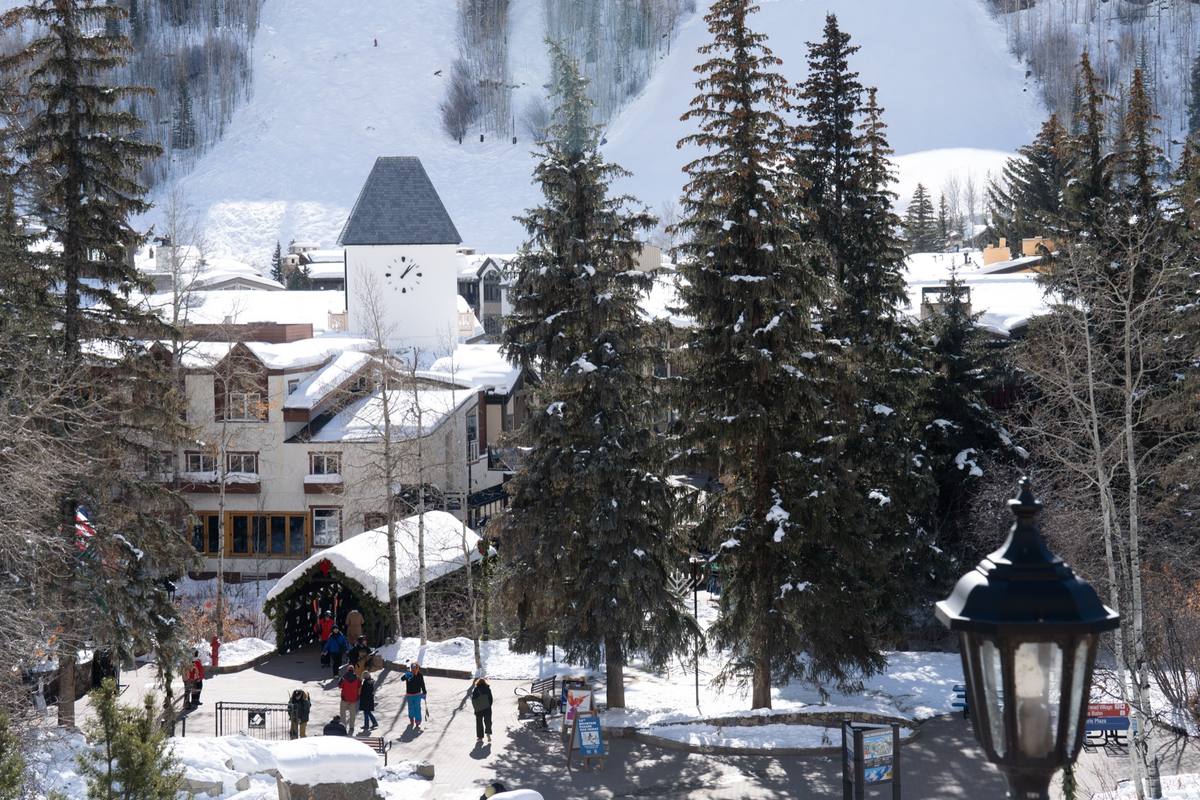
Vail & the Eagle Valley — 2½ hours from Denver by bus
The bus stops in the middle of town. The Vail, Avon & the Eagle Valley page puts Bustang at the Vail Transportation Center on the South Frontage Road, at Avon Station and at the Chambers park-and-ride in Eagle, with the first eastbound out of Vail at 6:30 a.m. and the last westbound in at 7:35 p.m. — nothing about it is a ski shuttle, which the page argues is precisely why it is reliable. The commercial alternative is a shared mountain van at roughly two and a half hours per seat; driving is about two hours in good conditions, and the page’s Sunday caution is the one to take seriously: CDOT meters the tunnel eastbound when volumes spike, and a two-hour return routinely becomes four. What the ride buys is the strongest car-free week in the state — the only page in this guide that rates a car unnecessary — with a free town bus every five to ten minutes in winter, fare-free Core Transit down the valley to Avon and Edwards, and the free Riverfront Express gondola lifting you off Avon Station onto Beaver Creek. The catch is the bill. Vail Village is priced at the top of the North American market, and the cheap beds sit forty-five minutes down-valley in Eagle and Gypsum.
Summit County — 2¾ hours from Denver by bus
The same West Line, on the Denver side of Vail Pass: Union Station to the Frisco Transit Center is a scheduled 105 minutes, roughly fifteen round trips a day, $12 one-way, and the Summit County page budgets a realistic two and a half to three hours door-to-Frisco once the A Line leg is counted. Pegasus, CDOT’s express van on the same corridor, trades frequency for speed; Epic Mountain Express runs shared shuttles from the airport at $69–129 a person; driving is about 75 miles, typically an hour and a half to two outside a storm. One arrival is gone and worth naming, because stale trip-planning pages still sell it: United’s Breckenridge “Landline” bus-as-flight is discontinued, confirmed against the operator’s and the airline’s own pages. The reason to ride to Frisco is what starts there — Breckenridge, Copper and Keystone on the fare-free Summit Stage roughly every half hour until about midnight, with Arapahoe Basin on a sparser flyer whose last bus down leaves mid-afternoon. Carry the page’s two caveats: every schedule it checked in August was still last season’s, and the weekend-only Snowstang bus from Denver had wrapped for 2025-26 with no new dates posted.
Over Berthoud Pass on US-40
US-40 is the other road out, and Winter Park’s page is blunt about it: Berthoud Pass tops out at 11,307 feet on the Continental Divide, CDOT closes it for avalanche control, crashes and whiteouts, and there is no second pass — the winter detour runs more than twice the distance. Bustang’s West Line does not come this way. The corridor’s scheduled options are a seasonal train and one bus a day — the Craig–Denver Outrider, which calls at both bases below on its single daily run each way.
Winter Park & Fraser — 2 hours from Denver by car or shuttle
The closest base in this guide, and the only one with a train. The Winter Park & Fraser page calls the Winter Park Express the reason the page exists: Amtrak, from Denver Union Station to a platform at the foot of Winter Park Resort, with a second stop at Fraser — in the 2025-26 season out at 7:00 a.m., under the lifts by 9:11, back into Denver at 7:05 p.m., Thursday to Sunday plus holiday weekends, one-way fares from $9, skis carried as baggage. The fine print is stated just as plainly: one round trip a day on four days a week, a train that did not run at all in 2021, and no 2026-27 dates published as of the page’s 20 August 2026 re-check — confirm with Amtrak before planning around it. By road it is roughly 67 miles on US-40, about two hours from the airport, and every mile that matters is Berthoud Pass; the page treats winter tires or chains as mandatory rather than advisable. Miss the train and one scheduled bus remains: the Craig–Denver Outrider calls at the Winter Park Transit Center daily — out of Union Station at 3:15 p.m., at Winter Park by 4:52 p.m., $11 one way — though its 10:20 a.m. eastbound makes the ride back cost a ski morning. Beyond that the fallback is Home James, a shared door-to-door shuttle around $80 a seat. What waits at the end is one substantial mountain — Winter Park and Mary Jane share a boundary and a ticket — plus a free town bus running to two in the morning, and the page is honest that a week here is that mountain skied seven times.
Steamboat Springs — about 3 hours from Denver by car
Say it plainly first: the primary gateway on the Steamboat Springs page is not Denver at all but Yampa Valley Regional (HDN) at Hayden, thirty-five minutes from town — six airlines and non-stops from roughly eighteen US airports through the winter, no public bus from the terminal, and shuttles booked ahead rather than found on arrival. Steamboat is in this guide because its page documents the Denver relationship in full. The drive is 157 miles, quoted at three hours — I-70 west to Silverthorne, CO-9 north to Kremmling, then US-40 over Rabbit Ears Pass — and in bad conditions, the page says, there is no honest number: Rabbit Ears shuts for wind and snow with no warning and no useful detour, Steamboat gets none of the I-70 corridor’s plow priority, and a Friday-night storm arrival is a genuine gamble rather than a delay. The car-free version is real and little known. CDOT’s Bustang Craig–Denver Outrider runs one bus a day, 365 days a year — out of Union Station at 3:15 p.m., at the Stockbridge Transit Center on Lincoln Avenue by 7:25, back out at 7:45 the next morning, $28 one-way — and with the A Line from the airport that makes DEN to downtown Steamboat a two-leg public journey with no rental counter in it. There is one departure each way, so a missed connection costs a day. At the end is a town that predates its lifts: Lincoln Avenue’s working main street, with a free city bus reaching the gondola about every fifteen minutes.
Considered and excluded
- Aspen & the Roaring Fork Valley — its page routes arrival through Aspen/Pitkin County Airport, three miles from town, and treats Denver as the weather fallback: four hours by road in winter with Independence Pass closed.
- Taos — its published gateway is Albuquerque International Sunport, two and a half hours away; Denver appears on its page only as a Contour Airlines flight into Taos Regional.
- Salt Lake City — three of the pages here name it as an alternative, but its own page puts Denver roughly eight hours away by road; it is a different trip, not a Denver corridor.