Park City, Utah
Fare-free buses have connected Park City Mountain and Deer Valley since before most ski towns had a bus at all — the reward for staying here car-free is a real Main Street and two major mountains; the trade is that the rest of the Wasatch is a planned excursion, not a day trip.
The core trip works without a car, but a car materially expands your lodging, evening or mountain choices. Verified August 18, 2026.
EveningsDaytime routes run on 15–30 minute headways into the evening, and Park City Transit brought back a citywide late-night route for winter 2025-26 — but neither agency publishes exact last-departure times for Kimball Junction or Canyons Village, so treat late-night service as real but unconfirmed in detail.
At a glance
- Ski areas
- 9
- Within 30 min
- 3
- Closest
- 10 minPublic bus
- Reachable by transit
- 6 of 9
- Arriving from
- Salt Lake City International (SLC)1h 10m by drive or shuttle
- Groceries on foot
- YesYear-round town
The verdict
Verdict
Come for two major mountains and a real town, connected by a bus system that has been fare-free since 1975. Park City Mountain and Deer Valley are both a short, frequent, free ride from nearly every bed in town, and Old Town's Main Street is a genuine nineteenth-century mining town, not a purpose-built plaza. Arrive at the airport, ride a chain of scheduled buses and trains to Kimball Junction, and you can go the whole trip without a rental counter.
Do not come expecting that freedom to extend across the rest of the Wasatch. The Cottonwood Canyons are honestly reachable by transit — Route 107, a TRAX transfer, then a ski bus — but the chain runs on a ninety-minute headway and can eat most of a day each way. Sundance and Snowbasin have no practical car-free path at all. If the plan is Park City Mountain and Deer Valley, this town delivers cleanly. If the plan is six Wasatch mountains in a week, rent a car, or read this site's Salt Lake City page instead.
Is this base for you?
Who this suits
Best for
- Skiers who want to leave the car at the rental counter entirely — Park City Mountain and Deer Valley are both a short, frequent, fare-free bus ride from nearly every bed in town.
- Visitors who want a real Main Street attached to the skiing, not a purpose-built base village — Old Town's mining-era architecture and independent restaurants predate the lifts by decades.
- Groups willing to let one member commit to "doing the Cottonwoods" — Brighton, Solitude, Snowbird and Alta are honestly reachable by transit from Park City, just slowly and with real planning.
Depends on you
- A resort town built around two portals and four lodging districts rather than one center — Old Town, Canyons Village, Deer Valley and Kimball Junction each trade walkability for something else.
- Fare-free transit that is genuinely excellent inside Park City and genuinely slow beyond it — the same free-bus identity that makes the local pair car-optional makes the Cottonwoods a multi-hour undertaking.
- A town, not a city — Park City has real restaurants, a hospital and a year-round population, but nothing like Salt Lake City's scale or six-mountain variety.
The honest part
Things you should know
- 01
Mountain Village and Canyons Village, Park City Mountain's two portals, sit roughly fifteen minutes apart by road with no direct transit connecting them — Park City Transit reaches one side, High Valley Transit's #105 the other, so the base you book decides which shuttle you learn.
- 02
The only scheduled transit to the Cottonwood Canyons is a three-leg chain — High Valley Transit's Route 107 to Salt Lake Central, a TRAX Blue Line transfer, then a UTA ski bus — built around Route 107's roughly ninety-minute headway, so a single missed connection costs an hour and a half, not a few minutes.
- 03
Sundance and Snowbasin have no practical car-free path from Park City at all: both mountains' seasonal ski buses originate in Provo/Orem and Layton/Ogden respectively, on the opposite side of the Wasatch from the Wasatch Back's own transit network.
- 04
Evening service is improving but underdocumented — Park City Transit reinstated a citywide late-night route for winter 2025-26, but neither agency publishes the exact last-departure times from Kimball Junction or Canyons Village.
The access matrix
What you can ski from Park City
Typical door-to-lift times in normal winter conditions. ● marks areas reachable on published transit during ski hours. Every row is dated below.
- On foot or skis
- Public transport
- Lift from town
- Needs a vehicle
| Ski area | Getting there | Time | Best for | Main drawback |
|---|---|---|---|---|
| Transit-served. Deer Valley | Public busPark City Transit to Snow Park · every 10 min · 2026-27 express dates not yet postedEvidence & assumptions for Deer ValleySnow Park Lodge to Old Town Transit Center runs every 10 minutes on Park City Transit, confirmed directly on Deer Valley's own site — the tightest headway in this matrix. A dedicated "Deer Valley Express" also runs from the Richardson Flat park-and-ride; 2026-27 season dates were not yet posted at verification. Source [10] Getting Here — Deer Valley Resort — verified August 18, 2026 | [10] | The most frequent transit link in town and an easy car-free evening on Main Street | The newer East Village base off US-40 is not on the same frequent Snow Park shuttle, so which base your lodging is assigned to changes your transit plan. |
| Transit-served. Park City Mountain | Public busFare-free Blue Route #3 · every 15 min peak, 30 off-peak · Canyons side via HVT #105Evidence & assumptions for Park City MountainPark City Transit's fare-free Blue Route #3 links Mountain Village, Old Town Transit Center and Snow Park every 15 minutes peak / 30 off-peak, plus a dedicated "Park City Mountain Express" from the Richardson Flat park-and-ride. Canyons Village is served instead by High Valley Transit's #105 shuttle (15-minute headway) and #101 Spiro/224 Local. Source [1] About Park City Transit — verified August 18, 2026 | [1] | A fare-free bus instead of a car, connecting your bed to America's largest single resort | Mountain Village and Canyons Village are separate portals roughly fifteen minutes apart by road with no route connecting them directly — Park City Transit reaches one side, High Valley Transit's #105 the other, so your lodging choice decides which shuttle you learn. |
| Woodward Park City | DriveNearest HVT routes run the Kimball Junction corridor · no published Woodward stopEvidence & assumptions for Woodward Park CityNearest HVT service is the #103/103b Kimball Junction Shuttle and #108 Silver Creek Village/Jeremy Ranch corridor; neither route's published stop list names a Woodward stop. Drive time is a planning estimate — no operator publishes a timed itinerary here. Source [2] Bus routes and schedules — verified August 18, 2026 | [2] | Terrain-park progression and an indoor training facility for a down day | No High Valley Transit stop is confirmed at Woodward — the nearest published routes run the Kimball Junction corridor without a stated walk-in distance, so plan on a car or rideshare. |
| Transit-served. Brighton | DriveBy transit: Route 107, TRAX Blue Line, then UTA 972 (every 15–30 min in season)Evidence & assumptions for BrightonDrive estimate via I-80 and SR-190, not operator-published. By transit: High Valley Transit Route 107 to Salt Lake Central, TRAX Blue Line to Midvale Fort Union, then UTA Route 972, which terminates at Brighton. Route 972 runs every 15–30 minutes in season. Source [4] Route 972 — Midvale Fort Union Station to Solitude & Brighton — verified August 18, 2026 | [4] | Night skiing and the cheapest lift ticket in the Cottonwoods, for a trip worth committing to | The only scheduled transit path is a three-leg chain — Route 107, a TRAX Blue Line transfer, then a UTA ski bus — built around Route 107's roughly ninety-minute headway, so a single missed connection costs an hour and a half. |
| Transit-served. Solitude | DriveSame chain: Route 107, TRAX, then UTA 972 · Solitude's stop precedes BrightonEvidence & assumptions for SolitudeDrive estimate via I-80 and SR-190, not operator-published. By transit: Route 107 to Salt Lake Central, TRAX Blue Line to Midvale Fort Union, then UTA Route 972 — the Solitude stop (Moonbeam Lodge) precedes Brighton on the same run. Source [4] Route 972 — Midvale Fort Union Station to Solitude & Brighton — verified August 18, 2026 | [4] | Weekday quiet and consistent cruising, for one member of the party willing to plan the chain | Same fragile three-leg chain as Brighton, and Big Cottonwood Canyon's own road closes for avalanche control with little warning on a storm day. |
| Sundance | DriveUTA lists Sundance among its ski resorts · none reachable from Park CityEvidence & assumptions for SundanceDrive estimate only, not operator-published. UTA's own ski-service page lists Sundance among the five resorts it serves, but confirms none of the five is reachable from Park City. Source [6] Ski Service — resorts served, fares and pass acceptance — verified August 18, 2026 | [6] | A quiet mountain with no resort-town scene attached, for visitors bringing their own car | UTA's seasonal ski bus reaches Sundance from Provo/Orem, not from Park City — a car-free rider would need Route 107 plus a FrontRunner leg plus an unpublished local transfer that nobody has confirmed works. |
| Transit-served. Snowbird | DriveBy transit: Route 107, TRAX Blue Line, then UTA 994 or commuter-hours CS1/CS2Evidence & assumptions for SnowbirdDrive estimate via I-80 and SR-210, not operator-published. By transit: Route 107 to Salt Lake Central, TRAX Blue Line to Historic Sandy or Midvale Fort Union, then UTA Route 994 or the commuter-hours Canyon Service (CS1/CS2). Source [5] Route 994 — Historic Sandy Station to Snowbird & Alta — verified August 18, 2026 | [5] | Sustained steep terrain and a tram, for visitors treating the Cottonwoods as a dedicated day | Same ninety-minute-headway transit chain as the rest of the Cottonwoods, ending in a canyon that closes outright for avalanche control more often than Big Cottonwood. |
| Transit-served. Alta | DriveSnowbird's chain, then UTA 994 ~5–10 min further to Goldminer's DaughterEvidence & assumptions for AltaDrive estimate via I-80 and SR-210, not operator-published. By transit: the same chain as Snowbird — Route 107, TRAX Blue Line, then UTA Route 994, which continues roughly 5–10 minutes past Snowbird to Alta's Goldminer's Daughter Lodge. Source [5] Route 994 — Historic Sandy Station to Snowbird & Alta — verified August 18, 2026 | [5] | Skier-only terrain with no snowboard traffic, for those willing to make the longest trip here | The longest itinerary in this matrix by either mode — over an hour by car, and the far end of a three-leg transit chain built on a ninety-minute headway. |
| Snowbasin | DriveUTA lists Snowbasin among its ski resorts · none reachable from Park CityEvidence & assumptions for SnowbasinDrive estimate only, not operator-published. UTA's own ski-service page lists Snowbasin among the five resorts it serves, but confirms none of the five is reachable from Park City. Source [6] Ski Service — resorts served, fares and pass acceptance — verified August 18, 2026 | [6] | A 2002 Olympic downhill venue and base lodges built for the Games, the farthest drive here | No practical transit from Park City at all — UTA's Snowbasin buses originate in Layton and Ogden, nowhere near the Wasatch Back or its own transit network. |
Boundary note. This page prices every ski area from a Park City base — Old Town, Canyons Village, Deer Valley and Kimball Junction. SkiTripedia’s Salt Lake City page prices the same four Cottonwood Canyon resorts (Brighton, Solitude, Snowbird and Alta) from a downtown Salt Lake base, at roughly half this page’s transit time. Both sets of numbers are correct; they answer different questions about where you are sleeping.
Where to stay
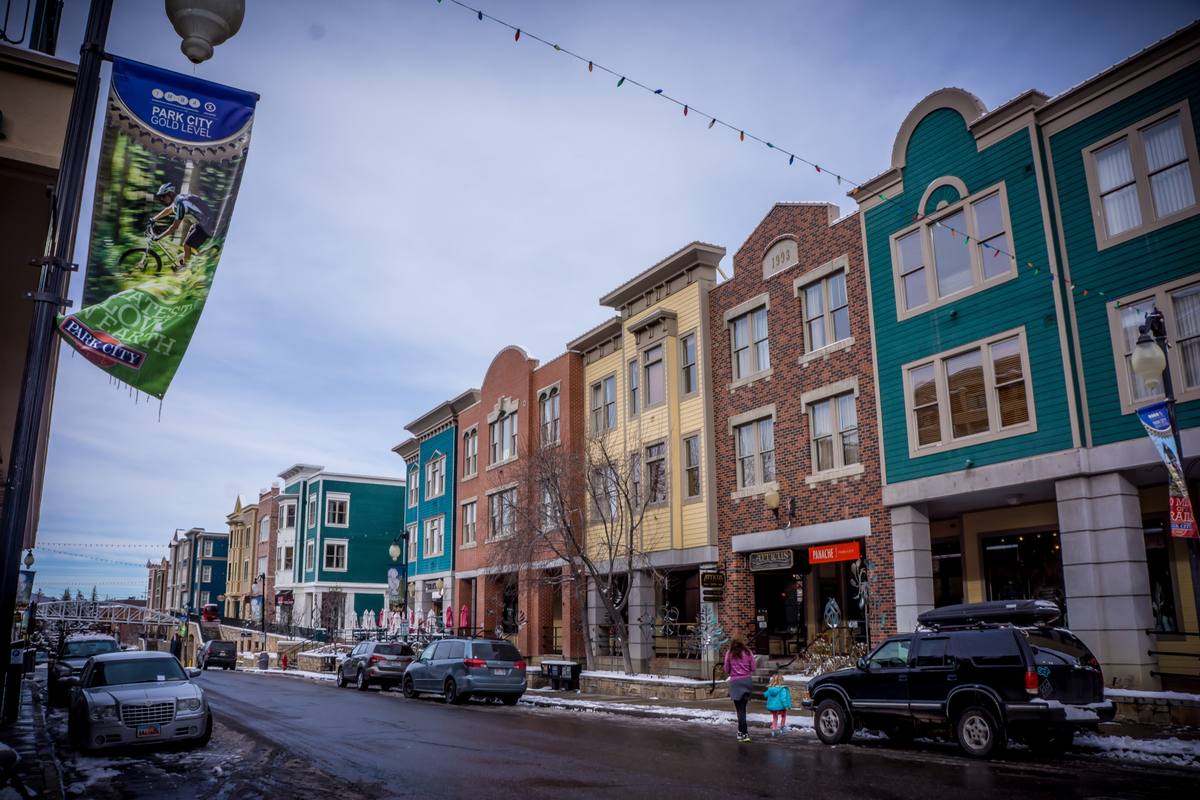
Old Town is Main Street, and the reason Park City looks the way it does in photographs — a compact grid of nineteenth-century mining-town buildings turned into restaurants, galleries and bars, with the Town Lift rising directly off the street. It is the most walkable base by a wide margin and the only one where an evening out does not involve checking a bus schedule. The trade is elevation and stairs: much of Old Town’s lodging sits on hillside streets that are genuinely steep in ski boots, and parking is scarce and expensive if you bring a car anyway.
Canyons Village is Park City Mountain’s other portal, a self-contained resort node about fifteen minutes by road from Old Town, with its own gondola base, hotel stock and a dedicated High Valley Transit shuttle (#105) running every 15 minutes. It works well for a ski-in/ski-out week centered entirely on the mountain, less well for anyone who wants a Main Street evening — that is a bus ride away here, not a walk.
Deer Valley lodging clusters around Snow Park Lodge and the newer East Village off US-40, and it is the quietest of the four bases once the lifts close: skier-only, service-oriented, and short on nightlife by design. The Snow Park–Old Town Transit Center shuttle runs every 10 minutes, the most frequent single route in town, so an Old Town evening is genuinely easy from here even without a car.
Kimball Junction and the wider Snyderville Basin trade walkability for practicality — larger hotels, chain groceries, and the transfer point for every regional bus, including the Route 107 service to Salt Lake City. Nobody picks Kimball Junction for atmosphere. People pick it for the grocery stores, the comparatively lower room rates, and the fact that every other base in town is a short free bus ride away. Prospector, between Kimball Junction and Old Town, splits the difference: fewer tourists, real supermarkets, and still on the Park City Transit network.
Getting there
Salt Lake City International is the gateway, and getting from the terminal to Park City is where this page’s story gets complicated. The realistic default for most visitors is a reserved shared or private shuttle — a genuinely competitive market with dozens of named operators, no single published schedule, and a typical door-to-door time of roughly 45 to 90 minutes depending on weather and how many other hotels your van visits first. Nobody publishes a timed itinerary for this because it is not one service; treat any specific minute figure, including this page’s own estimate, as a planning range rather than a schedule.
A fully scheduled, car-free alternative exists, and it is worth stating plainly because it resolves years of conflicting claims about a since-changed service: the airport has no one-seat ride to Park City, and never really has. The actual chain is TRAX Green Line from the terminal to a shared downtown station, a transfer to the Blue Line — the Green Line stopped serving Salt Lake Central directly back in 2012 — a ride to the Blue Line’s own northern terminus at Salt Lake Central Station, and then High Valley Transit’s fare-free Route 107, roughly a 65–70 minute ride on a 90-minute headway, out to Kimball Junction, followed by a free local bus to your lodging. Budget two to three hours including transfers. It is real, it is entirely fare-free past the Green Line’s $2.50 fare, and it is not what most people with luggage and a flight-lag headache are going to choose.
“PC–SLC Connect” is real — it is simply the tourism-friendly name for High Valley Transit’s Route 107, not a separate service. Two specific claims about it are worth rejecting, though. One aggregator described it as airport-serving, with a $4.50 fare and a 45-minute ride: it has no airport stop, it is fare-free, and the actual ride runs 65–70 minutes. Another described “two morning and three evening roundtrips,” which is accurate only for the commuter-only routes 901 and 902 that Route 107 replaced in August 2023. The current service runs daily, all day, roughly every 90 minutes.
Amtrak’s California Zephyr calls at Salt Lake Central once a day in each direction, which happens to be the same building Route 107 departs from — a same-station transfer, not a second trip across town. That is a smaller inconvenience than it sounds, but the Zephyr itself is a roughly 52-hour Chicago-to-Emeryville train running once a day, so a missed connection costs a full day, not a short wait. Driving in, Park City sits directly off I-80 about 35 miles east of Salt Lake City, and the final stretch is an easy one compared with the Cottonwood canyon roads.
Getting around
Within Park City itself, the fare-free-since-1975 claim is not marketing. Park City Transit’s color-coded routes (Red, Green, Blue, Orange) and High Valley Transit’s numbered lines cover Old Town, Canyons Village, Deer Valley and Kimball Junction on headways as tight as 10 minutes on the busiest Deer Valley link and no worse than 15–30 minutes on the others. Two dedicated express routes — the “Park City Mountain Express” and “Deer Valley Express” — run from the Richardson Flat park-and-ride specifically to cut down on in-town driving. In practice that puts Deer Valley about ten minutes from Old Town on the most frequent bus in the system — the shortest hop in this page’s matrix. The two operators split the territory rather than overlapping: Park City Transit runs in-town routes, and High Valley Transit runs everything regional, including the shuttle out to Canyons Village and the commuter run to Salt Lake City.
The gap is evening service. Park City Transit brought back a citywide late-night route for winter 2025-26, a real and recent improvement, but neither agency publishes a last-departure schedule distinct from its general winter schedule, so budget conservatively for a late night out from Canyons Village or Kimball Junction rather than assuming the buses run as late as Main Street’s bars do. Woodward Park City, the terrain-park and training facility out near Kimball Junction, sits in the same gap in reverse: nearby HVT corridor routes run past it, but none publishes a confirmed stop, so plan on a car or rideshare rather than a bus.
Leaving Park City for the day is the honest trade-off. High Valley Transit’s Route 107 reaches Salt Lake City in about 65–70 minutes on a roughly 90-minute headway — reliable, free, and genuinely usable for a deliberate day trip, not a spontaneous one. UTA’s seasonal ski buses (routes 972 and 994) are scheduled to resume for 2026-27 on December 6, and from Park City they require the full Route 107-plus-TRAX-plus-ski-bus chain described in the access matrix above, not a direct connection. There is no shortcut. The Cottonwoods sit in a different transit district from the Wasatch Back, and the schedules were not built to talk to each other.
Who it suits
- Skiers who want to leave the car at the rental counter. Park City Mountain and Deer Valley are both a short, frequent, fare-free bus ride from nearly every bed in town — a rarer combination in North America than it should be, and the reason this page carries a flagship rating despite a modest two-mountain local pair.
- Visitors who want a town, not a base village. Old Town’s Main Street predates skiing here by decades; it has real architecture, restaurants that are not resort-operated, and a life that continues after the lifts close. That is a genuinely different experience from a purpose-built plaza.
- Groups willing to let one member “do the Cottonwoods.” Brighton, Solitude, Snowbird and Alta are honestly reachable by transit from Park City — slowly, and only for someone willing to plan around a ninety-minute bus headway, but the option is real and this page says so plainly.
- Anyone who has already ruled out Salt Lake City. If a walkable Main Street and a car-optional local pair matter more than six mountains in a week, Park City is the more honest choice of the two Wasatch bases SkiTripedia covers.
It suits least the visitor who wants maximum mountain variety with minimum planning. Sundance and Snowbasin are not credibly reachable without a car, and even the Cottonwoods demand real commitment by transit. A renter who wants to ski a different Wasatch mountain most days of a week will spend more time on this page’s slower rows than its faster ones.
Living for a season
Park City is a real, year-round incorporated city, not a seasonal base camp — it has its own hospital, a permanent population, and an economy that does not fully shut off when the lifts stop turning in April. That distinguishes it from a purpose-built resort village even though skiing dominates its identity and its winter economy.
The honest caveat is cost and housing. Park City’s affordability and workforce-housing conversation is a persistent, well-known local topic, but we have not yet sourced a specific, dated housing-market figure for Summit County, so this page does not carry a numeric housing warning either way — treat the absence as a gap in our sourcing, not a claim that housing here is easy. Seasonal ski jobs exist across Park City Mountain, Deer Valley and Woodward, and a resort season pass typically bundles some transit or parking benefit; verify the specifics with the employer or resort directly rather than assuming last season’s terms carry over.
Practical points for a longer stay: groceries are easiest around Prospector and Kimball Junction rather than Old Town’s smaller-format stores, and every base in town connects to the others by free bus, which matters more over a season than over a single week.
What the town is like
Park City started as a nineteenth-century silver-mining camp, not a ski resort — Main Street’s brick and clapboard storefronts date to that boom, and the town’s National Historic District designation is a mining-era one, not a ski-era one. That history is still legible in a way it is not in most purpose-built resort towns: the buildings predate the lifts by the better part of a century.
The town’s other defining identity is cultural rather than architectural. The Sundance Film Festival takes over Main Street every January, and Park City hosted Nordic and sliding-sport events for the 2002 Winter Olympics at what is now the Utah Olympic Park near Kimball Junction — both facts that shape the town’s calendar and self-image well beyond its ski season.
Compared with Salt Lake City down the canyon, Park City reads as a smaller, more transient, more overtly tourism-oriented place — a real town, but one whose year-round rhythms are set by ski and festival seasons rather than by a university or a state government. The fare-free transit system, in place since 1975, is as much a civic identity marker here as a practical one: a small town that decided early to make a car optional, and largely built the infrastructure to make that true within its own borders, even where the rest of the Wasatch never quite got the memo.
Not sure?
Choose somewhere else if…
- Salt Lake City
You want mountain variety more than a walkable town — six major areas inside about an hour of a real city, at the cost of treating every ski day as a commute rather than a walk out the door.
- Vail, Avon & the Eagle Valley
You want zero commute at all — Vail Village is built to put you on the lift on foot, trading Park City's real mining-town Main Street for a purpose-built resort core.
- Aspen & the Roaring Fork Valley
You want several distinct mountains from one valley on a free local bus, without a ninety-minute commuter route standing between you and the next one.
Sources & data notes
How this page was verified
Section verification
- Access matrixAugust 18, 2026
- Getting thereAugust 18, 2026
- Getting aroundAugust 18, 2026
- Where to stayAugust 18, 2026
Sources
- About Park City Transit — Park City Municipal Corporation · official operator page, cited not reproduced · retrieved
- Bus routes and schedules — High Valley Transit · operator schedule, cited not reproduced · retrieved
- Route 107 — Park City / Salt Lake City Commuter — High Valley Transit · operator schedule, cited not reproduced · retrieved
- Route 972 — Midvale Fort Union Station to Solitude & Brighton — Utah Transit Authority · operator schedule, cited not reproduced · retrieved
- Route 994 — Historic Sandy Station to Snowbird & Alta — Utah Transit Authority · operator schedule, cited not reproduced · retrieved
- Ski Service — resorts served, fares and pass acceptance — Utah Transit Authority · operator schedule, cited not reproduced · retrieved
- Route 704 — TRAX Green Line (Salt Lake City International Airport) — Utah Transit Authority · operator schedule, cited not reproduced · retrieved
- Winter Change Day — seasonal service start, 6 December 2026 — Utah Transit Authority · operator schedule, cited not reproduced · retrieved
- Canyon Service FAQ (CS1 and CS2) — Utah Transit Authority · operator publication, cited not reproduced · retrieved
- Getting Here — Deer Valley Resort — Deer Valley Resort · official operator page, cited not reproduced · retrieved
- Bus 105 — Canyons Village Shuttle — High Valley Transit · operator schedule, cited not reproduced · retrieved
- Route 701 — TRAX Blue Line — Utah Transit Authority · operator schedule, cited not reproduced · retrieved
- California Zephyr — route and station information — Amtrak · operator schedule, cited not reproduced · retrieved
- Public Transportation — Parking & Transportation — Salt Lake City Department of Airports · official operator page, cited not reproduced · retrieved
Images
.jpg)
Page last reviewed August 18, 2026. Transit routes, schedules and fares change between seasons — check the operator before you travel. Mountain specifications for the northeastern US are maintained separately on NESKIS.