Burlington, Vermont
The only real city in the East that works as a ski base — car-free to live in, never car-free to ski from, and the strongest season-work town in the Northeast because of it.
Ordinary access to the principal ski experience requires private transport. Verified August 20, 2026.
At a glance
- Ski areas
- 8
- Within 30 min
- 1
- Closest
- 25 minDrive
- Reachable by transit
- 0 of 8
- Arriving from
- Burlington International Airport20 min by taxi
- Groceries on foot
- YesYear-round town
The verdict
Verdict
Come if the mountain is one part of your winter. Burlington is a university city on a lake. It has a working year-round economy and a downtown you can live in without a car. Bolton Valley stays lit until ten o'clock forty minutes up the road. Nothing else in the Northeast lets you hold a normal job, walk to a grocery store in February, and still ski five different mountains over a season. For a season worker who does not want employer housing, it is the strongest base in New England.
Do not come here for a ski week. Every mountain worth the drive is forty to seventy-five minutes each way, not one of them is reachable on a scheduled bus, and a seven-night trip based downtown buys you roughly fourteen hours in a car plus a winter parking ban that tows at ten. If you want to walk from your bed to a lift, go to Stowe or the Mad River Valley and accept the smaller town.
Is this base for you?
Who this suits
Best for
- Season residents whose winter includes work, study or family life. Church Street, the university, the medical center and daily shopping keep functioning through a thaw.
- Skiers with a car who want weeknight laps. Bolton Valley is forty minutes away and stays lit until 10 p.m.; community-run Cochran's is twenty-five minutes from downtown.
- People choosing urban life over a resort bubble. Downtown lodging puts the waterfront, City Hall Park, groceries and GMT buses on foot before you drive to the mountains.
Depends on you
- A city rather than a ski town. Burlington supplies a university, hospital and four-block Church Street, while skiing remains something residents commute to rather than the town's focus.
- Six meaningful mountains within seventy-five minutes. A car lets you choose Bolton, Stowe, Smugglers' Notch, Mad River Glen, Middlebury or Sugarbush, but never learn one as your local hill.
- The low Lake Champlain elevation. Downtown rain can coexist with snow above 3,100 feet at Bolton, useful if you read forecasts carefully and misleading if you judge from the window.
The honest part
Things you should know
- 01
No scheduled public transport reaches any ski area from Burlington. Green Mountain Transit eliminated the Route 36 Jeffersonville Commuter on 2 December 2024, Route 86 touches the Richmond park-and-ride only on peak commuter timings and in the wrong direction for a ski day, and Bolton Valley's own directions page lists no bus at all. The realistic car-free option is a private shuttle quoted at roughly 110 to 140 dollars each way to Stowe.
- 02
VT-108 over Smugglers' Notch closes for the winter — typically from early or mid-November until mid-May — because the pass cannot be plowed. Stowe and Smugglers' Notch sit on opposite sides of the same mountain, but from Burlington they are two entirely separate hour-long drives out and back, and there is no way to combine them in a day.
- 03
Keeping the car the skiing requires is its own tax. Burlington's winter parking ban bars on-street parking from 10pm to 7am citywide when activated, with a 75 dollar ticket and a 75 dollar tow, and municipal surface lots are closed overnight from 1 December to 15 March. Add 30 dollars for weekend base parking at Stowe unless you fill four seats, and the cheap urban rent starts giving some of itself back.
The access matrix
What you can ski from Burlington
Typical door-to-lift times in normal winter conditions. ● marks areas reachable on published transit during ski hours. Every row is dated below.
- On foot or skis
- Public transport
- Lift from town
- Needs a vehicle
| Ski area | Getting there | Time | Best for | Main drawback |
|---|---|---|---|---|
| Cochran's Ski Area | DriveEvidence & assumptions for Cochran's Ski AreaEstimated drive time via I-89 Exit 11 and US-2; not yet verified against a routing source. Nonprofit and community-run, with weekday hours starting mid-afternoon. Verified August 16, 2026 | After-work laps and teaching a kid to ski cheaply | A small community hill on surface lifts, with limited weekday hours — check before you go | |
| Bolton Valley | DriveDrive only · operator's page lists no bus or shuttle · winter access road slows the tripEvidence & assumptions for Bolton ValleyEstimated door-to-lift time. Bolton Valley's own Getting Here page claims under 30 minutes from Burlington, which does not allow for the access road in winter, and lists driving, flying and Amtrak only — no bus and no shuttle. Verified August 16, 2026 | Weeknight skiing and the shortest commute to real vertical | The last four to five miles are a steep access road that ices up long after I-89 is clear | |
| Smugglers' Notch | DriveDrive · GMT Route 36, the only bus that came close, was eliminated Dec 2024Evidence & assumptions for Smugglers' NotchEstimated drive time via VT-15; not verified against a routing source. GMT's Route 36 Jeffersonville Commuter, the only scheduled bus that ever came close, was eliminated on 2 December 2024. Verified August 16, 2026 | Natural-snow steeps and family programming in the same place | VT-15 through Underhill and Cambridge is two lanes the whole way with no faster alternative | |
| Stowe Mountain Resort | DriveDrive to Stowe · free Mountain Road shuttle covers the last 6 miles · no Burlington linkEvidence & assumptions for Stowe Mountain ResortEstimated drive time via I-89 Exit 10 and VT-100; not verified against a routing source. Stowe's free Mountain Road shuttle covers the last six miles once you are in town, but nothing scheduled connects Stowe to Burlington. Verified August 16, 2026 | A resort-scale day inside an hour | Paid base parking Friday through Sunday and holidays, and the Mountain Road lines from mid-morning | |
| Mad River Glen | DriveDrive · in snow Burlington skiers route via VT-116, not VT-17 over the App GapEvidence & assumptions for Mad River GlenEstimated drive time; not verified against a routing source. Burlington skiers commonly route via VT-116 through Hinesburg and Huntington rather than take VT-17 over the App Gap in snow. Verified August 16, 2026 | Experts, single-chair loyalists and skiers who dislike modern resorts | No snowboarding, limited snowmaking, and the approach crosses the Appalachian Gap or a web of back roads | |
| Middlebury College Snow Bowl | DriveEvidence & assumptions for Middlebury College Snow BowlEstimated as roughly 45 minutes south on US-7 to Middlebury plus about 23 minutes east on VT-125 over Middlebury Gap. Not verified against a routing source. Verified August 16, 2026 | Cheap tickets and genuinely empty midweek trails | A small college hill; public access sits behind the college's own calendar and race schedule | |
| Sugarbush Resort | DriveEvidence & assumptions for Sugarbush ResortEstimated drive time via I-89 Exit 10 and VT-100 south through Waitsfield; not verified against a routing source. Verified August 16, 2026 | A committed big-mountain day across two separate base areas | Well over an hour each way, and Lincoln Peak to Mount Ellen is a slow link once you arrive | |
| Jay Peak Resort | DriveEvidence & assumptions for Jay Peak ResortEstimated drive time. Roughly 61 to 70 miles depending on whether you leave I-89 at St. Albans or Swanton. Not verified against a routing source. Verified August 16, 2026 | Tree skiing and natural snow, on a committed full-day trip | Close to two hours each way on VT-105 and VT-108 back roads; the whole day is spent before you click in |
Where to stay
Downtown Burlington — the blocks around Church Street, City Hall Park and the waterfront — is the only base that justifies choosing a city in the first place. You can land here without a car, buy groceries at the co-op on South Winooski Avenue until eleven at night, eat somewhere different every evening for a week, and never think about transport until the morning you want to ski. That is the entire proposition, and it is a real one.
The Hill Section and the Old North End are where people actually live, five to twenty minutes on foot from downtown. The Hill is quieter, closer to the university and the medical center, and more expensive. The Old North End is the cheaper, denser, more mixed neighborhood and the one most seasonal workers end up in. Both are walkable to the same shops; neither is a hotel district.
South Burlington and Winooski trade the walk for parking and lower rent. Winooski is a compact former mill town across the river with its own small center and a bus into Burlington. South Burlington is suburban, close to the airport, and the pragmatic choice if you have a car and want somewhere to put it overnight without watching for the parking ban lights.
What Burlington does not have is a slopeside option of any kind. If lodging near a lift matters to you, this is not the destination and no neighborhood here fixes that.
Getting there
Burlington is the easiest ski-adjacent arrival in the Northeast, which is exactly why the page exists. Burlington International Airport sits about three miles from downtown in South Burlington — a short taxi or rideshare into the center, no ninety-minute mountain transfer, no rental counter unless you want one. What it no longer has is a city bus: none of GMT’s published routes serves the airport today, and the airport’s own ground-transportation page still points at a discontinued route under the operator’s old name. The only scheduled service we can verify at the terminal is Vermont Translines’ daily Albany bus.
Amtrak’s Ethan Allen Express runs one round trip a day between New York and Burlington Union Station via Albany and Rutland, roughly seven hours end to end. The station is on the waterfront, a few minutes’ walk from Church Street. It is a genuine option, not a technicality.
Vermont Translines runs a daily bus down the US 7 corridor to Albany — calling at both the Downtown Transit Center on St. Paul Street and the airport — with Amtrak connections at Rutland and Rensselaer. Driving, Burlington is about three and a half hours from Boston and five to six from New York.
Getting around
Inside the city, Green Mountain Transit runs the local network from the Downtown Transit Center, with the core Williston and City Connector corridor at roughly fifteen-minute headways and evening service on the main routes. It is enough to live on. It has also been cut repeatedly — Saturday evening trips were trimmed on several routes in December 2024 and MyRide lost Saturdays entirely in August 2025 — so treat evening and weekend coverage as thinner than the weekday map suggests.
Outside the city, be blunt about it: no bus goes skiing. Route 36 to Jeffersonville, the closest thing to a Smugglers’ Notch service, was eliminated in December 2024. Route 86 stops at the Richmond park-and-ride, which is still miles from Cochran’s and runs on commuter timings that point the wrong way for a ski day. Bolton Valley’s own directions page offers driving, flying and Amtrak, and no bus or shuttle at all. What remains is a private car service quoting flat rates around 110 to 140 dollars each way to Stowe, which is not transport, it is a taxi.
So the shape of a Burlington winter is: live car-free, ski by car. Most people who do this well own a modest all-wheel-drive car they barely use midweek, or they lock into a carpool. Four people in a car is also how you avoid Stowe’s 30-dollar weekend base parking, which is free for carpools of four or more.
Who it suits
- Anyone whose winter has to accommodate a job, a degree or a family. The city keeps working when the snow does not. That is not true of a resort village in a thaw.
- Skiers who want variety over vertical. Bolton for weeknights, Stowe for a real day, Smuggs for natural snow, Mad River for the trees, Cochran’s for a Tuesday afternoon with a kid. Five genuinely different kinds of skiing from one address.
- Season workers who refuse employer housing. More on that below; it is the strongest case for the place.
It suits car-free visitors on a ski vacation worst of all, and the mismatch catches people out because Burlington reads as a transit-friendly city in every other respect. It also disappoints anyone whose ideal day ends with boots off at the bar under the lift — you will be an hour away from that, in traffic, in the dark.
Living for a season
This is the argument. Burlington is a city of about forty-odd thousand with a university, a college, a state teaching hospital and a real service economy, sitting inside an hour of Bolton Valley, Stowe, Smugglers’ Notch and Sugarbush. You can hold a normal year-round job, rent a normal year-round apartment, and ski four or five mountains through the season without ever taking a resort job or living in resort housing. No other Northeast base offers that combination.
The rental market has eased slightly but is still tight: Chittenden County vacancy sat around 3.3 percent in summer 2026, up from under one percent during the pandemic years, and Vermont’s statewide rate remains among the lowest in the country. More than 1,300 rental units opened across 2024 and 2025, which is why it moved at all. Start looking in September, not November, and expect to compete with students.
The two costs people underestimate are the commute and the car. An hour each way to Stowe, four days a week, is a part-time job’s worth of driving over a season. And a car parked on a Burlington street overnight in winter is a car you have to move whenever the ban lights come on.
What the town is like
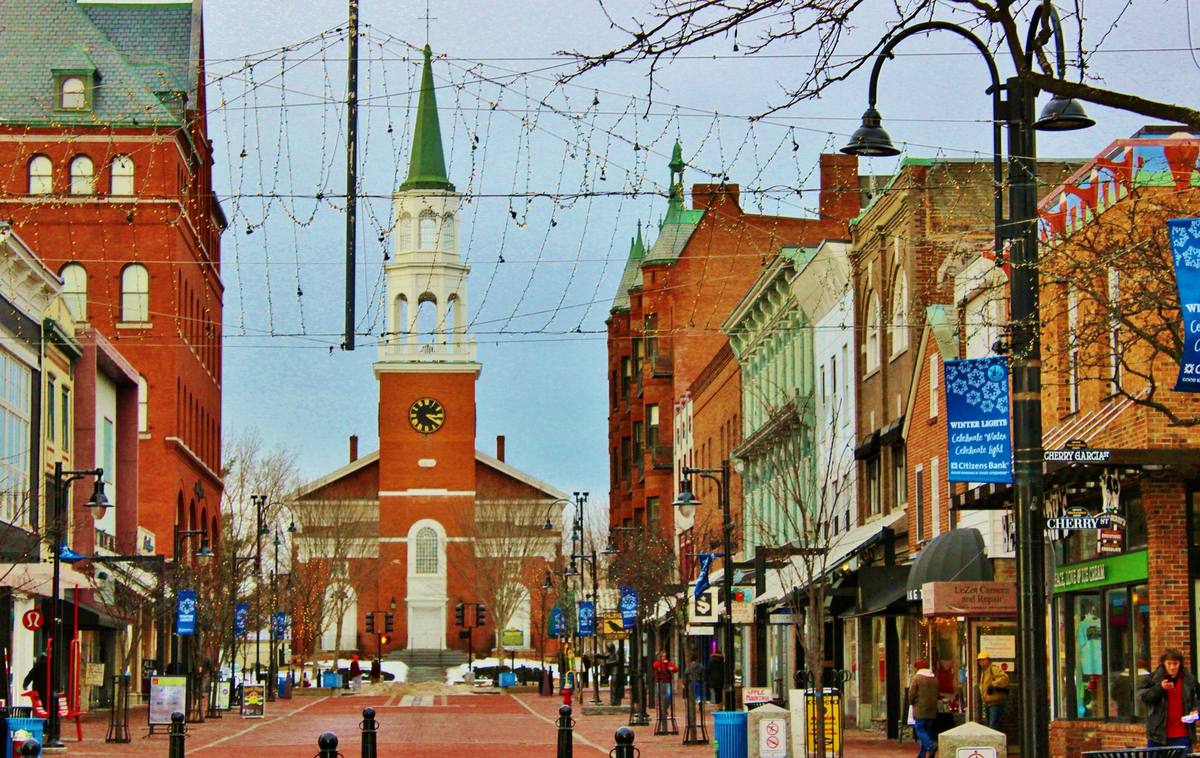
Burlington is a small city that behaves like a much larger one. Church Street is four blocks closed to traffic, lined with shops and restaurants and buskers, and it is genuinely busy in February rather than shuttered. The waterfront on Lake Champlain gives the place a horizon most New England ski towns do not have, and the Adirondacks across the water are the view.
The character is university town first, ski town a distant fourth — the mountains are something people here do, not what the city is for. That is the point. Nobody is selling you a ski vacation on Church Street. You will meet nurses, students, brewers and software people, some of whom ski sixty days a year and none of whom organize their identity around it.
The lake also means the weather downtown tells you almost nothing about conditions on the hill. Burlington sits near 200 feet of elevation; Bolton’s summit is over 3,100. Rain in the city is routinely snow at the top of the access road, and the reverse is just as common. Check the mountain, not the window.
Not sure?
Choose somewhere else if…
- Stowe & the Waterbury corridor
Car-free skiing is the actual requirement rather than car-free living. Waterbury has an Amtrak stop, a weekday commuter bus up VT-100, and Stowe's free Mountain Road shuttle to the lifts — the chain Burlington simply does not have. You give up the city.
Full comparison - Mad River Valley
You would rather live at the mountain than commute to it. Sugarbush and Mad River Glen are both local from Waitsfield instead of seventy minutes away, and the tradeoff is honest — one supermarket, a thin off-season, and no city to fall back on when it rains.
- Rutland & Killington
You want the city-base idea with a much shorter commute. Rutland is a small working city with year-round jobs and cheap housing, and Killington is roughly twenty-five minutes up US-4 rather than an hour — but Rutland is nothing like Burlington to spend an evening in.
This base appears in
Sources & data notes
How this page was verified
Section verification
- Access matrixAugust 16, 2026
- Getting thereAugust 20, 2026
- Getting aroundAugust 16, 2026
- Where to stayAugust 16, 2026
Sources
- Green Mountain Transit — routes and schedules index — Green Mountain Transit (GMT) · operator schedule, cited not reproduced · retrieved
- Burlington International Airport — ground transportation — Patrick Leahy Burlington International Airport (BTV) · airport authority publication, cited not reproduced · retrieved
- Vermont Translines — Burlington–Middlebury–Rutland–Bennington–Albany — Vermont Translines · operator site, cited not reproduced · retrieved
- Northeast resort profiles — NESKIS · sibling property; mountain specifications maintained there · retrieved
Images

Page last reviewed August 16, 2026. Transit routes, schedules and fares change between seasons — check the operator before you travel. Mountain specifications for the northeastern US are maintained separately on NESKIS.