Ski trips from New York
Eight bases within reach of New York, grouped by how you would actually leave the city — ski buses that end at a Catskill base lodge, two Amtrak lines whose stations sit in real downtowns, and three drives the pages time honestly.
At a glance
| Base | Where | Car-free reach | Evenings | Car |
|---|---|---|---|---|
| The Northern Catskills: Hunter, Windham & Tannersville | United States | 3 of 5 areas | None | |
| The Upper Valley: Hanover, Lebanon & White River Junction | United States | 0 of 7 areas | Limited | |
| Rutland & Killington | United States | 2 of 7 areas | Limited | |
| Burlington, Vermont | United States | 0 of 8 areas | Limited | |
| Stowe & the Waterbury Corridor | United States | 1 of 8 areas | Limited | |
| The Berkshires | United States | 0 of 6 areas | Limited | |
| The Deerfield Valley: Wilmington & West Dover | United States | 1 of 5 areas | Limited | |
| Lake Placid, New York | United States | 1 of 3 areas | Limited |
Leaving from New York, the ski decision is a journey decision first: which corridor out of the city, by which mode, and how much of the trip you are willing to spend in motion. Every time below is the verified figure from that base’s own page. Two things make the New York hand unusual. Ski buses leave the city for Catskill base lodges three days a week all season — an arrangement the Catskills page calls unmatched anywhere in the Northeast — and two Amtrak lines run north into ski country with stops in real downtowns rather than beside a highway. Eight bases follow: two reached by bus, three by train, three by car. This page settles the getting there — for how the New England bases among them compare as places to stay, Where to stay for New England skiing is the companion.
By ski bus and intercity bus
Two bus stories leave the city, at opposite ends of the scale: a fleet of ski buses built for day trips and pointed directly at base lodges, and an intercity service that ends among college towns where the skiing is the smallest part of the offer.
The Northern Catskills — 3 hours 10 from Union Square by ski bus
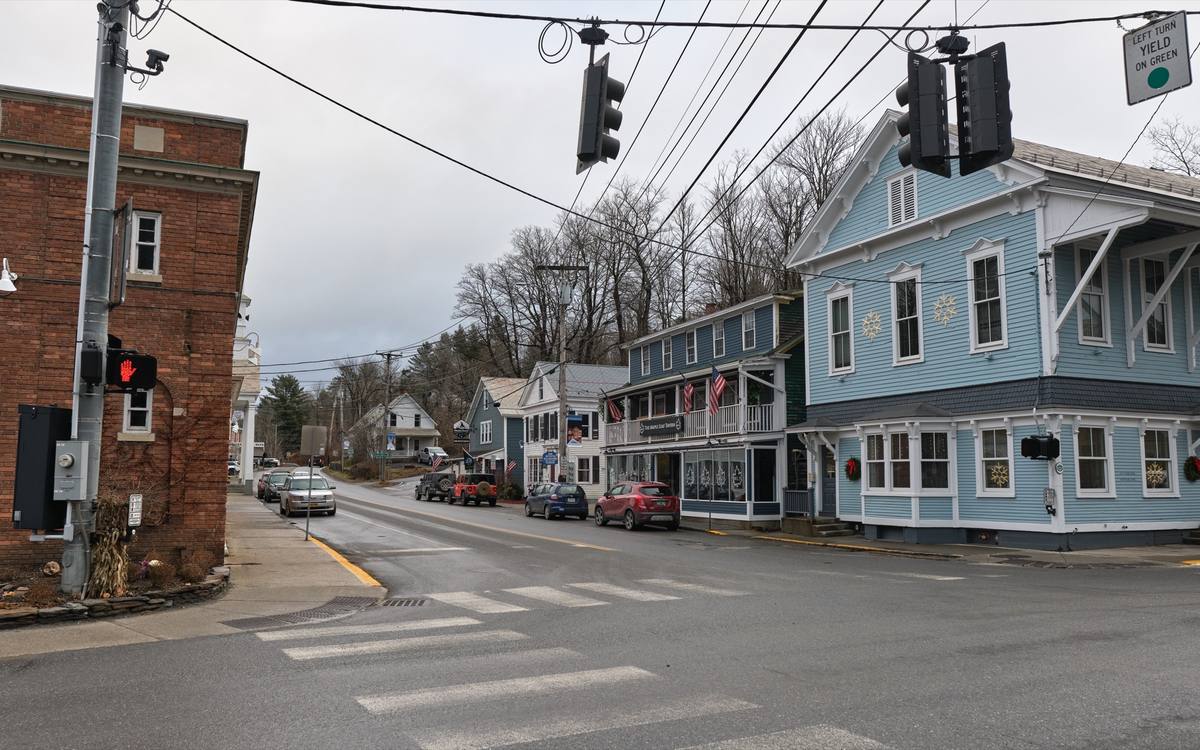
Urban Sherpa picks up at Union Square around 5.40am and Times Square at 6.00 and puts you at the Hunter base lodge at about 8.50 — Wednesdays, Saturdays and Sundays, December through March, with Windham and Belleayre on the same program. OvRride runs the comparable operation from Downtown Brooklyn and Union Square, serving Hunter, Belleayre and, on selected dates, Plattekill; both sell bus-only seats as well as bus-plus-ticket packages, and both drop you at the lodge rather than at a park-and-ride. The Northern Catskills page is blunt about how rare this is: no other mountain cluster in the Northeast lets a carless skier do it three days a week all season. To stay the week instead, Trailways runs one direct bus a day — about three and a half hours — to a flag stop in the middle of Tannersville’s painted Main Street, with a Tops supermarket open until ten and beds you can walk home to. The catch is local: the village and the lifts are five miles apart with nothing running between them, so a bus visitor plans on one mountain per stay. Driving is two and a half to three hours from Manhattan, and Route 23A through Kaaterskill Clove is the stretch the page tells you to take seriously.
The Upper Valley — a daily reservation-only bus from New York
Dartmouth Coach runs daily to and from New York City on a reservation-only basis, with an early-bird departure around 6.15am — and the Upper Valley page notes that no other ski-adjacent base in New England has a daily scheduled bus to both New York and Boston. Amtrak’s Vermonter backs it up with one train a day at White River Junction, where the Hotel Coolidge stands a block from the platform. Then comes the catch, which the page states without blinking: the two hills inside half an hour, the Dartmouth Skiway and Whaleback, hold under 1,700 feet of vertical between them, Whaleback is dark on Mondays and opens mid-afternoon Tuesday through Friday, and not one of the seven mountains in its matrix has bus service. Its own itinerary is the right one — arrive by bus, rent a car for the Killington and Okemo days an hour away, and let Hanover, Lebanon and White River Junction carry the evenings. Driving from New York takes around four and a half hours.
By train: the Ethan Allen Express and the Vermonter
Two Amtrak lines leave New York for ski country, and their stops are the rare kind worth building a trip on. The Ethan Allen Express runs one round trip a day via Albany to downtown Rutland and on to Burlington’s waterfront; the Vermonter takes the New Haven and Springfield side of New England and stops on Waterbury’s village green. None of the three arrivals leaves you on the edge of anywhere.
Rutland & Killington — one train a day, then an hourly $3 bus
The Ethan Allen Express stops at the James M. Jeffords station a short walk from downtown Rutland, and the chain continues from there: the Rutland–Killington Commuter runs roughly hourly, seven days a week, from about 7.15am to just after 7pm, stopping at Pico and continuing to Killington’s base areas for a $3.00 fare — Killington itself advertises the connection to guests arriving by train. The page states the result plainly: you can arrive by rail, sleep in Rutland, and ski Killington or Pico every day of a week without ever driving. What the trip buys is value at scale — the mountain that opens in October and is usually still running in May, half an hour from a working small city with supermarkets, a hospital and rents a lift operator can pay. What it does not buy is charm. Neither Rutland nor the Killington Road will feel like a ski village, the Road has no supermarket and no continuous sidewalk, and the last bus down leaves in the early evening. Driving from New York is roughly four and a half hours.
Burlington — 7 hours by train from New York
The same train, ridden to the end, reaches Burlington Union Station in roughly seven hours — on the waterfront, a few minutes’ walk from Church Street, and in its page’s words a genuine option rather than a technicality. What waits is the only real city in the East that works as a ski base: a university, a teaching hospital, a downtown you can live in without a car, and Bolton Valley lit until ten o’clock forty minutes up the road. The post-arrival catch is structural, and the page is blunt about it: no bus goes skiing. Every mountain worth the drive is forty to seventy-five minutes each way, the one commuter route that came close was eliminated in December 2024, and the car-free fallback is a private shuttle quoted at 110 to 140 dollars each way to Stowe. Burlington is where you live car-free and ski by car — the page recommends it for a season built around work or study, not for a seven-night ski week. Driving from New York takes five to six hours.
Stowe & Waterbury — the Vermonter to a platform on the village green
The Vermonter’s stop at Waterbury-Stowe is an unstaffed platform in the middle of a village, and it anchors the chain Stowe’s page is built around: the weekday Route 100 Commuter onward to Stowe Town Hall, then the free Mountain Road Shuttle to the Mansfield base all winter — every link of a car-free arrival, which no other Northeast destination can claim. New York is the right end of the line for it: the southbound train leaves the green at about 10.10am for Springfield, New Haven and New York. Time the northbound arrival the way the page tells you to — the train reaches Waterbury at about 7.50pm, roughly an hour after the last Stowe-bound bus, and the commuter does not run on weekends at all, so plan a Waterbury night or a paid transfer and ride the chain up in the morning. The reward is the most vertical in Vermont and a genuinely walkable village at the bottom of it; the page’s equally plain warning is not to come for value.
By car
Three bases where the pages’ own answer is the drive. Each names its road, and each is honest about what the scheduled alternatives do and do not solve.
The Berkshires — 2½ to 3 hours from New York by car
The shortest trip on this page: roughly two and a half to three hours to Great Barrington via the Taconic or I-684 and Route 22, then Route 23 east. The Berkshires page calls driving the honest answer — Peter Pan buses do reach Pittsfield, Lee, Lenox and Great Barrington on New York routings at a couple of round trips a day, and the Berkshire Flyer, the seasonal New York train, runs summer weekends only. What the drive buys is the inversion of everything else here: the best walkable downtowns in eastern ski country attached to the smallest mountains. Four lift-served areas sit inside thirty-five minutes, every one lives or dies on snowmaking, and nothing on public transport reaches a chairlift — arriving car-free is possible, skiing car-free is not. The page aims the whole region at New York weekenders for whom skiing is part of the weekend rather than the point: Butternut and Bousquet days wrapped around bookshops, the Mahaiwe and a Main Street dinner in a town that would still be worth visiting if the lifts closed.
The Deerfield Valley — about 4 hours from New York by car
Mount Snow is the closest large Vermont mountain to New York, and the Deerfield Valley page gives the line in full: I-684 and I-84 to I-91 north, off the interstate at Brattleboro, then twenty-odd miles west over Hogback Mountain — roughly four hours in good conditions and considerably more on a Friday night. The reason to accept it is what happens after you park. The free MOOver ran from about 5.45am to 10pm along the Wilmington–West Dover corridor through last winter, which makes this a rare New England base where the car becomes optional on arrival — ski all week, buy groceries in Wilmington’s rebuilt crossroads village, drink a beer, and never move it. A true car-free arrival exists but only midweek: the Vermonter and intercity buses reach Brattleboro, and the free connection up to Wilmington runs Monday to Friday only, so a Saturday arrival by public transport does not work. Know what you are choosing — a one-mountain valley, with the second-closest public lift nearly an hour away and weekend crowds that are the direct cost of the proximity.
Lake Placid — about 5 hours from New York by car
The farthest entry, and the only one whose page treats the bus as the number that decides the trip: Adirondack Trailways runs daily from New York to a stop inside Lake Placid’s village, but at roughly ten hours on two departures a day it costs a night of the vacation each way, while the drive is roughly five hours — a figure the page flags as approximate. The Amtrak route via Westport exists on paper; its onward connection has been suspended in past seasons and the page says to treat it as unverified. What justifies the distance is vertical: Whiteface holds the East’s largest lift-served drop, reached by a free county ski shuttle that runs seven days a week while it operates — the 2026–27 schedule was still unpublished at verification — and the village behind it works in February, with a supermarket, a free village loop bus running to 8.45pm Monday to Saturday, and the Olympic venues filling the days the wind takes the summit lifts. One alpine mountain within an hour is the deal; the page asks you to take it knowingly.
Considered and excluded
- Ludlow — its page gives New York four and a half to five hours by car as an unchecked estimate, and shows both trains within reach, the Ethan Allen at Rutland and the Vermonter at Bellows Falls, arriving hours after the last Ludlow-bound bus has left.
- Manchester & Southern Vermont — its published gateway is Albany International, and New York appears on its page only as a rough four-hour drive estimate not yet checked against a routing source.
- Mad River Valley — its page states that no scheduled public transport enters the valley and puts New York closer to five and a half hours by car, with no bus south from the nearest Amtrak stop.
- Mont-Tremblant — its page routes every arrival through Montréal, by Galland bus or winter airport shuttle, and documents no New York time or service at all.