The Mad River Valley
Two mountains ten minutes apart that reject each other's entire business model — a skier-owned cooperative that bans snowboards, and an Alterra resort on the Ikon Pass — sharing one Route 100 valley that no scheduled bus enters or leaves.
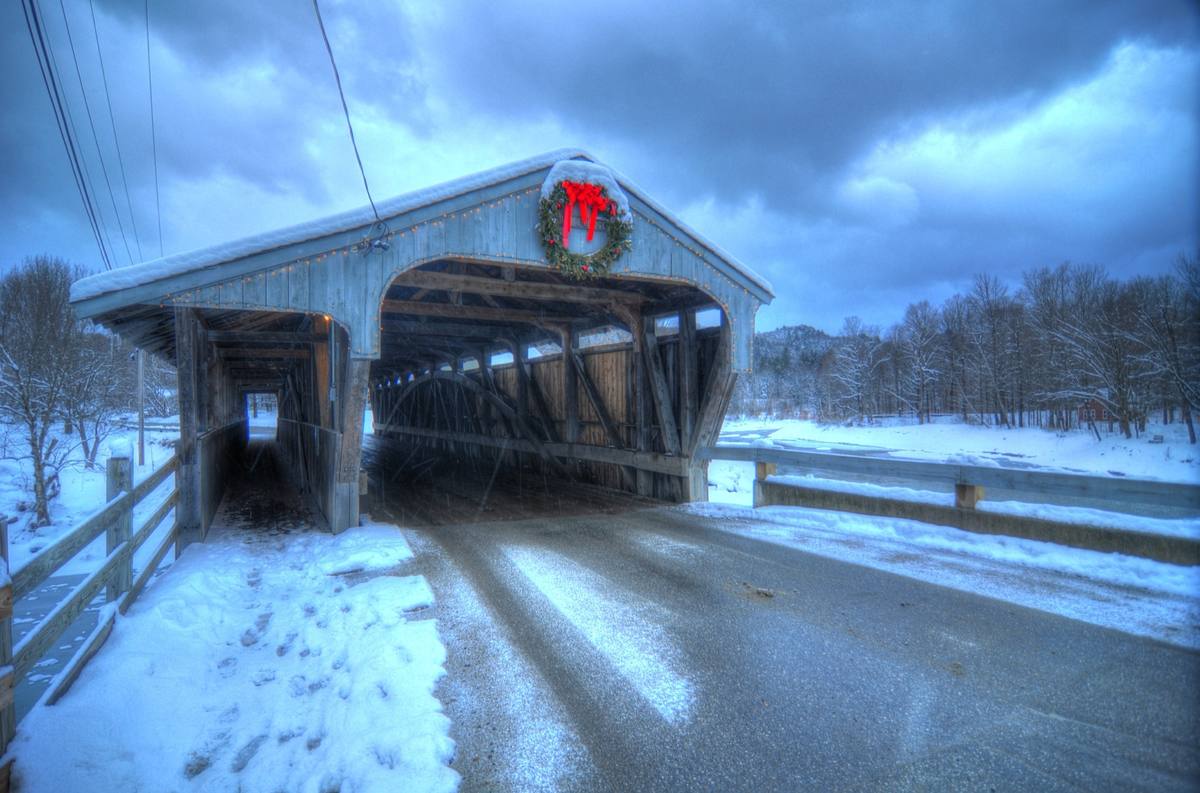
Ordinary access to the principal ski experience requires private transport. Verified August 16, 2026.
Evenings19:20 on the valley floor; later on Saturdays
At a glance
- Ski areas
- 6
- Within 30 min
- 2
- Closest
- 15 minDrive or shuttle
- Reachable by transit
- 1 of 6
- Arriving from
- Burlington International1h by drive
- Groceries on foot
- YesYear-round town
The verdict
Verdict
Come for the pairing. Nowhere else in the East matches it. A skier-owned cooperative and a large corporate resort sit within ten minutes of the same breakfast. If you want Mad River Glen's ungroomed natural terrain on a Tuesday and Sugarbush's sustained vertical on a Wednesday, this valley is the only address that does it, and Waitsfield gives you a supermarket, a covered bridge and enough restaurants to get through an evening without driving to Waterbury.
Do not come if anyone in the group rides a snowboard and wants variety — half the valley is closed to them and there is no joint ticket bridging the two areas. Do not come without a car: the free Mad Bus is a closed loop inside the valley, it does not serve Mad River Glen, and nothing scheduled connects Waitsfield to Waterbury's Amtrak platform. And do not come expecting dependable cover. Mad River Glen makes very little snow, and a lean January shows here faster than almost anywhere else in Vermont.
Is this base for you?
Who this suits
Best for
- Skiers who want two opposed mountains in one week. Sugarbush supplies two developed peaks; Mad River Glen supplies a single chair, natural snow and terrain that was never flattened.
- Experts and tree skiers in a good snow year. Mad River Glen's woods and Sugarbush's sustained vertical make an unusual pairing for one valley.
- Season workers who prefer a small valley. Waitsfield supplies the supermarket and restaurants, while the free valley bus reaches Lincoln Peak and links onward to Mount Ellen.
Depends on you
- Cooperative Mad River Glen and Alterra-owned Sugarbush. The contrast offers two resort cultures in one valley, but an Ikon Pass and a co-op share do not buy access to each other's lifts.
- Mad River Glen's skiers-only rule. Skiers get the cooperative's preserved old-cut terrain; snowboarders must build their trip around Sugarbush instead.
- Three towns acting as one valley. Waitsfield, Warren and Fayston offer distinct village, mountain and lodging positions, while daily life is spread along Route 100 rather than one center.
The honest part
Things you should know
- 01
Lincoln Gap Road — the direct line west out of Warren — is barricaded and unplowed from about 15 October to 15 May. In winter everything on the Champlain side is reached either over VT-17 at the Appalachian Gap, which is steep, twisting and genuinely nasty in a storm, or by going 45 minutes south to VT-125 at Middlebury Gap. The map lies to you here.
- 02
The valley is a transit dead end. The free Mad Bus is a seasonal circulator that runs only inside the valley, roughly mid-December to late March, and does not serve Mad River Glen at all. Nothing scheduled links Waitsfield to Amtrak at Waterbury or to Burlington's airport, so arriving without a car means a pre-booked private shuttle.
- 03
The two mountains that define the place are not interchangeable. Mad River Glen bans snowboards outright, so a mixed group is split from day one, and there is no joint ticket or pass between the areas — an Ikon Pass buys nothing at the co-op, and a co-op share buys nothing at Sugarbush.
The access matrix
What you can ski from Mad River Valley
Typical door-to-lift times in normal winter conditions. ● marks areas reachable on published transit during ski hours. Every row is dated below.
- On foot or skis
- Public transport
- Lift from town
- Needs a vehicle
| Ski area | Getting there | Time | Best for | Main drawback |
|---|---|---|---|---|
| Transit-served. Sugarbush Resort | Drive or shuttleFree Mad Bus · hourly to Lincoln Peak, half-hourly Mt Ellen link · ~mid-Dec–late Mar · 2026-27 schedule unverifiedEvidence & assumptions for Sugarbush ResortThe free Mad Bus serves both base areas roughly mid-December to late March — an hourly valley-floor route to Lincoln Peak plus a half-hourly Mount Ellen link. Operation passed from Green Mountain Transit to Tri-Valley Transit on 1 July 2026; the agencies stated routes, schedules and the zero fare carried over unchanged, but the winter 2026-27 schedule is UNVERIFIED here. Drive time estimated; not yet checked against a routing source. Source [1] Mad River Valley Bus Map & Guide, 2025-2026 ski season (the Mad Bus) — verified August 16, 2026 | [1] | Sustained vertical, two distinct mountains, and Ikon Pass holders | Lincoln Peak and Mount Ellen are about twenty minutes apart by road and the lift between them runs only on selected days, so "one resort" means two separate drives |
| Mad River Glen | DriveUp VT-17 · no bus serves it · the valley's free shuttle does not reach itEvidence & assumptions for Mad River GlenUp VT-17 toward the Appalachian Gap. No bus serves it — Mad River Glen's own directions page lists none — so the valley's free shuttle is useless for reaching it. Estimated drive time; not yet verified against a routing source. Verified August 16, 2026 | Natural-snow tree skiing and expert terrain that has never been flattened | Snowboards are banned outright and snowmaking is minimal, so a thin year closes much of the mountain | |
| Cochran's Ski Area | DriveEvidence & assumptions for Cochran's Ski AreaRoute 100 north to Waterbury, then I-89 west to Richmond. The VT-17 Appalachian Gap shortcut is no faster in winter. Estimated drive time; not yet verified against a routing source. Verified August 16, 2026 | Cheap short outings and children learning to race | A community hill with a handful of surface lifts — a two-hour outing, not a ski day | |
| Middlebury College Snow Bowl | DriveRoute 100 south then VT-125 west · Lincoln Gap Rd barricaded ~15 Oct–15 MayEvidence & assumptions for Middlebury College Snow BowlRoute 100 south through Granville Gulf to Hancock, then VT-125 west — NOT over the Appalachian Gap. Lincoln Gap Road, the direct line west out of Warren, is barricaded and unplowed from roughly 15 October to 15 May. Estimated drive time; not yet verified against a routing source. Verified August 16, 2026 | Uncrowded midweek skiing at college-hill prices | Small and student-oriented; the operating calendar follows a college, not a resort | |
| Bolton Valley | DriveEvidence & assumptions for Bolton ValleyRoute 100 north to Waterbury, then US-2 west. Estimated drive time; not yet verified against a routing source. Verified August 16, 2026 | Lift-served access to backcountry touring, and night skiing on the days it runs — check the calendar | Four steep miles of access road above US-2 that punish bad tires in a storm | |
| Stowe Mountain Resort | DriveEvidence & assumptions for Stowe Mountain ResortRoute 100 north through Waterbury, then VT-108. Estimated drive time; not yet verified against a routing source. Verified August 16, 2026 | Resort-scale terrain and lift capacity, for a committed day | An hour each way plus Mountain Road traffic, at Vermont's steepest walk-up ticket price |
Where to stay
Waitsfield and Irasville are the valley floor, and for most visitors the right answer. This is where the supermarket is, where most of the restaurants are, and where the free valley bus actually runs. It is also two places rather than one: the historic village sits on Bridge Street at the Great Eddy covered bridge, while Irasville — the shops, the market, the pizza — is a half-mile south on Route 100. Walking between them means walking a state highway shoulder in the dark. Neither is a ski base; both mountains are still a drive.
Sugarbush Access Road and Lincoln Peak put you at a lift and on the shuttle route. If your week is Sugarbush and only Sugarbush, this removes the car from the equation entirely. The cost is that it is a resort base — the food and the prices are the resort’s, there is nothing to walk to beyond it, and Mad River Glen is still twenty minutes away.
Warren Village is the prettiest thing in the valley by a distance: the Warren Store, a covered bridge, a tight cluster of buildings off Route 100. It is also tiny. There is no supermarket, few beds, and everything — both mountains, the market, the highway north — is a drive.
Fayston has no village center at all. What it has is position: German Flats Road and the VT-17 corridor put you closest to both Mount Ellen and Mad River Glen. Rentals here are scattered houses on unlit back roads with no services and no bus. Take it if Mad River Glen is the reason you came.
Moretown and the Route 100 corridor north are the cheaper spillover, ten minutes further from the lifts and ten minutes closer to the Waterbury commute. Season workers end up here more often than visitors do.
Getting there
There is no scheduled public transport into the Mad River Valley. That is the single most important logistical fact about the place, and it is easy to miss because Amtrak looks close on a map. The Vermonter stops at Waterbury, about eighteen miles north, but no bus runs south from there into the valley — the Route 100 commuter service out of Waterbury heads the other way, toward Morrisville. Getting from the train to Waitsfield means a taxi or a pre-booked private shuttle.
Driving, Burlington International is about an hour: I-89 to Waterbury, then Route 100 south. The alternative — VT-17 over the Appalachian Gap from the Champlain side — is shorter in miles and a worse idea in February. Boston is roughly three hours via I-93 and I-89, Montréal about three, New York closer to five and a half.
The last leg from Waterbury is eighteen miles of two-lane road along the Mad River. It is plowed and it is not difficult, but it is slow behind a truck, and it is the only way in from the north.
Getting around
The free Mad Bus is real, useful and narrower than it sounds. It runs a seasonal service — roughly mid-December to late March — with an hourly valley-floor route linking Waitsfield and Irasville to the Sugarbush Access Road and Lincoln Peak, a more frequent Mount Ellen connection, and a mountain-condo circulator. Fares are suspended; it costs nothing. Last valley-floor departures run into the early evening, later on Saturdays.
Two limits matter. The bus does not go up VT-17 to Mad River Glen — the co-op’s own directions page lists no transit at all — so the valley’s free shuttle reaches exactly one of its two headline mountains. And the bus does not leave the valley. It is a circulator, not a connection.
One more caveat on currency: responsibility for these routes passed from Green Mountain Transit to Tri-Valley Transit on 1 July 2026. Both agencies said routes, schedules and the zero fare would carry across unchanged, and Tri-Valley Transit still lists the seasonal Mad River Valley service. We have not verified the winter 2026-27 schedule. Check it before you build a trip on it.
For roads: Route 100 is the spine and stays open. VT-17 over the Appalachian Gap is open year-round, steep on both sides, and hard enough in weather that Mad River Glen tells skiers to check the gap camera before driving. Lincoln Gap Road is closed — barricaded and unplowed from roughly mid-October to mid-May — which removes the obvious shortcut west and is the reason Middlebury Snow Bowl is a Route 100 trip south rather than a hop over the ridge. Winter tires, not all-seasons.
Who it suits
- Skiers who want two opposed mountains in one week. Mad River Glen’s 1948 single chair, minimal snowmaking and unpisted terrain, then Sugarbush’s lifts and vertical the next day. Nowhere else offers the contrast at this range.
- Experts and tree skiers in a good snow year. In a bad one, be honest with yourself about what Mad River Glen is without natural cover.
- Season workers who want a small valley. High season-worker relevance here — read the next section first.
It suits snowboarders worst. Half the valley is closed to them, permanently, by member vote. It suits car-free travelers nearly as badly. And it is not a beginner destination: Sugarbush handles learners well enough, but Mad River Glen is not a teaching hill and the valley has no gentle third option nearby.
Living for a season
Sugarbush is the large employer and runs a conventional resort hiring cycle. Mad River Glen is a cooperative with a small paid staff and a volunteer culture that runs deep — a different kind of workplace, and a much smaller one.
Housing is the constraint, and it is severe rather than merely tight. Warren is overwhelmingly second homes, the valley’s long-term rental stock is a small fraction of total housing and has been shrinking as short-term rentals grew, and the specific problem seasonal workers report is lease length: landlords want twelve months, and a five-month job cannot commit to that. Start looking in summer, expect to share, and treat employer-linked housing as a serious advantage rather than a fallback.
Practically: Mehuron’s on Route 100 covers groceries without a car if you are on the valley floor. Waitsfield has a health center for primary care, but the nearest emergency department is Central Vermont Medical Center at Berlin, around thirty minutes away, with Burlington’s teaching hospital an hour out. We have not verified a coworking space in the valley — if remote work is part of the plan, check broadband at the specific address before signing anything. Waterbury is a 25-to-30-minute commute and Montpelier around forty, which is what keeps the valley’s year-round economy from being purely seasonal.
What the town is like
The Mad River Valley is three towns — Waitsfield, Warren, Fayston — that behave as one and argue like siblings. There is no outlet strip, no resort village pretending to be a town, and very little nightlife. Après is a handful of bars and a general store.
Waitsfield carries most of the weight, split between the covered-bridge village on Bridge Street and the low-slung retail of Irasville. Warren Village is the postcard. Fayston is a road network with houses on it. The valley is unusually self-aware for a ski destination: it runs its own planning district, studies its own housing, and its flagship ski area is a cooperative whose members vote on policy — including, twice now, on keeping snowboards off the mountain.
The character that follows from all this is agricultural and slightly countercultural rather than resort-polished. That is the appeal, and it is also why the valley is quieter in November and April than visitors expect. Summer brings Route 100 traffic, the swimming holes on the Mad River and the gliders out of the Warren-Sugarbush airport, but the shoulder seasons here are genuinely empty in a way Stowe’s are not.
Not sure?
Choose somewhere else if…
- Stowe & the Waterbury corridor
You want one bigger mountain and an actual chain of public transport. Amtrak reaches Waterbury, a regional bus reaches Stowe village and a free shuttle reaches the lifts — the exact link the Mad River Valley does not have. You give up the co-op and pay more for everything.
Full comparison - Burlington
You need an airport, a job market, a teaching hospital and a city more than you need a fifteen-minute drive to the lift. Bolton, Smugglers' Notch, Stowe and Sugarbush are all day trips from there — but every one of them is a day trip, and nothing is out the back door.
- Rutland & Killington
You measure a season in vertical and want a genuine après scene. Killington and Pico offer far more lift-served terrain than the Mad River Valley can, at the cost of the valley's character and its two-mountain-in-one-morning geography.
This base appears in
Sources & data notes
How this page was verified
Section verification
- Access matrixAugust 16, 2026
- Getting thereAugust 16, 2026
- Getting aroundAugust 16, 2026
- Where to stayAugust 16, 2026
Sources
- Mad River Valley Bus Map & Guide, 2025-2026 ski season (the Mad Bus) — Green Mountain Transit (GMT) · operator schedule, cited not reproduced · retrieved
- Sugarbush Resort — Mad Bus / GMT Mad River Valley transportation — Sugarbush Resort · official site, cited not reproduced · retrieved
- Northeast resort profiles — NESKIS · sibling property; mountain specifications maintained there · retrieved
Images
Page last reviewed August 16, 2026. Transit routes, schedules and fares change between seasons — check the operator before you travel. Mountain specifications for the northeastern US are maintained separately on NESKIS.