Val Gardena — Ortisei, Santa Cristina & Selva
One valley bus, roughly hourly, ties three villages and an Italian rail gateway together, while two direct cableways out of the largest village reach Seceda and the Alpe di Siusi plateau in minutes — against a Sellaronda circuit that only ever moves by ski, never by scheduled bus, and a last valley-bound departure from Bolzano that closes before nine.
Car-free arrival is practical, daily needs are walkable or transit-served, and at least 80% of the ski areas in this page’s matrix are reachable on published transit during normal ski hours. Verified August 18, 2026.
Evenings20:13 from Bolzano on line 350 is the last valley-bound departure, reaching Selva at 20:52 — nearly an hour before the last valley-to-Bolzano run at 21:04. The return leg, not the outbound one, is the real evening constraint. A separate paid Nightliner covers late movement between the three villages themselves; its exact hours were not independently confirmed this pass.
At a glance
- Ski areas
- 8
- Within 30 min
- 4
- Closest
- 8 minWalk
- Reachable by transit
- 7 of 8
- Arriving from
- Bolzano/Bozen48 min by public bus
- Groceries on foot
- YesYear-round town
The verdict
Verdict
Come to Val Gardena for three villages on one hourly valley bus, and for two direct cableways out of the largest of them. Ortisei puts a two-stage cable car to Seceda and a second cable car to the Alpe di Siusi plateau within a few minutes of a real town center, and the same line 350 that links Selva, Santa Cristina and Ortisei also reaches Bolzano's trains in under an hour. The valley's own terrain, and the connected circuits into Alta Badia, Arabba and Val di Fassa, run on one Dolomiti Superski pass without a rental car anywhere in the chain.
Do not come expecting a bus to follow you onto the Sellaronda. The only road service over Passo Gardena and Passo Sella runs in summer, not winter, so crossing into the neighboring valleys is a lift-and-ski commitment with no scheduled way back if you misjudge the last lift. Do not come for a late dinner in Bolzano either — the last bus out of the city toward the valley leaves at 20:13, nearly an hour before the last one in. And do not assume Ortisei's convenience is Selva's: the village closest to the Sellaronda's start is the one furthest from the valley's best shopping and its two headline cable cars.
Is this base for you?
Who this suits
Best for
- Skiers who want their lift pass to double as their transport pass. The Dolomiti Superski network and the valley's own line 350 bus both run from the same Ortisei bed without a rental car anywhere in the chain.
- Anyone drawn to two distinct mountains from one village. Seceda's ridge panorama and the wide, open Alpe di Siusi plateau sit a few minutes apart by cable car from central Ortisei.
- Committed skiers who read a last-lift time before they cross a pass. The Sellaronda genuinely reaches three neighboring valleys without a car, but only for someone willing to plan the return the way this page's matrix insists on.
Depends on you
- Which of the three villages you book. Ortisei is the walkable town center with the strongest shops and two direct cable cars, but it sits off the Sellaronda; Selva sits on the circuit and gives up Ortisei's convenience for it.
- A German-and-Italian valley wearing an English tourist veneer over a Ladin base. Timetables, signage and village names come doubled — Ortisei/St. Ulrich, Selva/Wolkenstein — which some travelers find charming and others find one extra thing to parse at seven in the morning.
- The Sellaronda's ski-only structure. It rewards a fit, forecast-reading skier who can plan a circuit and be back before the last lift, and it offers nothing to anyone who wants a bus or a train as a backup plan.
The honest part
Things you should know
- 01
The Sellaronda into Alta Badia, Arabba and Val di Fassa has no winter bus at all — südtirolmobil's only road service over Passo Gardena and Passo Sella, lines 472 and 473, runs summer only, roughly June to October. Skiing across commits you to skiing back before the last lift of the day; miss it and the fix is a taxi over a mountain pass that can be shut by weather, not a bus.
- 02
Evening service is not symmetric. On the 2024–25 line 350 timetable the last bus INTO Bolzano leaves Selva at 21:04, but the last bus back OUT of Bolzano toward the valley leaves at 20:13 and reaches Selva at 20:52 — nearly an hour earlier in the direction that actually matters for a dinner or a late train in the city.
- 03
Ortisei is the valley's largest and most walkable base, but it does not sit on the Sella Ronda. Reaching the Ciampinoi and Dantercepies lifts that carry the Saslong course and the Sellaronda's start means a ski run down into Selva or the valley bus, not a walk from an Ortisei hotel.
The access matrix
What you can ski from Val Gardena
Typical door-to-lift times in normal winter conditions. ● marks areas reachable on published transit during ski hours. Every row is dated below.
- On foot or skis
- Public transport
- Lift from town
- Needs a vehicle
| Ski area | Getting there | Time | Best for | Main drawback |
|---|---|---|---|---|
| Transit-served. Val Gardena (Ciampinoi–Dantercepies–Saslong) | WalkLifts begin in-village at all three bases · exact walk time from Ortisei unconfirmedEvidence & assumptions for Val Gardena (Ciampinoi–Dantercepies–Saslong)Estimated; the dossier behind this page could not confirm an exact walk time to the nearest portal from central Ortisei. The Val Gardena lift network (Ciampinoi, Dantercepies, the Saslong World Cup course) begins in-village across all three bases, but Ortisei's closest lifts are Seceda and the Alpe di Siusi cable car, covered separately below. Source [4] Val Gardena — lifts and winter visitor information — verified August 18, 2026 | [4] | A full valley day on the groomed Ciampinoi-Dantercepies-Saslong network, without touching the Sellaronda's cross-valley lifts | Ortisei's own portals feed Seceda and the Alpe di Siusi cable car, not this network — reaching the Ciampinoi and Dantercepies lifts above Selva and Santa Cristina means a ski run down or the valley bus, not a walk from an Ortisei bed |
| Transit-served. Seceda | Cable carTwo-stage Seceda cableway direct from Ortisei · ~10–12 min ride (estimate)Evidence & assumptions for SecedaTwo-stage Funivie Seceda SpA cableway (Ortisei–Furnes–Seceda), confirmed direct from Ortisei on the operator's own site. The operator publishes hours, not minutes; 12 here is an estimate within the 10–12 minute range secondary sources give for the full two-stage ride. Source [6] Seceda cableway — Ortisei–Furnes–Seceda — verified August 18, 2026 | [6] | The ridge panorama and open descent from Seceda's summit, the valley's signature run | A two-stage cableway is the only way up or down; a stop or a queue at either stage closes the whole sector, and the operator does not publish a minutes figure for the ride |
| Transit-served. Alpe di Siusi | Cable carMont Sëuc cable car direct from Ortisei · free with the Guest Pass · ride time unresolvedEvidence & assumptions for Alpe di SiusiOrtisei–Alpe di Siusi cable car ("Mont Sëuc"), confirmed direct from Ortisei with no scheduled-bus leg. Ride time is unresolved: neither operator site (funiviaortisei.eu, montseuc.it) publishes a minutes figure, and secondary sources (Tripadvisor, AllTrails, Wanderlog) range from 7 to 15 minutes. 12 here is a mid-to-upper estimate, not a timed figure. The free Val Gardena Guest Pass covers this cable car but not the separate Alpe di Siusi feeder buses (lines 10/11/12) from the Kastelruth/Siusi side. Source [7] Ortisei–Alpe di Siusi cable car ("Mont Sëuc") — verified August 18, 2026 | [7] | Europe's largest high alpine meadow — wide, treeless beginner and intermediate cruising | One cable car is the only direct link from Ortisei; the ride time is genuinely unsettled, with secondary sources disagreeing by close to a factor of two |
| Transit-served. Vallunga | Public busBus 350 up-valley plus a short walk in · minutes derived from the 2024–25 timetableEvidence & assumptions for VallungaFrom central Selva, Vallunga is a walk or short ski directly into the valley mouth, with groomed trails covered by the Val Gardena Guest Pass. From Ortisei, this page's reference base, the figure here (roughly 20–25 minutes) is derived from the confirmed Ortisei–Bolzano and Selva–Bolzano journey times on line 350's 2024–25 timetable, since the timetable does not publish an Ortisei–Selva segment directly, plus a short walk into the valley. Source [1] Line 350 timetable — Gröden/Val Gardena–Waidbruck–Bozen — verified August 18, 2026 | [1] | Free cross-country skiing in a quiet side valley, no lift pass required | It is a Selva-side valley, not an Ortisei one — from Ortisei this means riding line 350 up-valley and walking in, not stepping out of a village-center hotel |
| Transit-served. Val di Fassa | Lift from townLift-and-ski chain over Passo Sella · no winter bus over the pass · 55 min is an editorial estimateEvidence & assumptions for Val di FassaNo lift-to-lift timing is published anywhere; 55 minutes is an editorial estimate for a lift-and-ski chain over Passo Sella, not a measured or timetabled figure. südtirolmobil's only road service over the pass, lines 472/473, runs summer only (roughly June–October), so there is no scheduled bus alternative in winter. Private-car drive time over the same pass, weather permitting, is roughly 20–30 minutes — shorter than the lift chain, which is normal for a mountain-pass ski circuit rather than a road. Source [5] Dolomiti Superski — Val Gardena, Alpe di Siusi and Sellaronda network — verified August 18, 2026 | [5] | The Sellaronda's other direction — Canazei's terrain over the shorter of the two passes | Same one-way risk as the rest of the circuit: no winter bus over Passo Sella, and the return crossing depends on the last lift of the day, not a timetable |
| Transit-served. Alta Badia | Lift from townLift-and-ski chain over Passo Gardena · no winter bus over the pass · 60 min is an editorial estimateEvidence & assumptions for Alta BadiaNo lift-to-lift timing is published anywhere; 60 minutes is an editorial estimate for a lift-and-ski chain over Passo Gardena via Ciampinoi or Dantercepies, not a measured or timetabled figure. südtirolmobil's only road service over the pass, lines 472/473, runs summer only (roughly June–October). Private-car drive time over the same pass, weather permitting, is roughly 25–45 minutes. Source [5] Dolomiti Superski — Val Gardena, Alpe di Siusi and Sellaronda network — verified August 18, 2026 | [5] | A change of valley and terrain on the same lift pass — Corvara's wider, sunnier pistes | No scheduled winter bus over Passo Gardena at all — a late finish or a stopped lift strands you on the wrong side of the circuit for the night, with only a taxi to fix it |
| Carezza | DriveCar-only in winter · line 180 reaches Carezza from Bolzano, not from Val GardenaEvidence & assumptions for CarezzaTwo plausible road routings exist (via Ponte Gardena, or via Passo Sella and Passo Costalunga); neither is timed by an operator. 65 minutes is the midpoint of a 50–75 minute estimate that was not independently timed this pass. Carezza's own südtirolmobil service is line 180 (Bolzano–Nova Levante/Welschnofen–Passo Costalunga–Val di Fassa), confirmed this pass to not touch Val Gardena at all — reaching Carezza on published transit from here means backtracking to Bolzano on line 350 and transferring to line 180, not a direct valley-to- valley service, which is what makes this row car-only in practice despite South Tyrol's otherwise dense transit network. Source [9] südtirolmobil — South Tyrol integrated transport journey planner — verified August 18, 2026 | [9] | Karersee's postcard lake view and a smaller ski area away from the Sellaronda crowds | Car-only in winter — no südtirolmobil line was found serving this pairing directly, and the minutes figure itself is a road-geometry guess, not a timed one |
| Transit-served. Arabba/Marmolada | Lift from townTwo-pass lift-and-ski chain on the Sellaronda · no winter bus · 100 min is an editorial estimateEvidence & assumptions for Arabba/MarmoladaNo lift-to-lift timing is published anywhere; 100 minutes is an editorial estimate for a two-pass lift-and-ski chain via the Sellaronda circuit, not a measured or timetabled figure. Both passes involved (Gardena/Campolongo, or Sella/Pordoi) carry only summer-only road service (lines 472/473). Private-car drive time over two passes, weather permitting, is roughly 40–60 minutes. Source [5] Dolomiti Superski — Val Gardena, Alpe di Siusi and Sellaronda network — verified August 18, 2026 | [5] | The Sellaronda's longest spur and the closest lift approach to the Marmolada glacier | The longest leg in the matrix and the easiest to misjudge — two passes each way, no winter bus on either, and the least forgiving last-lift margin in the valley |
Sourcing note. This page’s access matrix is anchored to Ortisei, the valley’s largest and most walkable base — the schema does not support a duplicate ski area per destination, so Santa Cristina’s and Selva’s own, shorter or longer distances to the same lifts are carried in the prose below rather than in a second or third matrix row, the same approach
hakuba.mdxuses for its own multi-village valley anchored to Happo. All nine sources behind this page areapprovedas of a 2026-08-18 live re-check — the Dolomiti Superski, Trenitalia and general südtirolmobil entries were the last three to clear, via a browser-based re-fetch of dolomitisuperski.com and direct fetches of südtirolmobil’s own line 100 and line 472 timetable PDFs — and every lift-timing figure not tied to a printed timetable is still flagged as an editorial estimate in its own row rather than presented as measured.
Where to stay
Ortisei: the default for most first visits
Ortisei is the largest of the three villages. It has the valley’s strongest shopping and dining, a real pedestrian center, and two lift systems a few minutes’ walk from most beds: the two-stage cable car to Seceda, and the separate cable car up to the Alpe di Siusi plateau. What it does not have is a seat on the Sellaronda — reaching the Ciampinoi and Dantercepies lifts that carry the Saslong course and the Sellaronda’s start means skiing down into Selva or taking line 350, not walking out of an Ortisei hotel.
Santa Cristina: quieter, between the other two
Santa Cristina sits between Ortisei and Selva, quieter and more spread out, with its own access toward the Col Raiser/Seceda side and the Saslong slope. It has fewer everyday shops than Ortisei, and because the village is more dispersed, “central” lodging here is worth testing against both the nearest lift and the nearest line 350 stop rather than assuming either. A separate Monte Pana/Saltria shuttle also serves the upper Santa Cristina side; it is explicitly excluded from the free Val Gardena Guest Pass, and this page does not yet have a reliable frequency or fare for it — ask before assuming it runs on a schedule you can plan around.
Selva: the Sellaronda base
Selva is the base built for the Sellaronda itself — the strongest lift-linked access to the outward circuit and the easiest starting point for a day into Alta Badia, Arabba or Val di Fassa. It is smaller and more resort-like than Ortisei, stretched along the road rather than centered on a square, and the trade for that lift access is a thinner everyday-life geography.
Plan de Gralba: lift-first, town-second
Plan de Gralba, the satellite above Selva, pushes the access logic further still — it sits closer to the Sellaronda lifts than any village base does — at the cost of having almost no ordinary village life of its own. It suits a lift-first, town-second trip rather than a first visit.
Getting there
There is no railway station inside Val Gardena, and the honest starting point is Bolzano/Bozen, roughly 30 km from Selva by road. Bolzano sits on the Trenitalia Bolzano–Brennero regional line, with long-distance trains also calling at Bressanone/Brixen, and from either station the connection into the valley is a südtirolmobil bus rather than a second train.
Line 350 is the valley’s own bus, and the more reliable of the two routes in: confirmed from two consecutive seasons of the operator’s own timetable PDFs, it runs daily and roughly hourly, covering the full length of the valley — Selva, Plan de Gralba, Santa Cristina, Ortisei — before continuing via Waidbruck/Ponte Gardena to Bolzano. Journey time is about 45 to 50 minutes from Ortisei, 65 to 75 minutes from Selva. One detail the printed timetable does not resolve: at Waidbruck, line 350 shows a same-stop connection about five minutes later onto a differently numbered corridor toward Bolzano and Bressanone, signed on the timetable as “100.” Whether that is a through-running vehicle under a different line number or an actual change of bus could not be determined from the timetable alone — do not describe this as a no-transfer connection until it is confirmed with the operator directly.
Line 351 offers a second gateway via Chiusa/Klausen and on to Bressanone/Brixen, running hourly including Sundays and holidays, with a confirmed Chiusa–Ortisei journey of about 44 minutes; a parallel line 360 reaches the same Bressanone endpoint via Waidbruck instead. Bressanone is a genuinely practical second rail gateway here, not just a fallback.
Airports are a weaker part of this page than the buses are. Bolzano has the nearest airport but few scheduled routes; Innsbruck, Verona, Venice and Munich are the broader gateways most travelers actually use, each requiring a train-and-bus combination or a booked transfer. None of those airport-to-valley journeys were timed by an operator source this pass, so no figure for them appears in the matrix or above — treat “the better part of a day, door to door” as a planning assumption, not a verified number, until a dedicated check fills the gap.
Getting around
Val Gardena’s three villages — Selva, Santa Cristina, Ortisei — sit in a line along one valley road, and line 350 is the thread that connects them to each other as well as to Bolzano. It is covered by the Val Gardena Guest Pass, issued free to anyone booked through a Val Gardena Tourist Association member property, valid from midnight on arrival day to 23:59 on departure day. The pass covers every public bus inside the valley, line 350 to Bolzano, and nearly all of South Tyrol’s public transport besides. It does not cover the late-night Nightliner between villages, the separate Monte Pana/Saltria shuttle on the Santa Cristina side, long-distance trains, or — a specific exclusion worth knowing before you rely on it — the Alpe di Siusi feeder buses (lines 10, 11 and 12) that approach the plateau from the Kastelruth/Siusi side. Reach Alpe di Siusi by the Ortisei cable car and the guest pass covers it; arrive by the feeder buses instead and it does not.
Evening service is the constraint to plan around, and it is not symmetric. On the 2024–25 line 350 timetable, the last bus INTO Bolzano leaves Selva at 21:04 — but the last bus back OUT of Bolzano toward the valley leaves at 20:13 and reaches Selva at 20:52, nearly an hour earlier. A dinner in Bolzano that runs past nine has no bus home that night. A paid Nightliner covers late movement between the three villages themselves (€3 a ride, €5 for an all-night pass), but its exact hours were not independently confirmed this pass.
The bigger structural fact is the Sellaronda. Dolomiti Superski’s lift network genuinely links Val Gardena to Alta Badia, Arabba/Marmolada and Val di Fassa — but it links them by ski, not by bus. The only road service over Passo Gardena and Passo Sella, südtirolmobil lines 472 and 473, runs summer only, roughly June to October. In winter, crossing into any of those three neighboring valleys is a lift-and-ski commitment: there is no scheduled way back if a storm closes a lift or you misjudge the last one, and no published source this page found gives a warning about when that last lift actually is. Treat a Sellaronda day as a one-way decision made at the top of the first lift, not a there-and-back errand you can time from a bus schedule.
On the car_need conclusion: across this page’s eight-row matrix, seven ski areas are reachable without a car — by walk, cable car, valley bus, or the Sellaronda’s own lift network — against one, Carezza, that is genuinely car-only in winter. That is 88%, comfortably past the 80% bar this site sets for “unnecessary,” and it holds only once lift-only access is credited as transit-served, which is the correction this page’s research turned up: dismissing the Sellaronda as “not really transit” because no bus runs on it would have undersold the case Val Gardena actually has.
Who it suits
- Skiers who want their lift pass to double as their transport pass. The Dolomiti Superski network and the valley’s own line 350 bus both run from the same Ortisei bed, and the Val Gardena Guest Pass covers most of both.
- Anyone drawn to two distinct mountains from one village. Seceda’s ridge panorama and the wide, open Alpe di Siusi plateau are a few minutes apart by cable car from central Ortisei, and neither needs a ski down to the next lift to reach.
- Committed skiers who read a last-lift time before they cross a pass. The Sellaronda genuinely reaches three neighboring valleys without a car, but only for someone willing to plan the return the way this page’s matrix insists on — before lunch, not after the third run of the afternoon.
It suits anyone who wants a scheduled way home from a big linked circuit least. Every other row on this matrix has a bus, a cable car or a walk behind it; the Sellaronda rows do not, and a stranded afternoon on the wrong side of Passo Gardena is a taxi problem, not a timetable problem.
Living for a season
Val Gardena’s three villages are working South Tyrolean communities, not stations built and staffed only for the season. Ladin, German and Italian are all in genuine daily use, and the valley keeps a summer hiking and cycling economy that carries much of the year-round population through the shoulder seasons. Ortisei has the fullest everyday-services geography of the three — groceries, a pharmacy, and the kind of shops that serve residents as much as visitors.
South Tyrol’s autonomous-province status means public services and signage are routinely bilingual German/Italian, with Ladin added on top in the Gardena and Badia valleys specifically — a genuinely three-language environment that is unusual even by Alpine standards. For a European Union national, working a season here is comparatively straightforward; for anyone outside the EU/Schengen area, Italy’s normal visa and work-authorization rules apply, and a tourist entry does not cover paid seasonal work — confirm your status before committing to a winter here.
This page did not find a recent, sourced account of seasonal-worker housing pressure in Val Gardena specifically, so it makes no housing-market claim rather than guess at one. That is a gap to fill before this page can answer “is it hard to find a room” with anything more than a shrug.
What the town is like
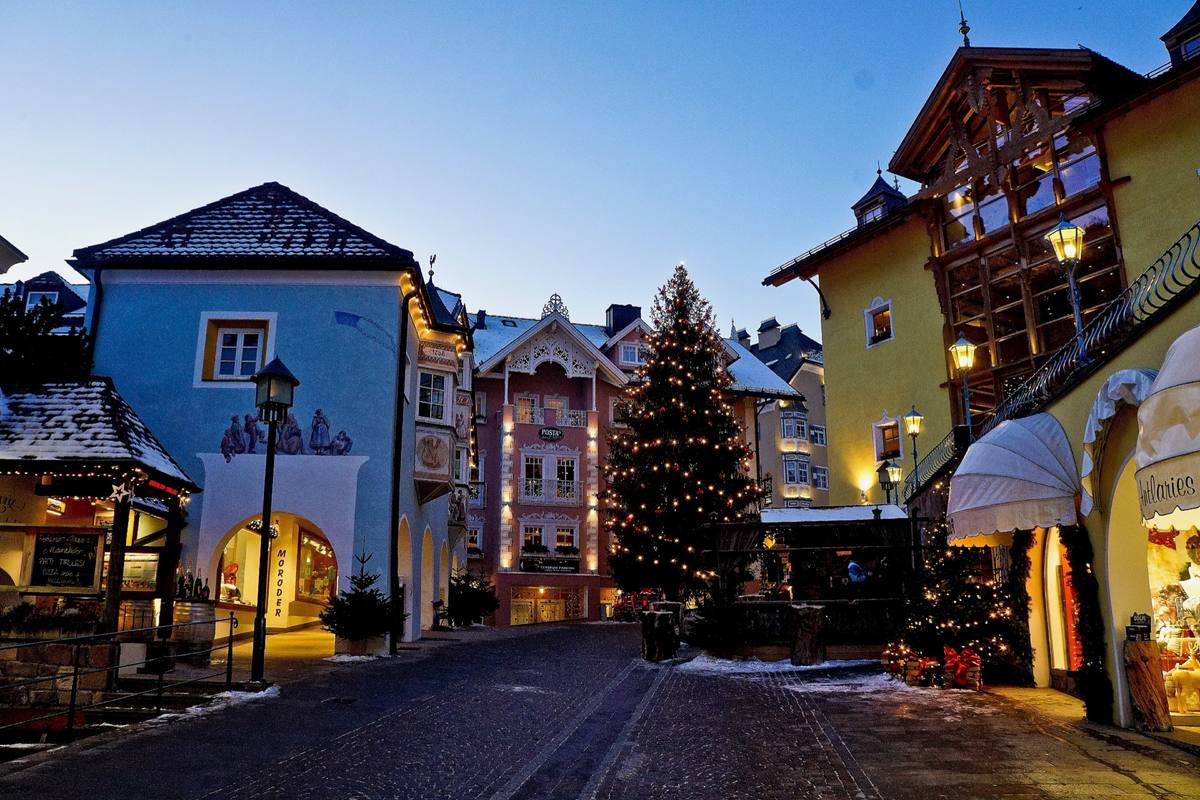
Val Gardena runs Ladin-German-Italian trilingual signage the length of the valley, and village names come doubled as a matter of course — Ortisei is also St. Ulrich, Selva is also Wolkenstein, Santa Cristina is Santa Cristina Gherdëina in Ladin. The valley has been carving wood and running lifts for long enough that neither business feels like a recent addition: Ortisei’s center still reads as a real Dolomite market town, with its two cable-car stations built into the edges of it rather than replacing the middle.
The Sella group closes the valley’s southern view, and it is the reason the Sellaronda exists at all — four valleys, one massif, one lift-linked loop around it. That geometry is also why the valley’s transit logic runs the way it does. South, toward the Sella group, there is no road built for scheduled buses to use in winter, only ski terrain and two high passes that shut behind the last chair. North, down-valley toward Bolzano, the geography opens out and the same corridor that carries line 350 also carries the regional trains — which is why arrival and departure both run through Bolzano or Bressanone rather than through the mountains on the other side.
The result is a valley that reads as two different places depending which direction you are facing. Look north and it is an ordinary, well-connected Alpine valley with a bus and a rail gateway. Look south and it is high mountain terrain that answers only to skis.
Not sure?
Choose somewhere else if…
- Alta Badia (Corvara)
You want to be based ON the Sellaronda circuit rather than at one end of it. Corvara sits inside the loop with faster access to all four connected valleys, at the cost of Ortisei's stronger town center and its two direct cable cars to Seceda and Alpe di Siusi.
- Innsbruck
You want the car-free story proven by scheduled buses rather than by a ski circuit. Innsbruck's ten ski areas sit on published timetables with a real city underneath them; Val Gardena trades that timetabled certainty for bigger, lift-linked terrain that only a skier, not a bus rider, can actually reach.
- Chamonix
You want a valley bus and a train station in the same town, with terrain to match the reputation. Chamonix's SNCF line reaches every base directly; Val Gardena's nearest station is Bolzano, 45 to 75 minutes down the valley by bus depending which of the three villages you start from.
Sources & data notes
How this page was verified
Section verification
- Access matrixAugust 18, 2026
- Getting thereAugust 18, 2026
- Getting aroundAugust 18, 2026
- Where to stayAugust 18, 2026
Sources
- Line 350 timetable — Gröden/Val Gardena–Waidbruck–Bozen — südtirolmobil (Südtiroler Transportstrukturen AG) · operator timetable, cited not reproduced · retrieved
- Line 351 timetable — Ortisei–Laion/Lajen–Chiusa/Klausen–Bressanone/Brixen — südtirolmobil (Südtiroler Transportstrukturen AG) · operator timetable, cited not reproduced · retrieved
- Val Gardena Guest Pass — Val Gardena Tourist Association (valgardena.it) · official destination site, cited not reproduced · retrieved
- Val Gardena — lifts and winter visitor information — Val Gardena Tourist Association (valgardena.it) · official destination site, cited not reproduced · retrieved
- Dolomiti Superski — Val Gardena, Alpe di Siusi and Sellaronda network — Dolomiti Superski Consortium · official lift-network site, cited not reproduced · retrieved
- Seceda cableway — Ortisei–Furnes–Seceda — Funivie Seceda SpA · operator site, cited not reproduced · retrieved
- Ortisei–Alpe di Siusi cable car ("Mont Sëuc") — Seiser Alm Seilbahn AG / Funivia Ortisei · operator site, cited not reproduced · retrieved
- Bolzano–Brennero regional line (Trenitalia, südtirolmobil line 100) — südtirolmobil (Südtiroler Transportstrukturen AG) / Trenitalia · operator timetable, cited not reproduced · retrieved
- südtirolmobil — South Tyrol integrated transport journey planner — südtirolmobil (Südtiroler Transportstrukturen AG) · operator timetable and journey planner, cited not reproduced · retrieved
Images
Page last reviewed August 18, 2026. Transit routes, schedules and fares change between seasons — check the operator before you travel. Mountain specifications for the northeastern US are maintained separately on NESKIS.