Aosta
A Roman-walled regional capital whose own ski area hangs 18 gondola minutes above the railway forecourt, with four more lift bases on the valley's bus network — in a winter when the trains themselves are not running.
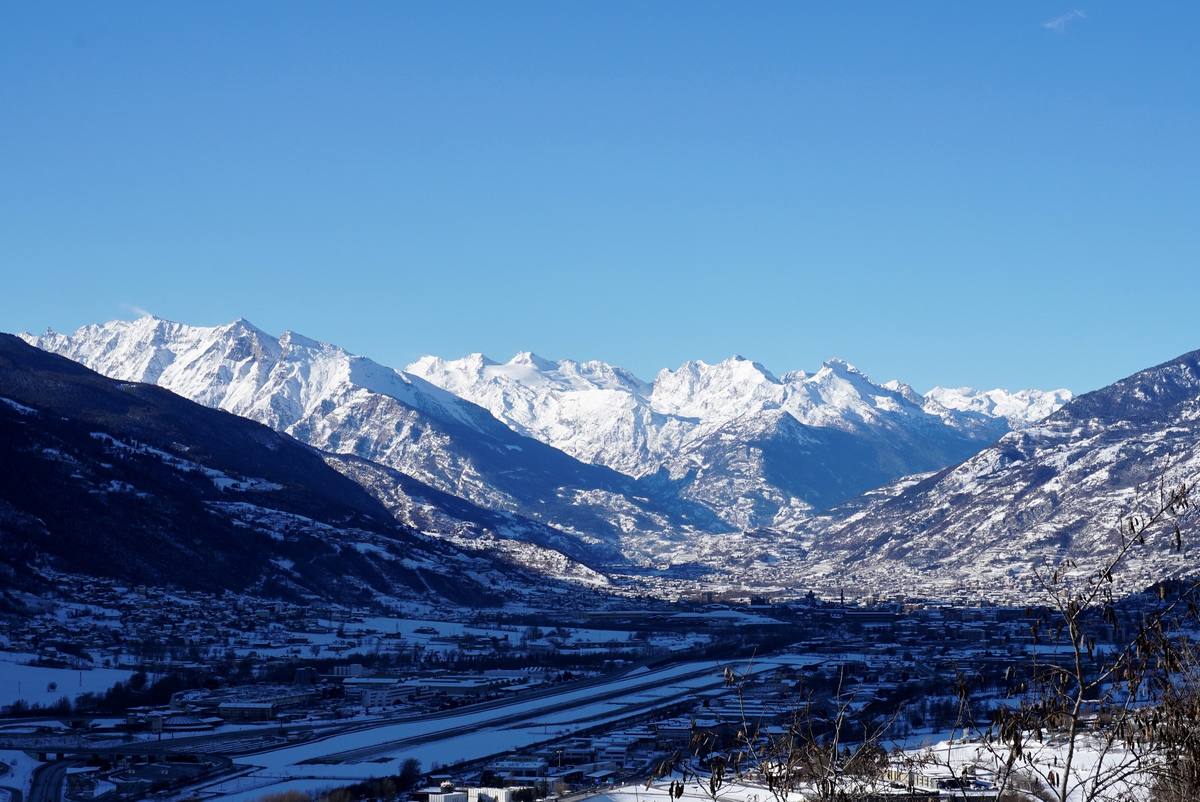
Car-free arrival is practical, daily needs are walkable or transit-served, and at least 80% of the ski areas in this page’s matrix are reachable on published transit during normal ski hours. Verified August 23, 2026.
Evenings17:30 is the Pila gondola's last published descent — the binding evening constraint for the primary mountain. The valley buses run far later on the sheets in force: the last working-day evening departure from Courmayeur is 22:05 (a final 23:45 night run follows), and trunk line 110 toward Châtillon runs into the small hours. Those are the summer-edition tables; winter 2026-27 editions replace them in December.
At a glance
- Ski areas
- 5
- Within 30 min
- 1
- Closest
- 18 minLift from town
- Reachable by transit
- 5 of 5
- Arriving from
- Turin (Porta Nuova & Porta Susa stations)2h 5m by public bus
- Groceries on foot
- YesYear-round town
The verdict
Verdict
Come to Aosta to sleep in a real city and commute to snow. The Pila gondola's base stands a short pedestrian underpass from the railway station, runs continuously from 8:25 to 17:30 through a winter season already published for 2026-27, and lands at 1,800 metres in 18 minutes. From the bus station beside it, Courmayeur is an hourly, direct 60-minute ride that stops at the cable-car base itself; Cogne is 50 minutes on a line that runs every day of the year but Christmas; La Thuile and Breuil-Cervinia work with one advertised change each.
Do not come expecting to arrive by train: the Aosta–Ivrea railway has been closed for electrification since January 2024, and the region's own plan restores service to Aosta only by spring 2027 — this winter, arrival means a coach, booked in advance on the Turin line. And do not treat the outer clock times as settled: the sheets in force are summer editions, and the winter tables that replace them in December will move the minutes, if not the map.
Is this base for you?
Who this suits
Best for
- City-based skiers: a Roman-walled regional capital with restaurants, ordinary shops and a working year-round life, whose own ski area hangs 18 gondola minutes above the station forecourt.
- One-base, many-mountains travellers who prefer buses to rental cars — Courmayeur hourly and direct, Cogne every day of the year but Christmas, La Thuile and Cervinia with one advertised change each.
- Mixed groups where not everyone skis: the non-skiing half gets a genuine Roman town — theatre, arch, walls — rather than a resort base area's shopping arcade.
Depends on you
- The skiing starts a lift ride away, by design. Pila's slopes sit at 1,800 metres above the city and you commute up every morning — a fair trade for an urban evening, or a daily tax, depending on who is asking.
- Aosta is a city first and a ski base second. That is the entire appeal for one kind of traveller and the entire objection for another; a purpose-built village will out-convenience it every time.
- This winter specifically, arriving means a pre-booked coach. Travellers drawn by the idea of a rail-served base should either embrace the Turin bus or wait a season — the region's own plan returns trains to Aosta in spring 2027.
The honest part
Things you should know
- 01
There is no train to Aosta this winter. The Aosta–Ivrea line has been closed for electrification since January 2024, and the regional transport authority's own plan reopens it progressively from 11 January 2027, reaching Aosta only by spring 2027 — arrival is by coach (booking obligatory on the Turin line) or by the Ivrea rail-replacement bus.
- 02
Every outer-valley clock time on this page rests on summer-edition sheets — Arriva's 581, 573 and 503 tables in force run 11 June–9 September 2026, and the Turin coach's validity ends 30 November — so the winter 2026-27 editions, unposted at verification, will change the specific times if not the structure.
- 03
The two marquee day trips cost real bus time: Courmayeur is an hour each way and Breuil-Cervinia closer to two with a change at Châtillon, so a week based in Aosta trades slope-side convenience for city life every single morning.
- 04
The load-bearing timetables are Italian-only PDFs with day-code legends (FER, FEST, GG, "1 6") that reward careful reading — Arriva's English pages link the sheets but do not translate them.
The access matrix
What you can ski from Aosta
Typical door-to-lift times in normal winter conditions. ● marks areas reachable on published transit during ski hours. Every row is dated below.
- On foot or skis
- Public transport
- Lift from town
- Needs a vehicle
| Ski area | Getting there | Time | Best for | Main drawback |
|---|---|---|---|---|
| Transit-served. Pila | Lift from townGondola from the station underpass · 18 min · 28 Nov–2 May, 8:25–17:30 dailyEvidence & assumptions for PilaThe operator's own words carry the whole claim: the base station is at Strada Ponte Suaz 4 and "from the train station you can walk to the Aosta-Pila cableway via a short pedestrian underpass"; the ride lands "directly at 1800 meters" in 18 minutes. Unusually, the winter 2026-27 season is already published: 28/11/2026–02/05/2027, gondola running without interruption 8:25–17:30. The road alternative is the operator's stated 30-minute drive up the SR18, or SVAP's marginal minibus (three Mon–Sat runs, none Sundays). Source [1] Pila — How to reach us — verified August 23, 2026 | [1] | Ski days that start on foot — out of a city hotel, through the station underpass, onto a gondola | The last published descent is 17:30, and the road fallback is a three-runs-a-day, Mon–Sat SVAP minibus — linger on the mountain past the closing cabin and getting down means a taxi on a 30-minute mountain road |
| Transit-served. Cogne | Public busSVAP line · 10/day year-round · runs every day except 25 DecEvidence & assumptions for CogneSVAP's Aosta-Cogne line, 50 minutes, ten runs a day each way; six carry the timetable's GG code — "every day of the year, working days and holidays, except 25 December" — and the sheet is headed "In vigore" with no seasonal window, making this the only outer row whose timetable needs no winter-edition caveat. The lifts (Cogne–Montzeuc gondola plus two chairs, operated per the regional tourism board by Pila spa – Funivie Gran Paradiso) rise from the village itself; Cogne's larger winter identity is its cross-country network. Source [9] Linea Aosta-Cogne — orario — verified August 23, 2026 | [9] | A quiet family hill and Cogne's cross-country network, on the most dependable bus of the five | A small mountain — one gondola and two chairlifts — that a strong piste skier will have exhausted by lunch, and the last bus back to Aosta leaves Cogne at 19:40 |
| Transit-served. Courmayeur | Public busArriva 581 · roughly hourly · to the Plan Checrouit lift base · winter sheet pendingEvidence & assumptions for CourmayeurArriva line 581, Aosta Autostazione to Courmayeur P.le Monte Bianco in 60 minutes, calling at "Courmayeur - Funivie Plan Checrouit" two minutes before the terminus — the bus serves the lift base, not just the town square. On the current sheet (in force 11 June–9 September 2026) it runs roughly hourly, with some twenty weekday departures between 5:15 and 22:30, and the last evening return from Courmayeur at 22:05 on working days (a 23:45 night run follows). The line's structure, route and cadence are verified; the specific winter clock times are not yet published. Source [5] Linea Aosta / Courmayeur — orario (581) — verified August 23, 2026 | [5] | Mont Blanc-scale terrain on an hourly, direct valley bus that stops at the Courmayeur cable-car base itself | Two hours of valley-floor bus riding brackets every visit, and the sheet in force is the summer edition — the winter 2026-27 timetable was not yet posted at verification, so the exact ski-season clock times need a December re-check |
| Transit-served. La Thuile | Public bus581 + 573 via Pré-Saint-Didier · advertised 5-min change · ~85 min on current tablesEvidence & assumptions for La ThuileLine 581 to Pré-Saint-Didier (52 minutes) plus Arriva line 573 to La Thuile (10 runs a day, identical weekday and holiday columns, about 19 minutes from the Pré-Saint-Didier rail-station stop). The change is the operator's own advertised connection — Arriva's Turin through-sheet prints "Cambio autobus a Pré-Saint-Didier (5 min.)" — and a typical chain on current tables runs about 85 minutes (Aosta 7:45 → Pré-Saint-Didier 8:37, 573 at 8:51 → La Thuile 9:10). Both sheets are summer editions; winter times unposted at verification. Source [6] Linea Courmayeur / La Thuile — orario (573) — verified August 23, 2026 | [6] | Espace San Bernardo's long, quiet skiing without basing in a resort village | No direct service — every trip changes buses at Pré-Saint-Didier — and on the current sheet the connecting line terminates at La Thuile's Piazzale Fiera: the timetable's printed "La Thuile - Funivia" stop carries no times, so the last stretch to the lifts is on foot through the village |
| Transit-served. Breuil-Cervinia | Public busLine 110 to Châtillon + line 503 · advertised connection · 10 climbs/dayEvidence & assumptions for Breuil-CerviniaLine 110 (run jointly by VITA S.p.A. and Arriva) covers Aosta–Châtillon in 35 minutes at half-hourly-to-hourly cadence — an open-ended, year-round sheet suspended only on 25 December — then Arriva line 503 climbs Châtillon–Breuil-Cervinia in 55 minutes, ten runs a day. The interchange is the operator's own advertised connection ("Coincidenze… Breuil-Cervinia - linea 503, cambio bus a Châtillon" on the Turin through-sheet). A well-landed chain runs about 95–110 minutes: Aosta 8:45 → Châtillon 9:20, 503 at 9:25 → Breuil Terminal 10:20. Source [7] Linea Chatillon / Breuil-Cervinia — orario (503) — verified August 23, 2026 | [7] | The region's high-altitude ski area — with Zermatt beyond it — as a committed full-day outing | Two buses each way with an unprotected interchange at Châtillon, close to four hours of round-trip riding on current tables, and the connecting line's winter 2026-27 edition was not yet posted at verification |
Where to stay
The walled centre is the base this page is about. Aosta’s Roman grid — between the Arch of Augustus, the Porta Praetoria and Piazza Chanoux — holds the hotels, the restaurants and the daily-needs shops, and its southern edge runs straight into the transport cluster this page’s every claim anchors on: the Autostazione, the (currently trainless) railway station and the Pila gondola base at Strada Ponte Suaz 4, which the lift operator places “a short pedestrian underpass” from the station. Staying anywhere inside the walls keeps the whole system on foot.
Pila itself, the purpose-built village at 1,800 metres where the gondola tops out, is the alternative for ski-first visitors: slope-side beds and morning corduroy, at the price of trading the city’s evenings for a resort’s. It is the top of Aosta’s own lift rather than a separate destination, which is why it appears in this page’s boundary and not as its own entry.
Courmayeur, La Thuile, Breuil-Cervinia and Cogne are matrix rows here, not lodging advice — each is its own base with its own logic, and basing in one of them answers a different question than this page asks.
Getting there
Start with the fact most ski write-ups omit: the railway to Aosta is closed. The Aosta–Ivrea line shut in January 2024 for electrification, and the regional transport authority’s July 2026 plan reopens it progressively from 11 January 2027 — Ivrea to Pont-Saint-Martin first, service reaching Aosta itself “by spring 2027.” For winter 2026-27 there are no trains at any point; a rail-replacement bus covers Ivrea–Aosta, and the station keeps its ticket office open.
The practical car-free arrival is Arriva’s Turin coach: four departures a day each way between Torino Porta Nuova/Porta Susa and the Aosta Autostazione, about two hours five minutes, €15 full route — and booking is compulsory (“prenotazione obbligatoria”), online, in the app or at authorized sellers, not a turn-up-and-go service. The current sheet is valid 13 April–30 November 2026; the winter edition replaces it from December. From Milan, a parallel Arriva coach runs from Lampugnano on the M1 metro, also booking-required; the operator publishes no journey time for it, so none is quoted here. Turin Caselle airport connects to Porta Susa by a separate Turin-side bus that this page has not verified — plan the last leg through Turin’s stations, which the Aosta coach serves directly.
Getting around
One interchange carries the whole page. The Autostazione, the railway station and the Pila gondola base sit together at the south edge of the walled centre, and every matrix time above is anchored there.
Pila is the wedge: an 18-minute gondola ride from the station underpass to 1,800 metres, running without interruption 8:25–17:30 — and, unusually for August, the operator has already published its winter 2026-27 season, 28 November to 2 May. The 17:30 last descent is the evening constraint that matters: after it, the mountain road is a taxi or the SVAP minibus’s three Monday–Saturday runs.
The valley buses do the rest. Courmayeur: Arriva 581, direct, hourly-ish, 60 minutes, with a stop at the Courmayeur cable-car base itself two minutes before the terminus. Cogne: SVAP’s 50-minute line, ten runs a day, six of them every day of the year except Christmas — the one outer timetable with no seasonal caveat at all. La Thuile: change at Pré-Saint-Didier onto line 573, about 85 minutes all told, with the change printed as a five-minute advertised connection on Arriva’s own through-sheet. Breuil-Cervinia: the committed one — line 110 to Châtillon (35 minutes, half-hourly to hourly, running even overnight), then line 503 up the Valtournenche (55 minutes, ten runs a day), around 95–110 minutes when the connection lands well.
The honest caveat repeats because it must: the Arriva sheets in force are summer editions (11 June–9 September 2026). The lines’ existence, routes and cadences are verified against the operators’ own PDFs; the specific winter clock times arrive with the December editions and should be re-checked then.
Who it suits
- City skiers. Aosta is the rare base where the evening options are a provincial capital’s — and the morning option is a gondola from the station forecourt.
- Bus-network travellers. Five lift bases on published operator timetables from one bus station, no rental car in the chain.
- Mixed ski/non-ski groups. The Roman theatre, the arch and the walls give the non-skiing half a real place, not a base-area arcade.
It suits slope-side convenience seekers least: every mountain here is a commute — 18 minutes to Pila, an hour to Courmayeur, nearly two to Cervinia — and this winter it suits rail-only purists poorly too, since the trains return only in spring 2027.
Living for a season
Aosta is the capital and largest city of the Valle d’Aosta and a fully year-round place — groceries, services and ordinary urban life continue regardless of snow. The regional hospital, the Ospedale regionale Umberto Parini, is in the city itself, with an emergency department whose live waiting-room board the health authority publishes online. The rental market was not assessed this pass and is marked accordingly rather than guessed at.
Italy is an EU member: EU/EEA citizens can take seasonal work directly, while anyone else needs a work visa under Italy’s quota system before arrival — the permit, not the job offer, is the constraint to check first.
Source note: Aosta is built from a from-scratch research pass dated 2026-08-23, entirely against operator and government sources: pila.it, Arriva Italia’s Valle d’Aosta line sheets, SVAP’s timetables, and the regional transport authority on the rail closure. The open items are seasonal, not structural: Arriva’s winter 2026-27 editions for lines 581, 573 and 503 (and the December Turin-coach sheet) were not yet posted at verification, so those rows carry the summer editions’ times with explicit notes; whether winter 573 runs extend beyond Piazzale Fiera to La Thuile’s Funivia stop is unknown; and the Ivrea rail-replacement bus quotes no minutes anywhere this page could cite. Re-verify all four when the December editions post.
Not sure?
Choose somewhere else if…
- Chamonix
You want the same many-mountains-from-a-real-town formula at larger scale, with a working railway into the valley and Courmayeur reachable through the tunnel — accepting a far more crowded town and valley traffic in exchange.
- Bourg-Saint-Maurice
You want the lift-from-the-station idea with the trains actually running — Bourg's funicular rises from beside a station with direct winter rail service, including from the UK, while Aosta's railway stays closed until 2027.
- Val Gardena
You want village life inside the ski terrain rather than a city below it — three walkable villages with lifts in-village and the Dolomites' connected circuits, at the cost of Aosta's urban depth and Roman fabric.
Sources & data notes
How this page was verified
Section verification
- Access matrixAugust 23, 2026
- Getting thereAugust 23, 2026
- Getting aroundAugust 23, 2026
- Where to stayAugust 23, 2026
Sources
- Pila — How to reach us — Pila S.p.A. · official operator page, cited not reproduced · retrieved
- Pila — Lift timetable (Aosta-Pila gondola) — Pila S.p.A. · operator timetable, cited not reproduced · retrieved
- By gondola lift from Aosta to Pila (Aosta-Pila gondola lift) — Love VdA — Valle d'Aosta official tourism site (Office régional du tourisme) · tourism board page, cited not reproduced · retrieved
- Aosta / Courmayeur — line page (581) — Arriva Italia (Valle d'Aosta) · official operator page, cited not reproduced · retrieved
- Linea Aosta / Courmayeur — orario (581) — Arriva Italia (Valle d'Aosta) · operator timetable, cited not reproduced · retrieved
- Linea Courmayeur / La Thuile — orario (573) — Arriva Italia (Valle d'Aosta) · operator timetable, cited not reproduced · retrieved
- Linea Chatillon / Breuil-Cervinia — orario (503) — Arriva Italia (Valle d'Aosta) · operator timetable, cited not reproduced · retrieved
- Autolinea Aosta - Pont-Saint-Martin — orario (110) — V.I.T.A. S.p.A. and Arriva Italia (joint) · operator timetable, cited not reproduced · retrieved
- Linea Aosta-Cogne — orario — SVAP — Società Valdostana Autoservizi Pubblici (S.V.A.P. S.r.l.) · operator timetable, cited not reproduced · retrieved
- Linea Aosta-Pila (minibus) — orario — SVAP — Società Valdostana Autoservizi Pubblici (S.V.A.P. S.r.l.) · operator timetable, cited not reproduced · retrieved
- Aosta – Torino — coach line page — Arriva Italia (Valle d'Aosta) · official operator page, cited not reproduced · retrieved
- Orari Aosta > Torino / Torino > Aosta — Arriva Italia (Valle d'Aosta) · operator timetable, cited not reproduced · retrieved
- Aosta – Milano — coach line page — Arriva Italia (Valle d'Aosta) · official operator page, cited not reproduced · retrieved
- Elettrificazione Aosta - Ivrea — Regione Autonoma Valle d'Aosta — Assessorato Trasporti (regional transport authority) · government transport authority page, cited not reproduced · retrieved
- Linea ferroviaria Aosta-Ivrea: i lavori di elettrificazione entrano nella fase conclusiva — Regione Autonoma Valle d'Aosta — Assessorato Trasporti (regional transport authority) · government transport authority page, cited not reproduced · retrieved
- Stazione di Cogne (Cogne ski resort) — Love VdA — Valle d'Aosta official tourism site (Office régional du tourisme) · tourism board page, cited not reproduced · retrieved
- Azienda USL della Valle d'Aosta — home (Ospedale regionale Umberto Parini) — Azienda USL della Valle d'Aosta · public health authority page, cited not reproduced · retrieved
Images
Page last reviewed August 23, 2026. Transit routes, timetables and fares change between seasons — check the operator before you travel. Mountain specifications for the northeastern US are maintained separately on NESKIS.